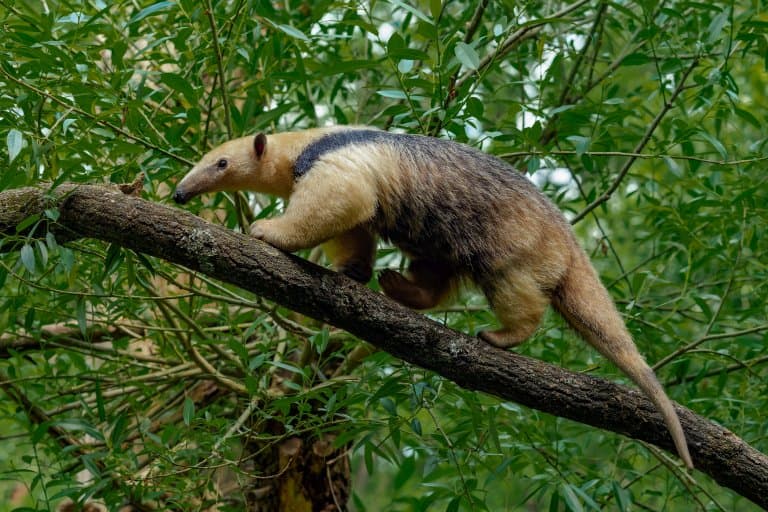
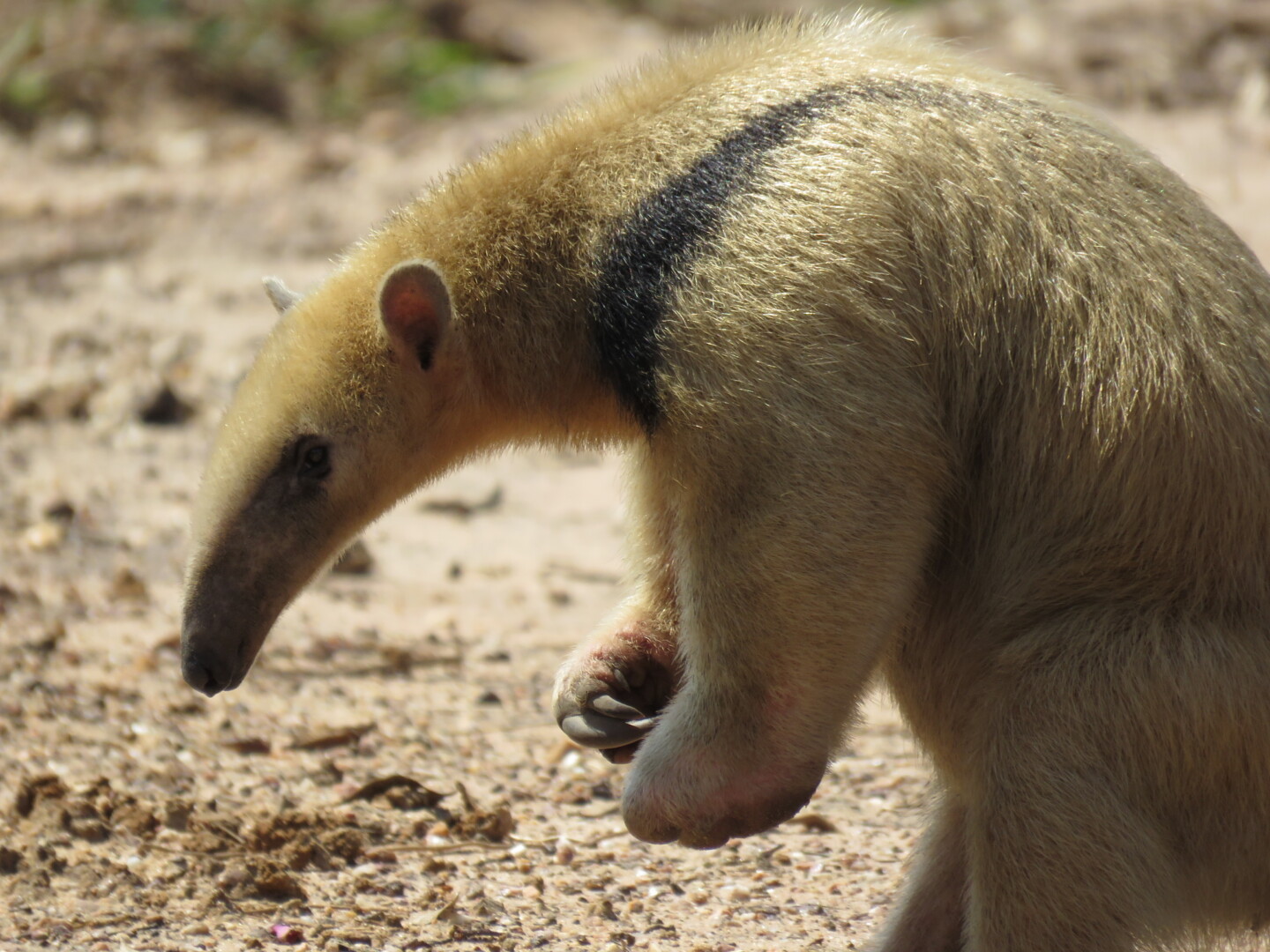
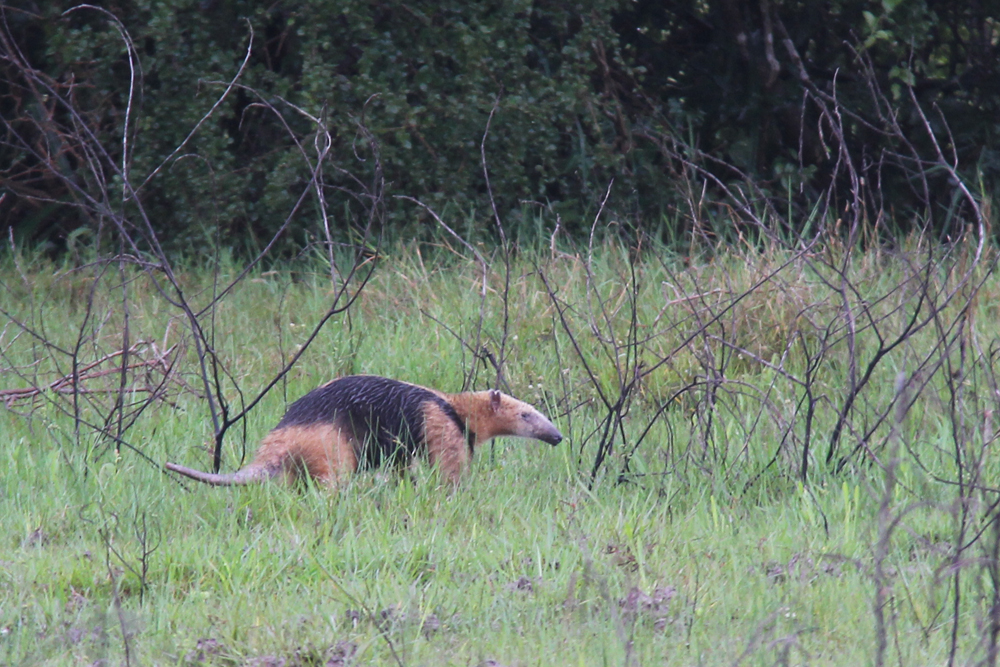
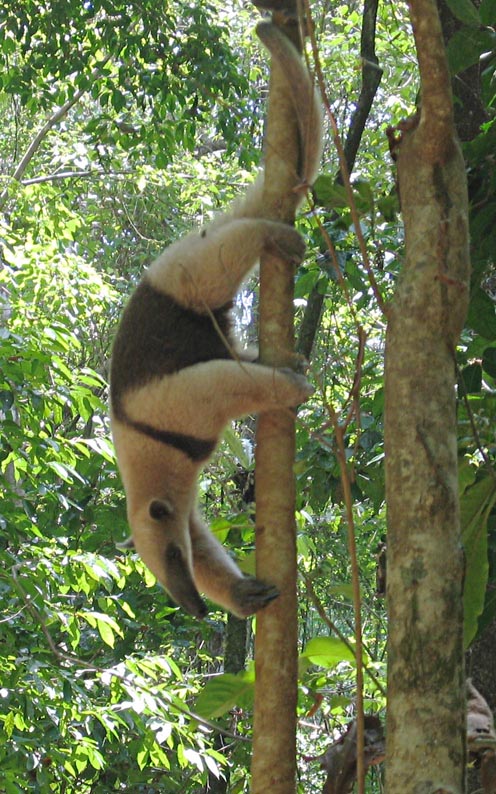
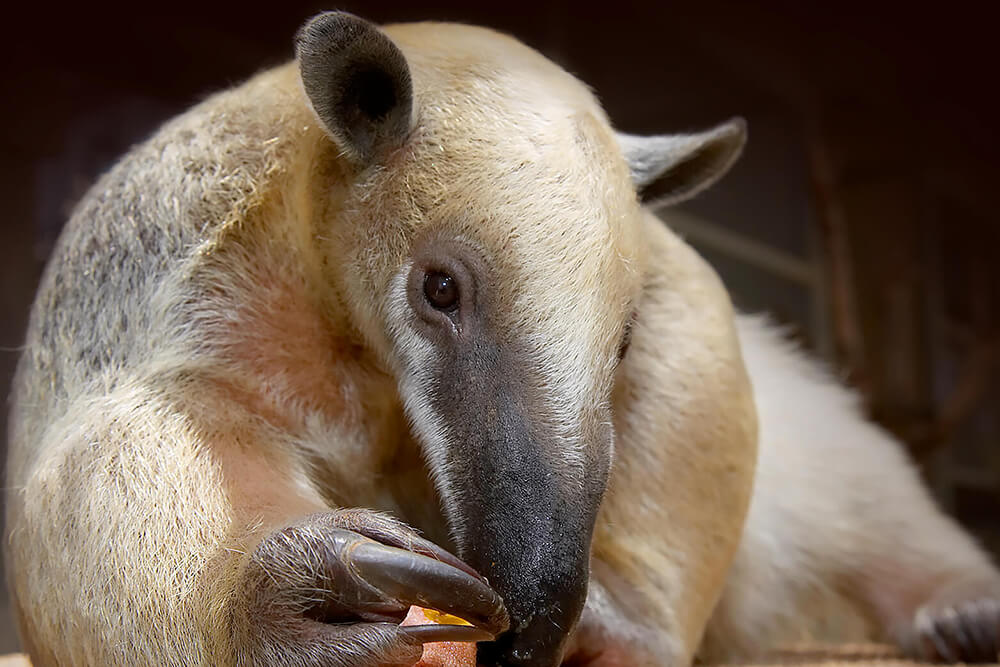
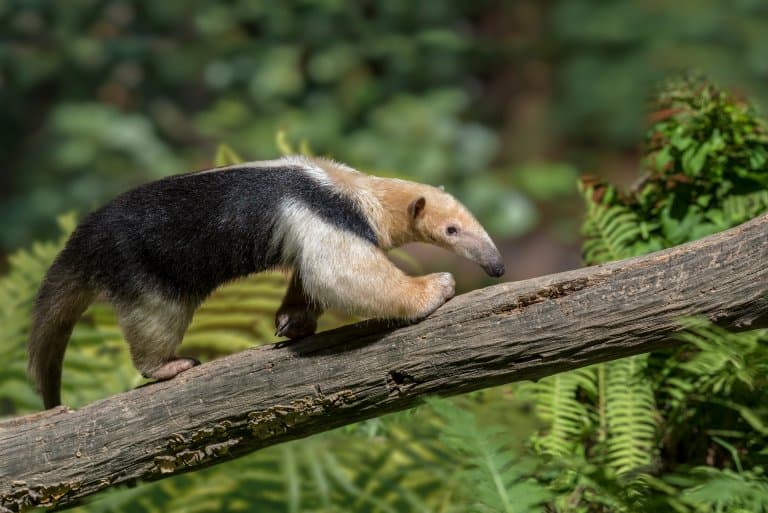
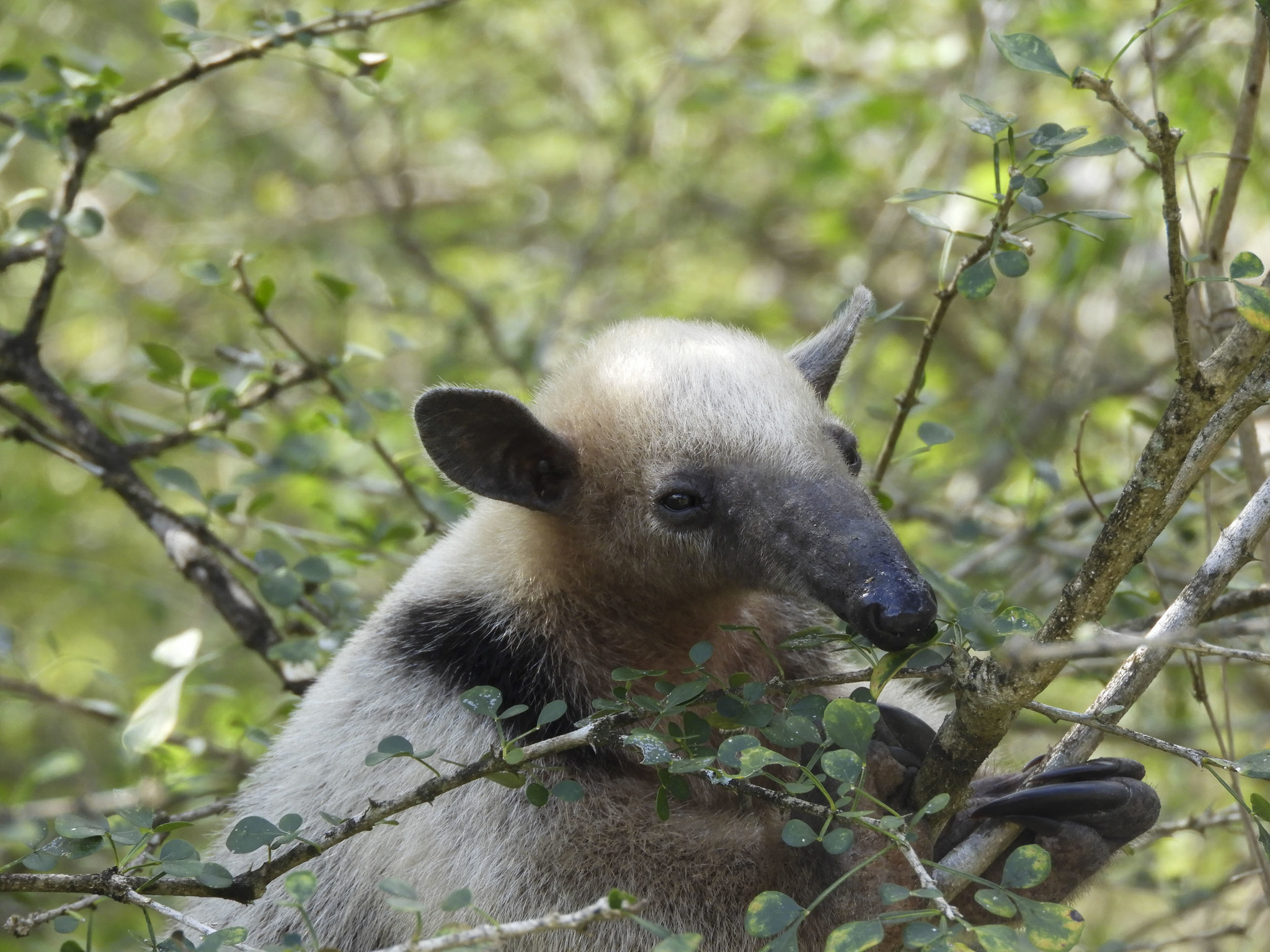
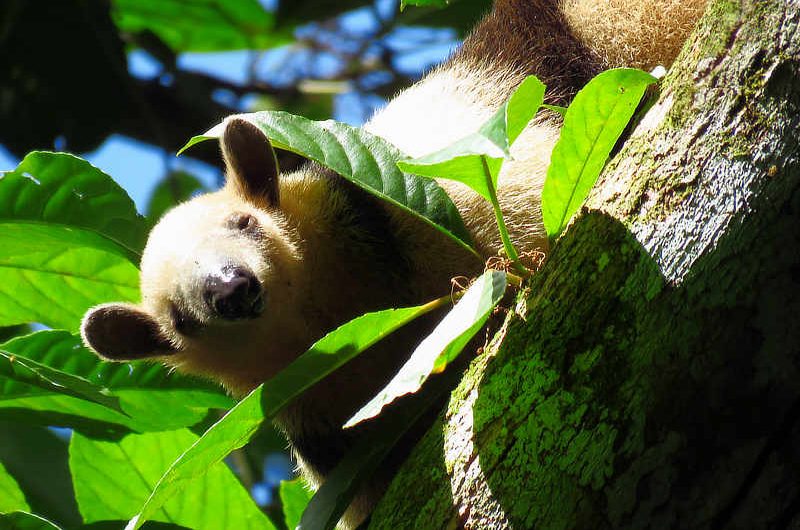
The southern tamandua (Tamandua tetradactyla), also called the collared anteater or lesser anteater, is a species of anteater from South America and the island of Trinidad in the Caribbean. It is a solitary animal found in many habitats, from mature to highly disturbed secondary forests and arid savannas. It feeds on ants, termites, and bees. Its very strong foreclaws can be used to break insect nests or to defend itself.
The southern tamandua is found in Trinidad and throughout South America from Venezuela to northern Argentina, southern Brazil, and Uruguay at elevations up to 1,600 m (5,200 ft). It inhabits both wet and dry forests, including tropical rainforest, savanna, and thorn scrub.[4] It seems to be most common in habitats near streams and rivers, especially those thick with vines and epiphytes (presumably because its prey is common in these areas).[citation needed]
The oldest fossil tamanduas date from the Pleistocene of South America, although genetic evidence suggests they may have diverged from their closest relative, the giant anteater, in the late Miocene, 12.9 million years ago.[5]
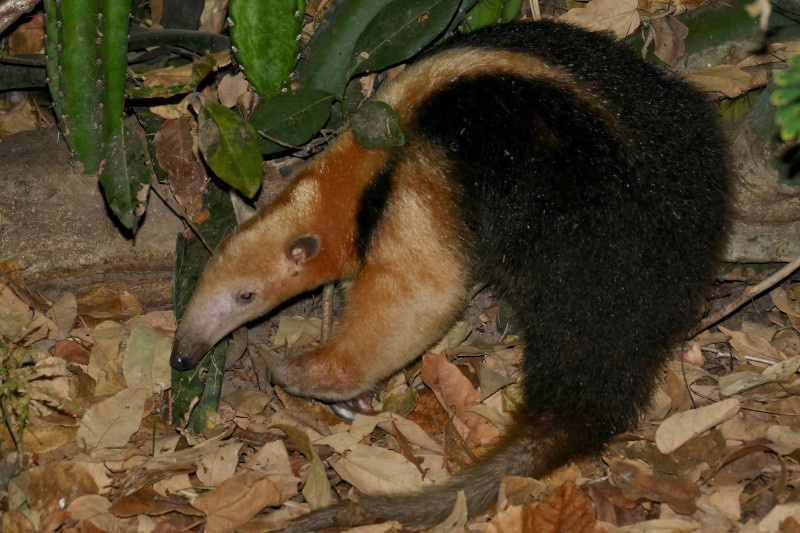
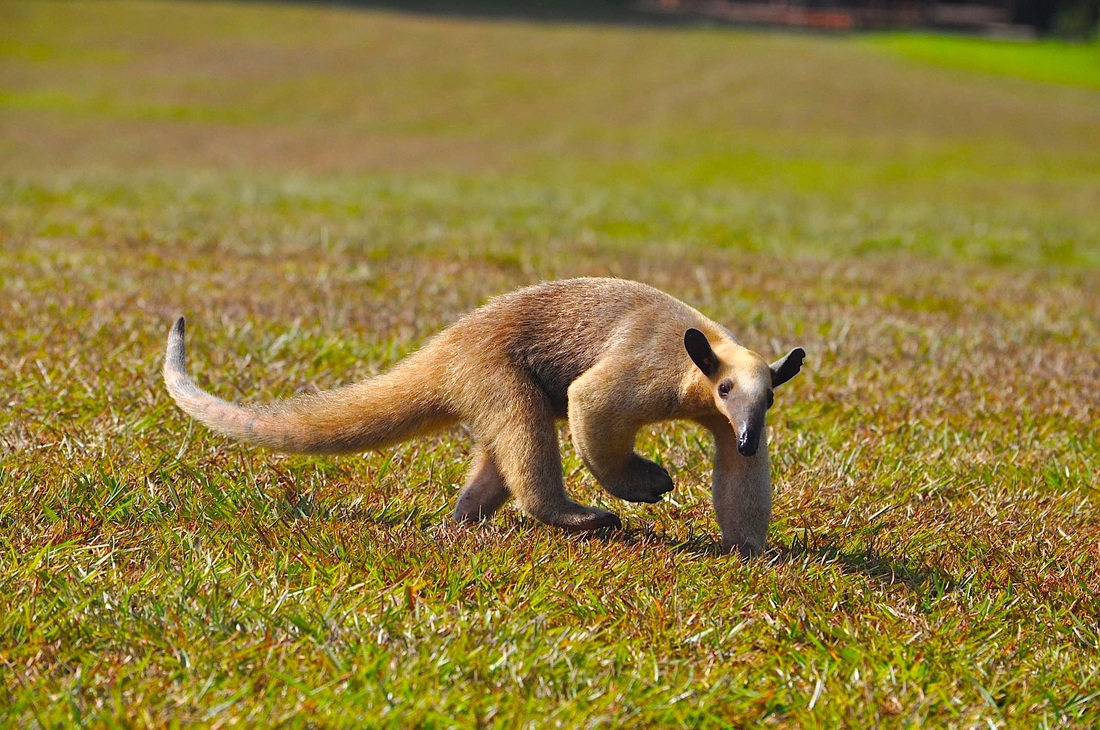
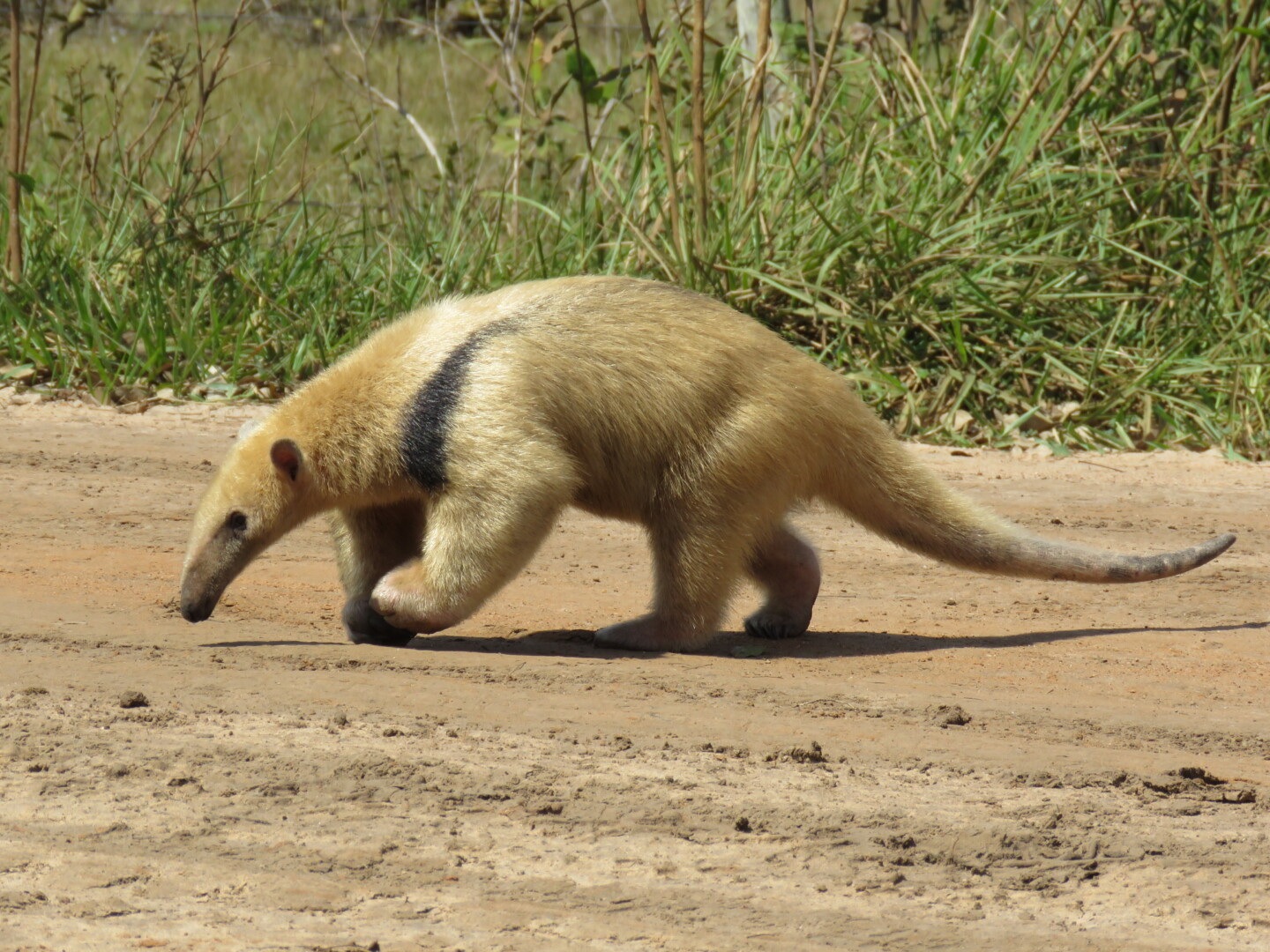
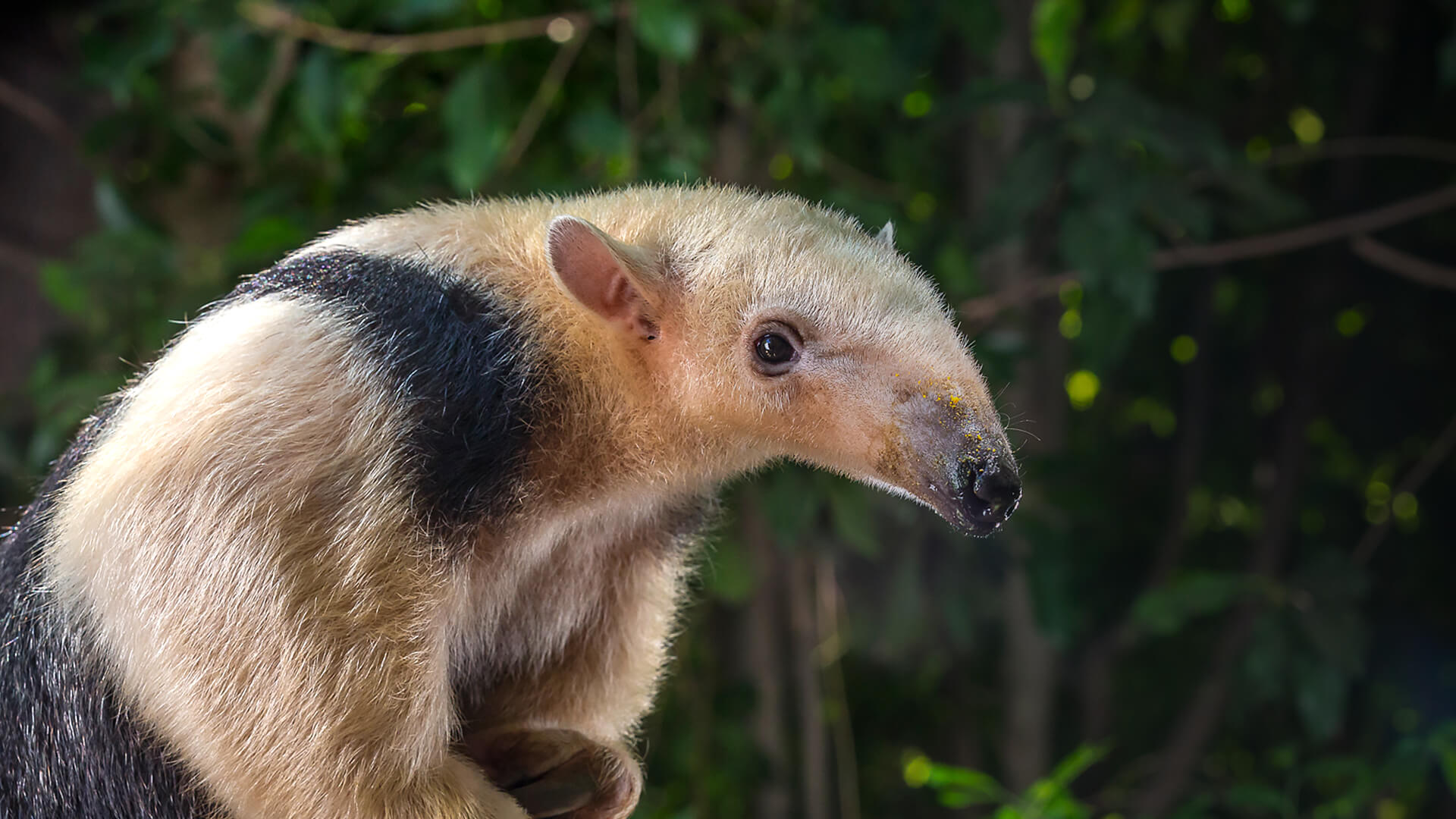
The individual and geographic variation observed in the southern
tamandua have made the taxonomic description of these animals a
difficult task. Animals from the southeastern part of the range are
"strongly vested", meaning they have black markings from shoulder to
rump; the black patch widens near the shoulders and encircles the
forelimbs. The rest of the body can be blonde, tan, or brown. Animals
from northern Brazil and Venezuela to west of the
Females are polyestrous; mating generally takes place in the fall. The estrous cycle will last approximately about 42 days. Gestation ranges from 130 to 190 days.[4] The female gives birth to one offspring per year.[8]
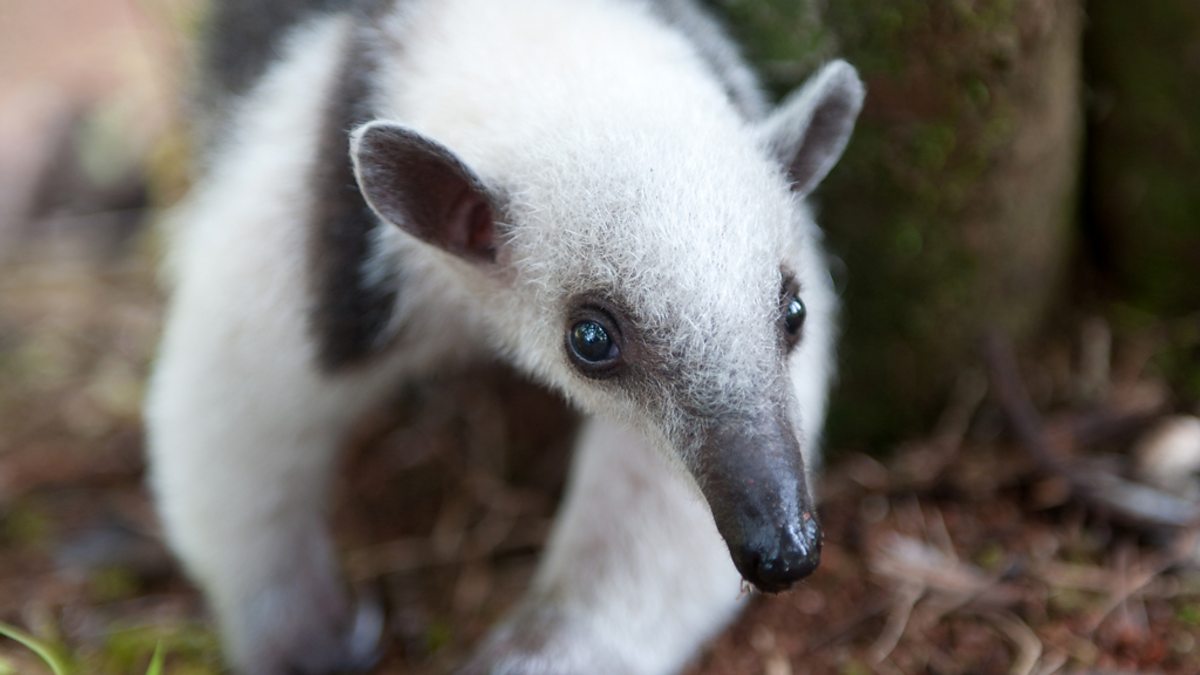
At birth, the young anteater does not resemble its parents; its coat
varies from white to black. It rides on the mother's back for several
months up to a year and is sometimes deposited on a safe branch while
the mother forages.
Behavior
A cub in the Frankfurt Zoo
The tamandua is mainly nocturnal but is occasionally active during
the day. The animals nest in hollow tree trunks or in the burrows of
other animals, such as armadillos.
They are solitary, occupying home ranges that average from 100 to
375 ha (250 to 930 acres), depending on the local environment.[4]
They may communicate when aggravated by hissing and releasing an
unpleasant scent from their anal glands. They spend much of their time
foraging arboreally; a study in various habitats in Venezuela[citation needed]
showed this anteater spends 13 to 64% of its time in trees. The
southern tamandua is quite clumsy on the ground and ambles along,
incapable of the gallop its relative, the giant anteater, can achieve.
The southern tamandua uses its powerful forearms in self-defense.
If it is threatened in a tree it grasps a branch with its hindfeet and
tail, leaving its arms and long, curved claws free for combat. If
attacked on the ground, this anteater backs up against a rock or a tree
and grabs the opponent with its forearms. In the rainforest, the
southern tamandua is surrounded during the day by a cloud of flies and
mosquitoes and is often seen wiping these insects from its eyes.[citation needed] This animal has small eyes and poor vision, but its large, upright ears indicate that hearing is an important sense.
Southern tamanduas eat ants and termites
in roughly equal proportions, although they may also eat a small
quantity of fruit. They locate their food by scent, and prey on a wide
range of species, including army ants, carpenter ants, and Nasutitermes.[4] They avoid eating ants armed with strong chemical defenses, such as leafcutter ants.[citation needed] They also consume beetlelarvae and their water requirement is obtained through their food.[10] But as with the ants, beetles with a chemical defense are generally avoided.[10]
Evidence also suggests that southern tamanduas in captivity prefer
termites over ants whilst Tamanduas
examined in the wild consume a
larger quantity of ants than termites.[11][12]
Anteaters extract their prey by using their extremely strong fore limbs
to rip open nests and their elongated snouts and rounded tongues (up to
40 cm (16 in) in length) to lick up the insects. These tongues are
adapted specifically for myrmecophagy thanks to specialized papillae
that allow them to grab onto their tiny prey.[13]
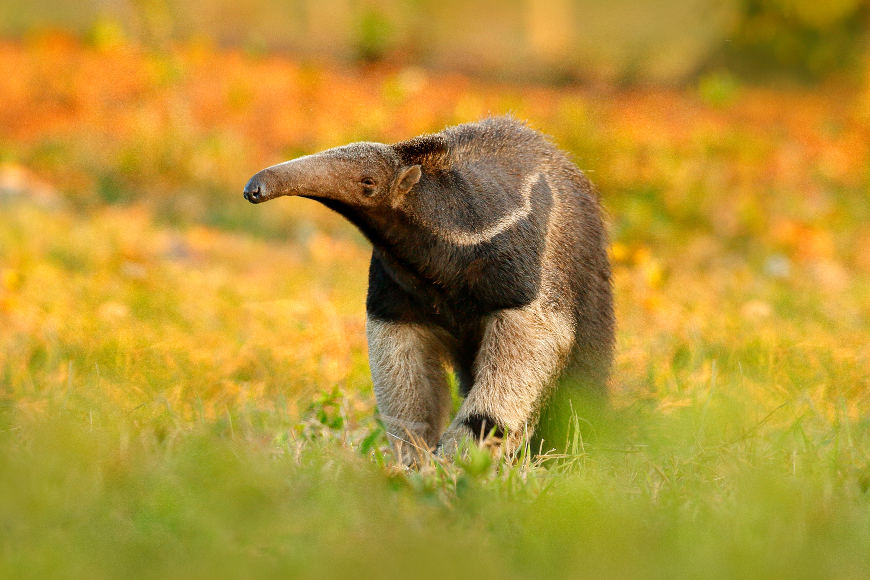
Although it has the same diet as the giant anteater, both animals
are able to live alongside one another, perhaps because the southern
tamandua is able to reach nests in trees, while its larger relative
cannot.[4]
Another reason for this is that southern tamanduas often prefer to eat
ants that get their food from the vegetation, as well as the soil, while
giant anteaters look for ants that gather food in just the soil.[14]
While southern tamanduas are solitary creatures, they thrive in
captivity when they live together in pairs. These interactions increase
their motivation to search for food and to stay active.
Being housed with another tamandua can help, but there are still
other factors of captivity that impact their behavior. Their
interactions with the enclosure managers, as well as regular
appointments to a veterinary clinic, can cause stress in the southern
tamandua. This stress is often exhibited in their behavior and tends to
be heightened in the summer.[17]
Southern tamanduas are classified as Least Concern on the
Conservation Status scale, but they still face many threatening
situations. These threats can include wildfires, habitat loss, and
hunters that use the tendons in the southern tamanduas' tails as a
material for producing rope.[7]
They are also used as pest control, specifically for termites and
ants, by Indigenous people, who sometimes bring the southern tamanduas
into their homes to take care of these insects.[18]
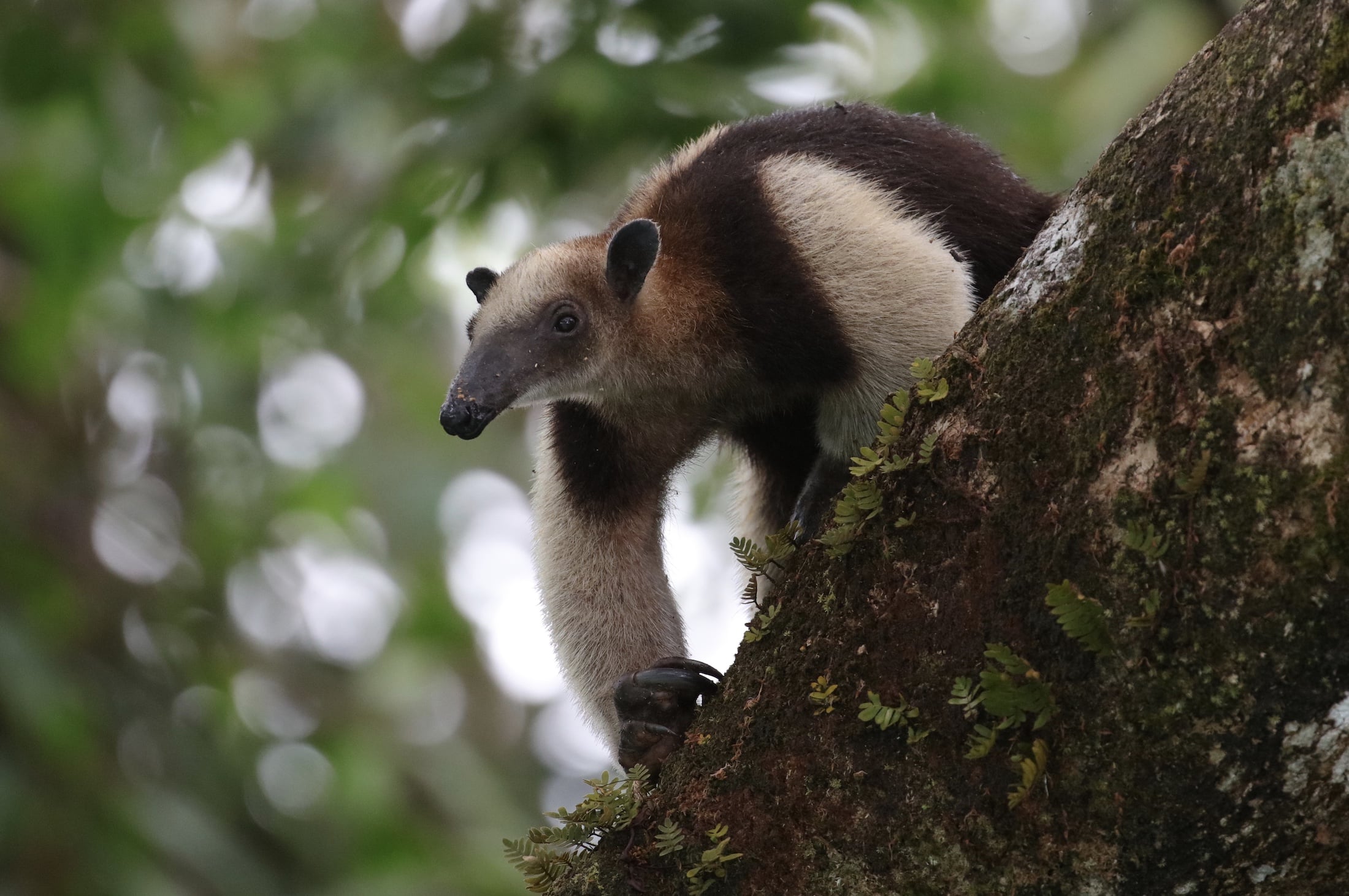
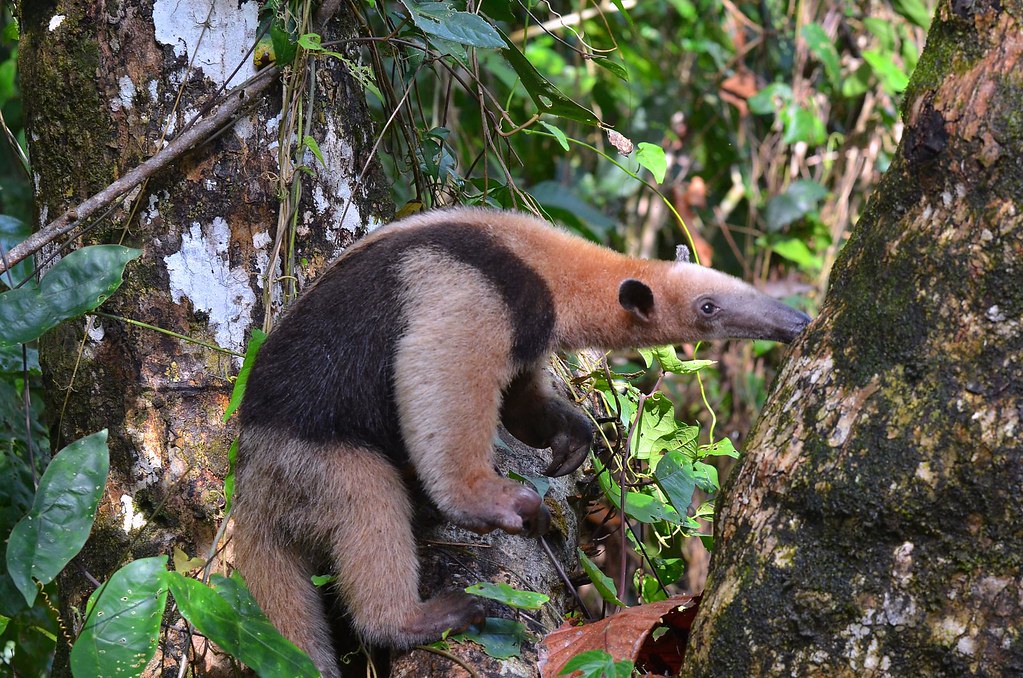
The northern tamandua (Tamandua mexicana) is a species of tamandua, a small anteater in the family Myrmecophagidae. They live in tropical and subtropical forests from southern Mexico, through Central America, and to the edge of the northern Andes.[2]
The
northern tamandua is a medium-sized anteater with a prehensile tail,
small eyes and ears, and a long snout. The fur is pale yellow over most
of the body, with a distinctive patch of black fur over the flanks,
back, and shoulders, that somewhat resembles a vest in shape. The presence of this colouration pattern makes it possible to distinguish these species from its southern relative, which has a more uniform colour.[3]
The tail has fur on its upper surface for about a third of its length,
but is otherwise hairless. The hind feet have five toes, while the fore
feet have only four.
Males and females are similar in size and colour, and range from 102
to 130 centimetres (40 to 51 in) in total length, including the 40 to 68
centimetres (16 to 27 in) tail. Adults weigh between 3.2 to 5.4
kilograms (7.1 to 11.9 lb).[4]
Like other anteaters, the northern tamandua is highly adapted to its
unusual diet. The tongue is long, extensible, and covered in sticky saliva able to pick up ants and termites. It has unusually well developed muscles, attached to a large hyoid bone and rooted to the top of the sternum. The entire oral cavity is modified to accommodate this tongue, and is so elongated that the back of the soft palate is level with the fifth cervical vertebra near the base of the neck, rather than at the top of the pharynx as in most other mammals.[5] The jaw muscles and mandible are reduced, and the latter is particularly fragile. Like other
anteaters, the northern tamandua has no teeth.[4]
In addition to its diet, and unlike the giant anteater,
the northern tamandua is also adapted to an arboreal lifestyle. The
muscles of the toes and the presence of a tough pad on the palms makes
the forefeet prehensile,
enabling them to grip onto projections as it climbs. The middle toe of
the forefeet also bears an unusually large claw, and the toe has enough
muscle and leverage to allow it to rip open wood to get at the ants
within.[4]
The northern tamandua inhabits forests from southern Mexico, through Central America to western Colombia, Venezuela, and Ecuador, and the northwestern corner of Peru.[2] It has been reported from various types of forest within this region, including evergreen, deciduous, mangrove swamps, cloud forests, and secondary forest. Four subspecies of T. mexicana are currently recognised:[4]
Northern tamanduas are mainly nocturnal,
but are also often active during the day, and spend only around 40% of
their time in the trees. They are active for about eight hours each day,
spending the rest of the time sheltering in hollow trees. They are
solitary animals, occupying home ranges of between 25 and 70 ha (62 and
170 ac). Known predators include jaguars and harpy eagles.[4]
Northern tamanduas subsist almost entirely on diets of ants and termites,
although they have also been
observed to eat small quantities of fruit.
They prefer relatively large insects, over 4 mm (0.16 in) in length,
including Camponotus, Azteca, Crematogaster, and Nasutitermes, among others. They may eat up to 9,000 insects per day, from 50 to 80 different nests,[4]
which they locate by scent and then dig into with their powerful claws.
They extract the ants with their long, narrow, sticky tongues, but seem
to do little permanent damage to the nests, perhaps because they do not
spend long at each one before being driven away by the insects' natural
defences.[4]
The anteaters can communicate with each other by leaving scent marks with their anal scent glands.
Although infants can be quite vocal, adults rarely make any sounds. If
provoked, they can prop themselves up on their hind legs and tails using
a tree or rock for support, and lash out with their claws.[4]
With no defined breeding season for northern tamanduas, females appear to be able to enter oestrus
at any time of year. Males locate fertile females by scent, and court
them with repeated sniffing and swatting with their claws. Eventually,
they use their strong fore limbs and tails to secure the females while
they mate.[6]
Gestation lasts from 130 to 190 days, and results in the birth of a
single offspring. The young anteater initially shelters in a nest in a
hollow tree, but later moves about by clinging to its mother's back.
Young leave the mother at about a year of age, and northern tamanduas
have been reported to live up to 9.5 years in captivity.[4]
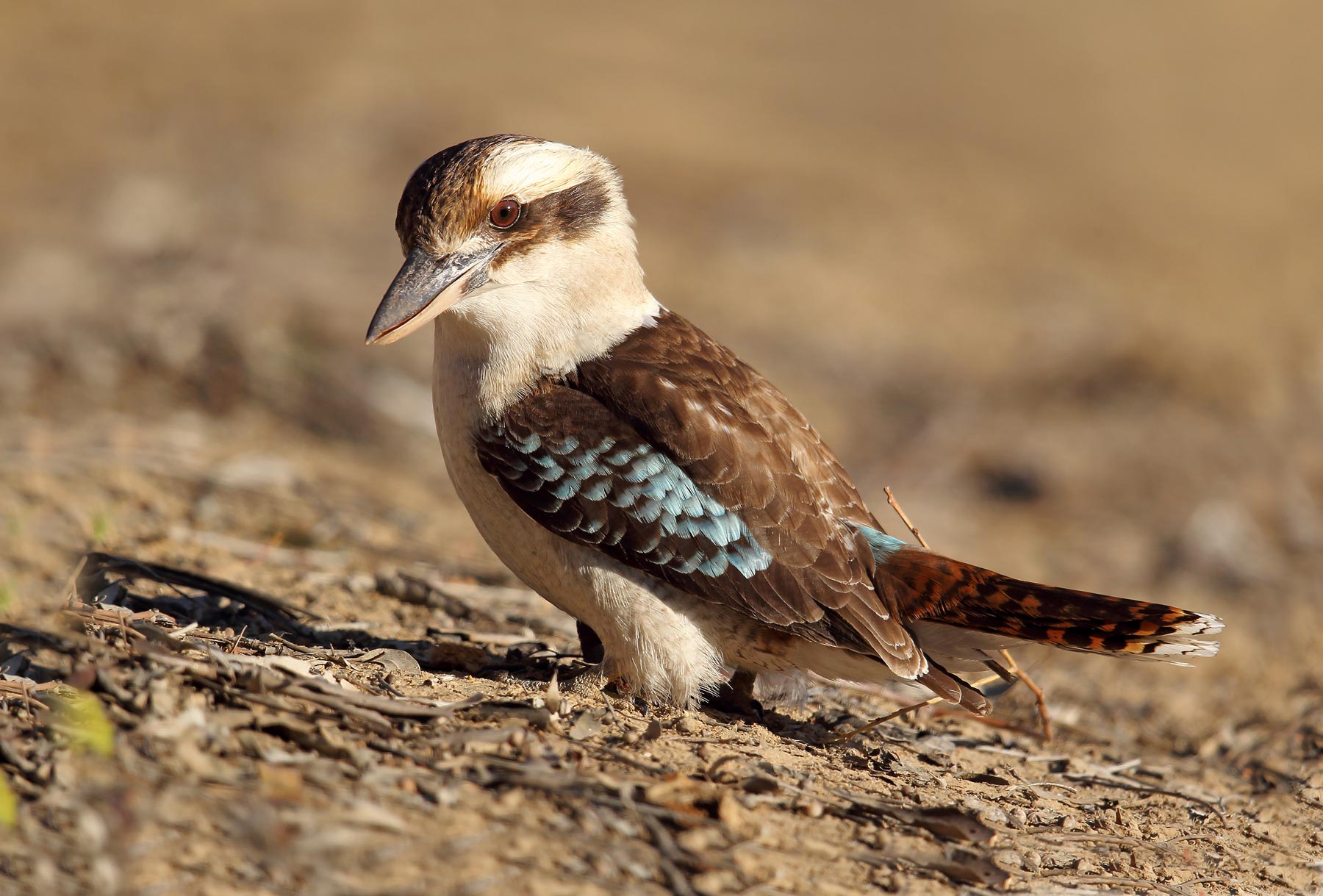
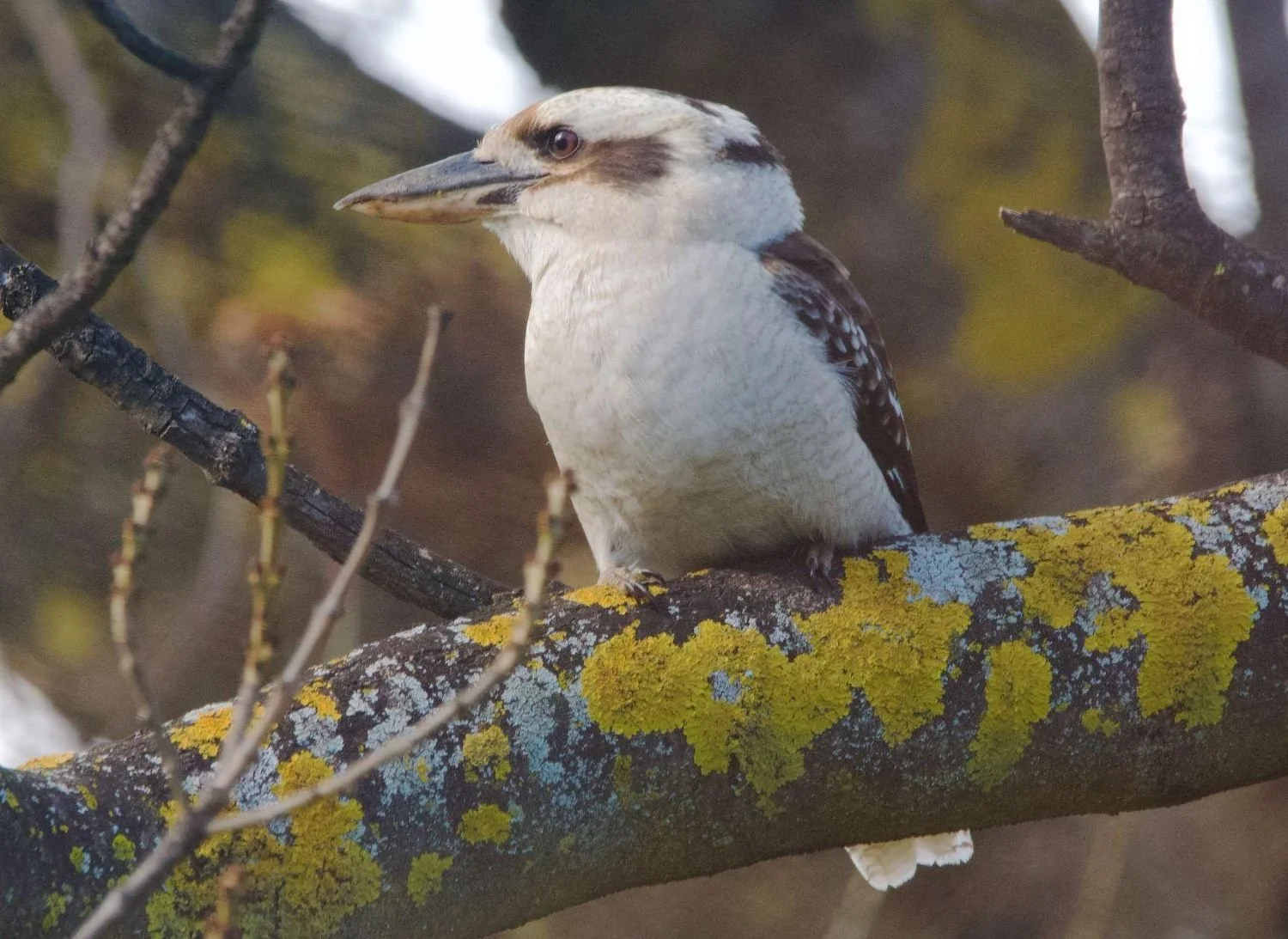
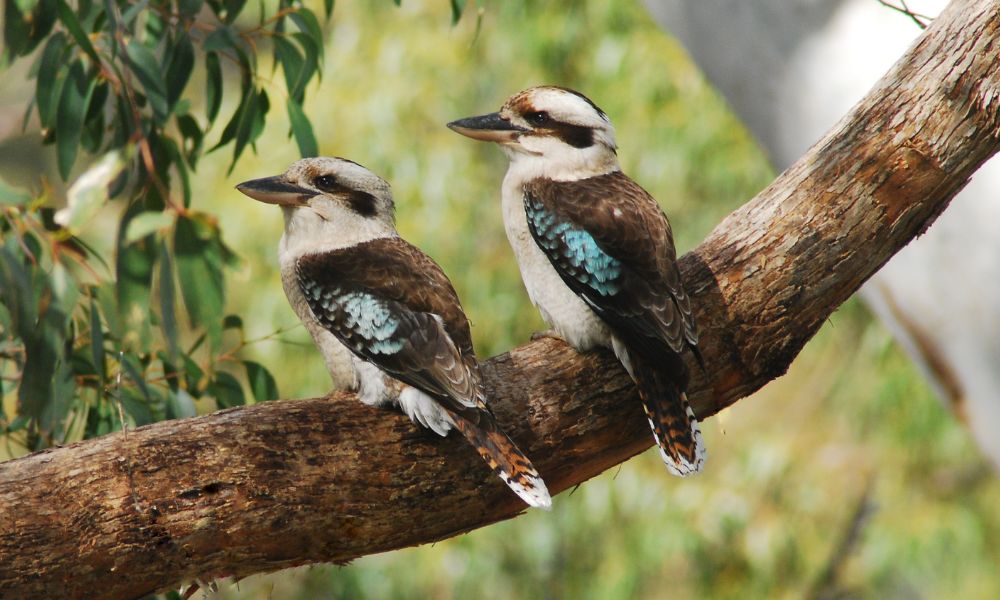
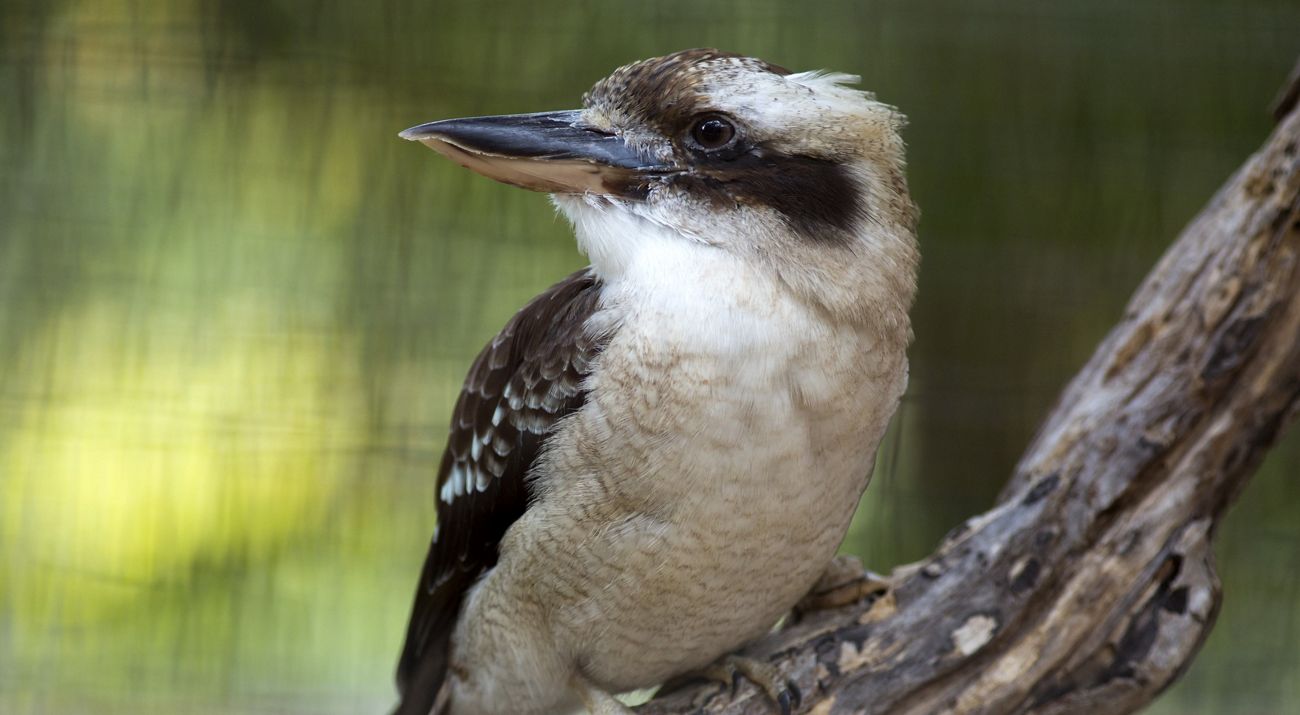
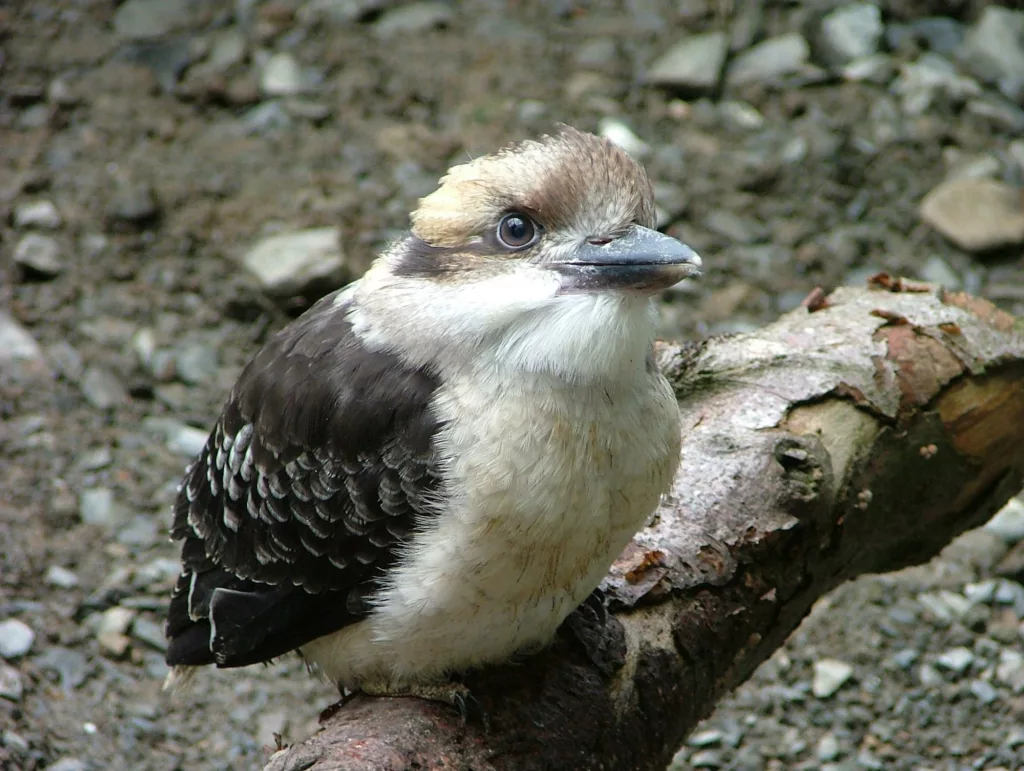
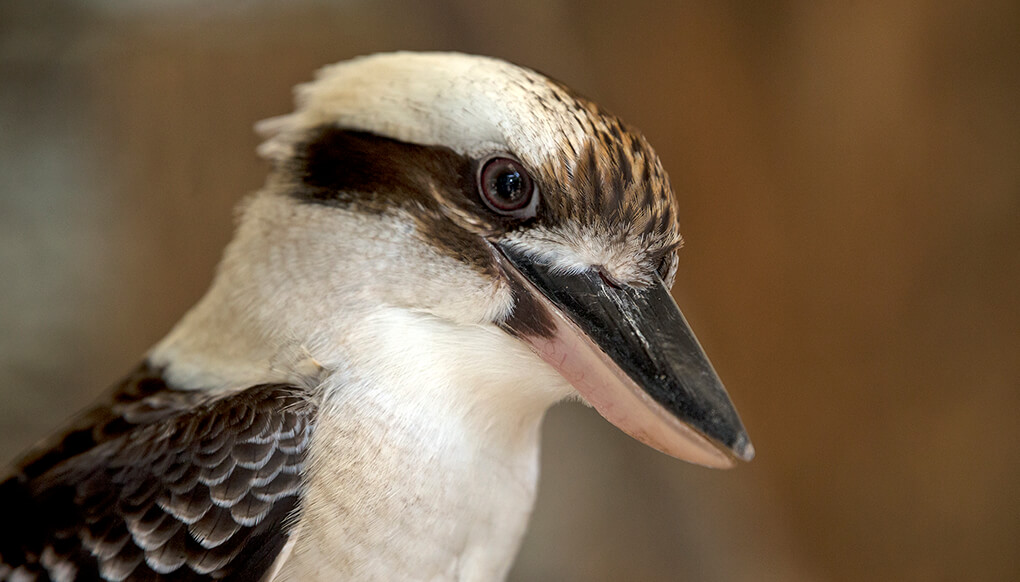
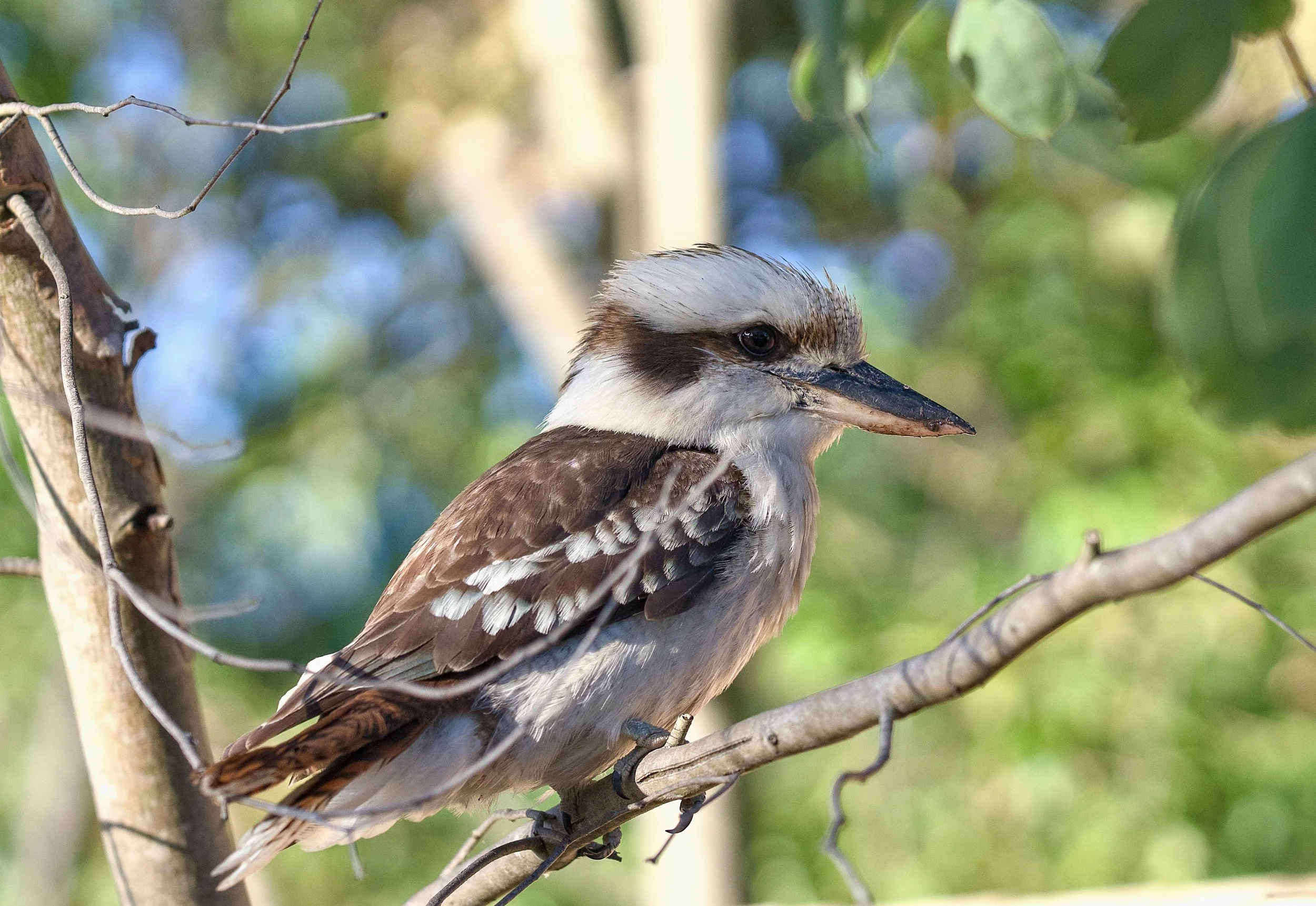
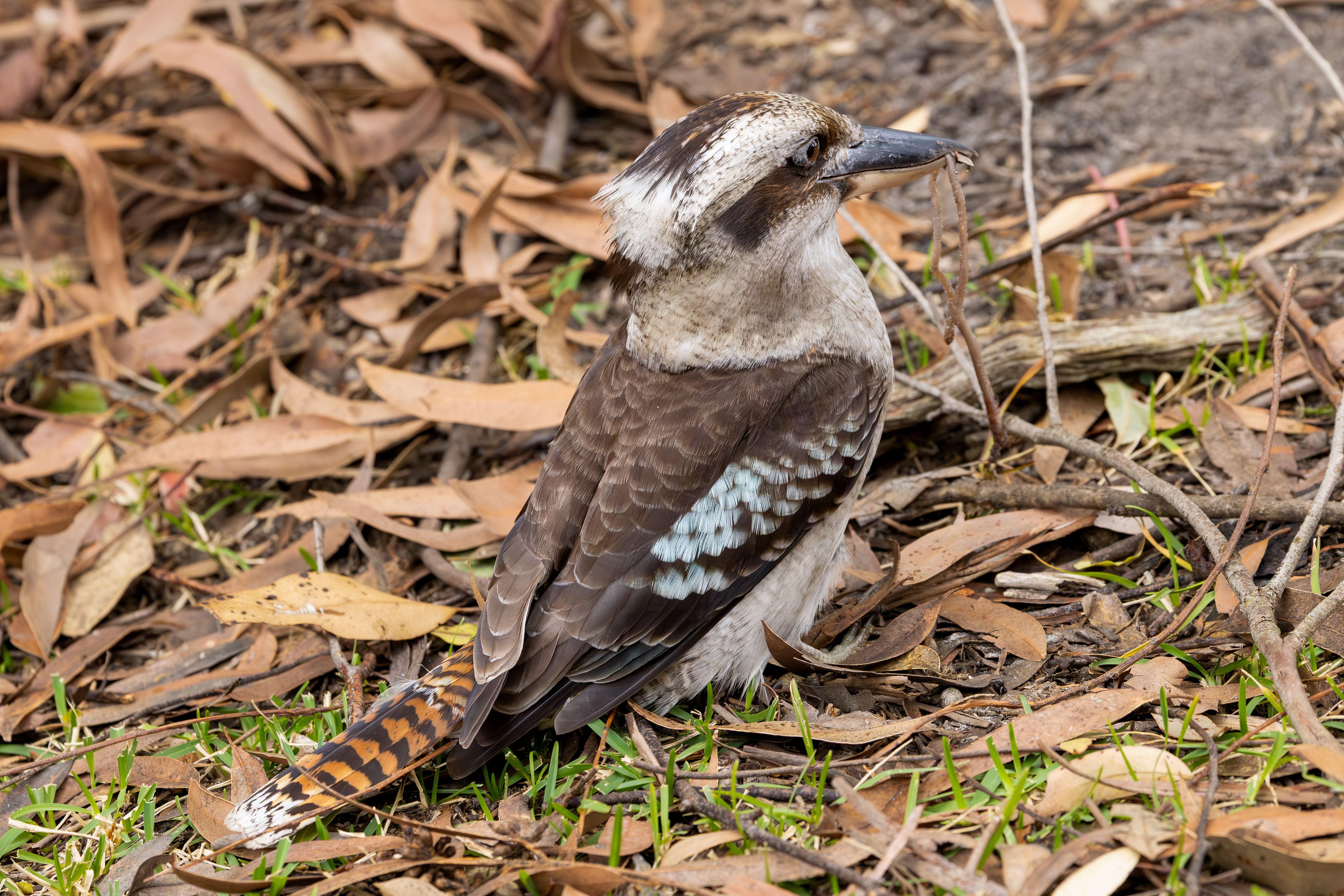
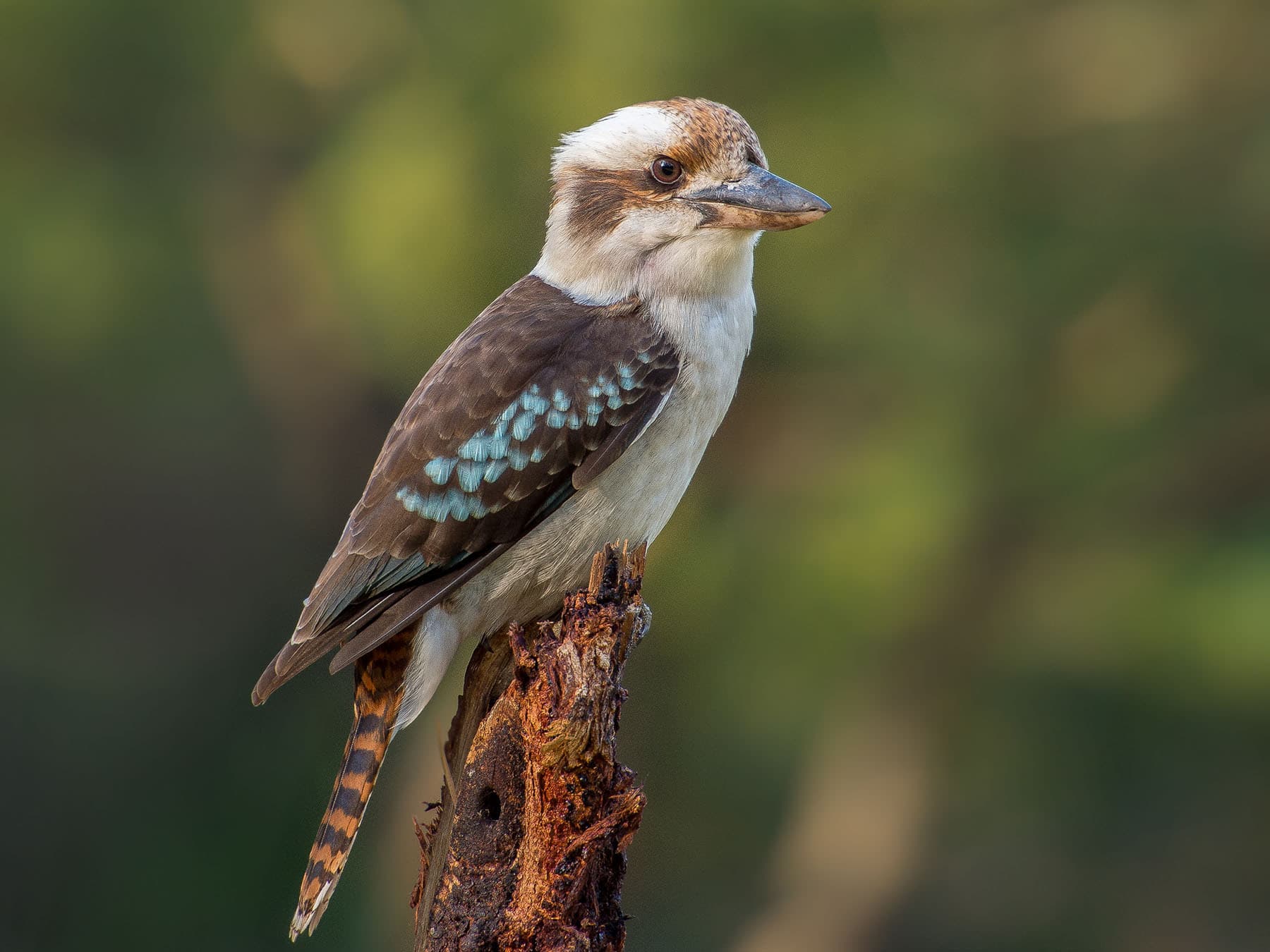
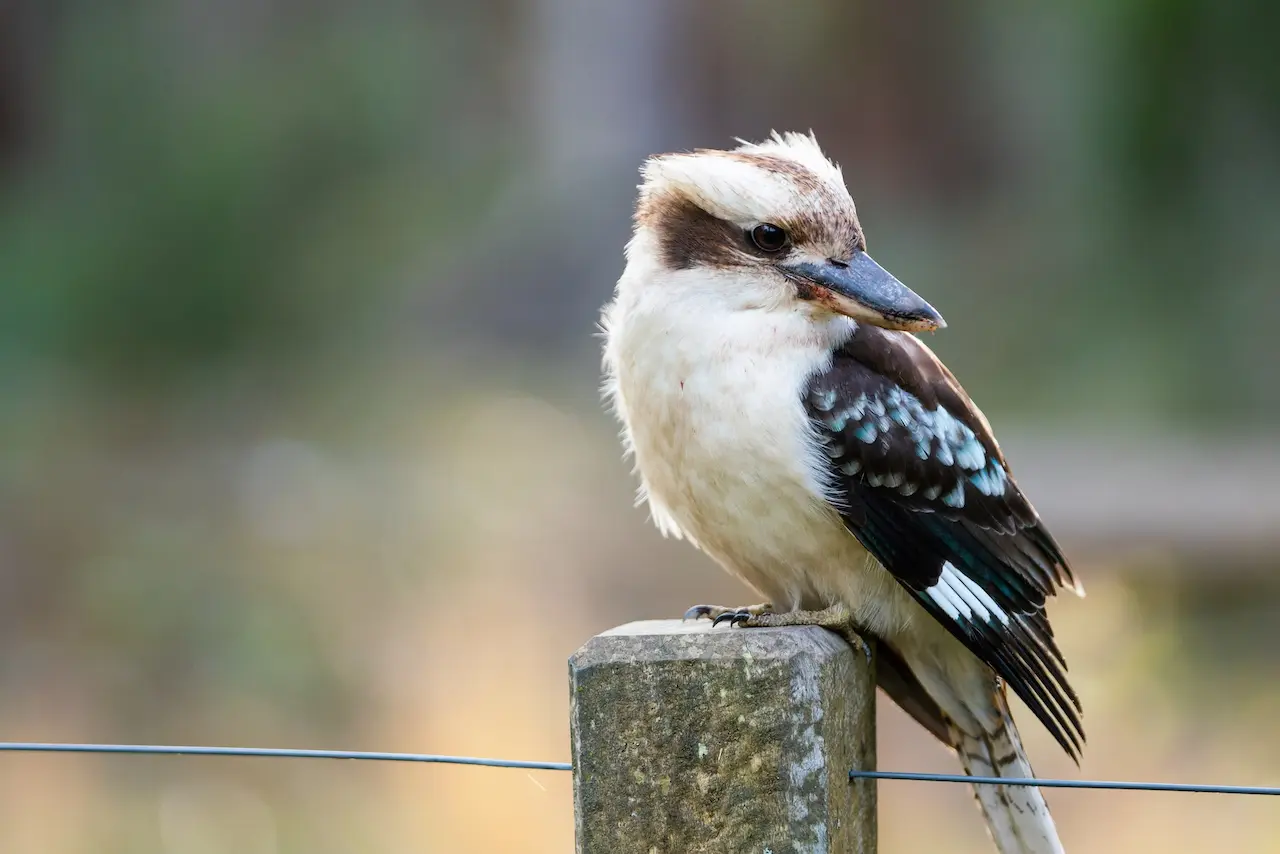
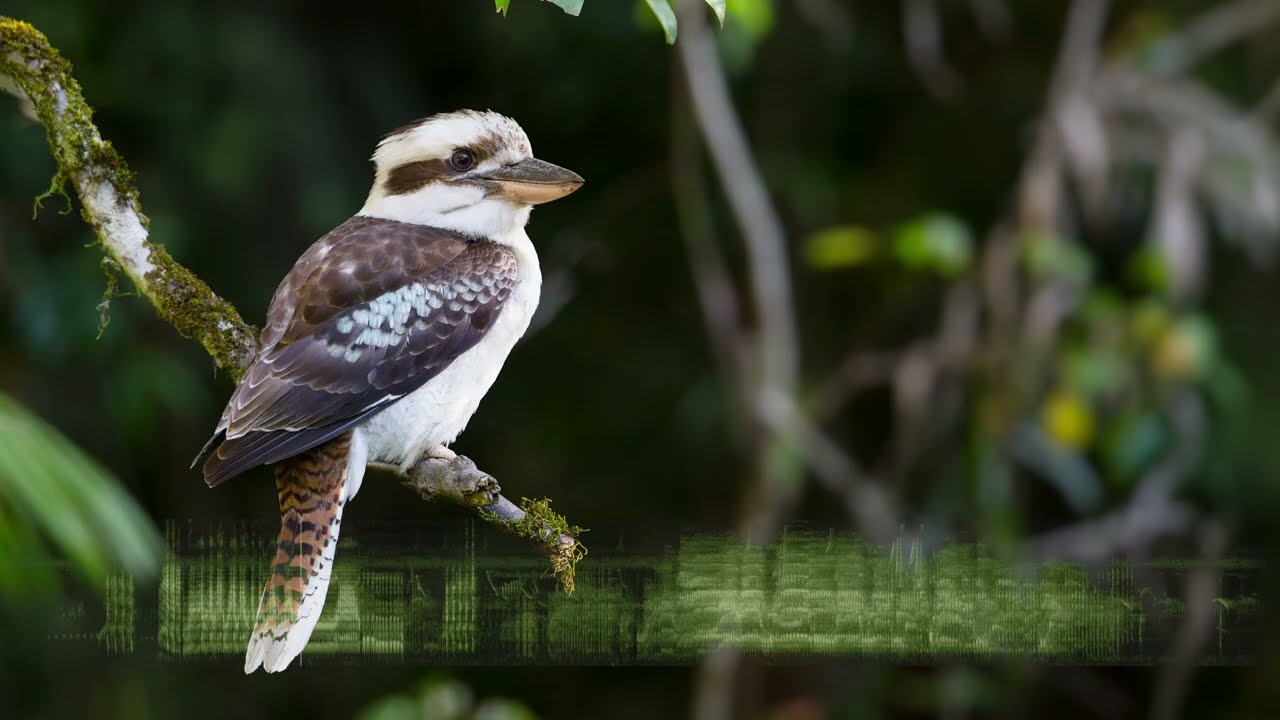
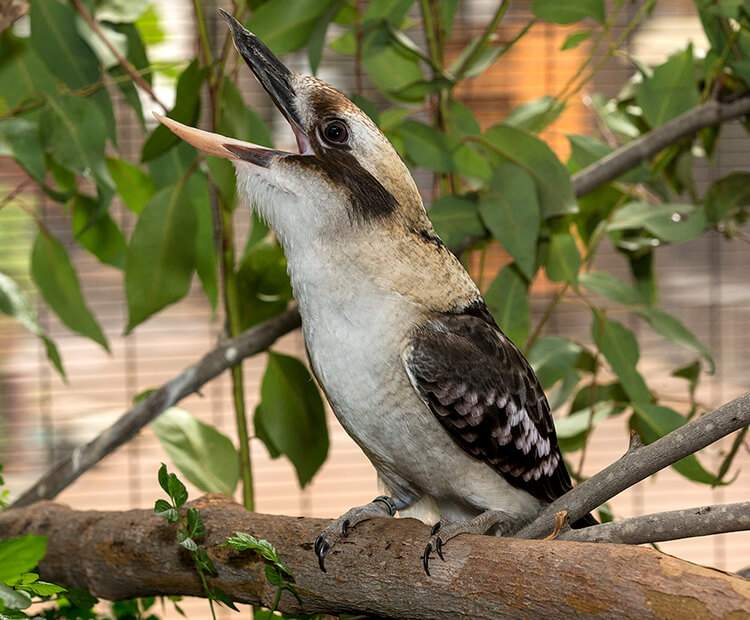
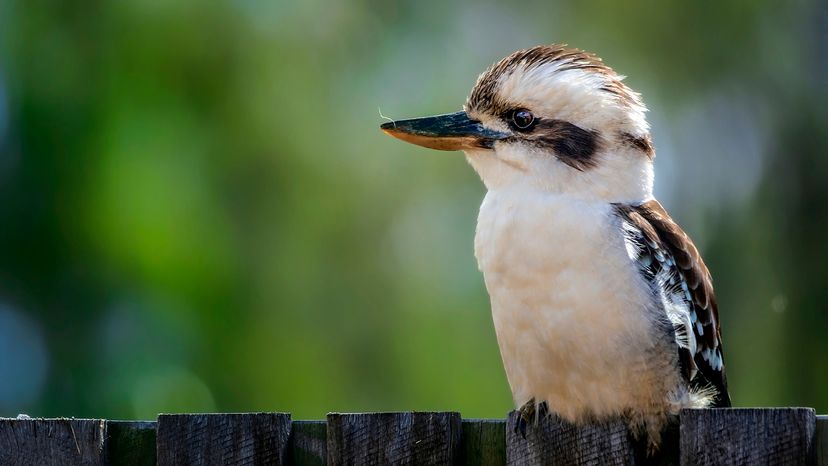
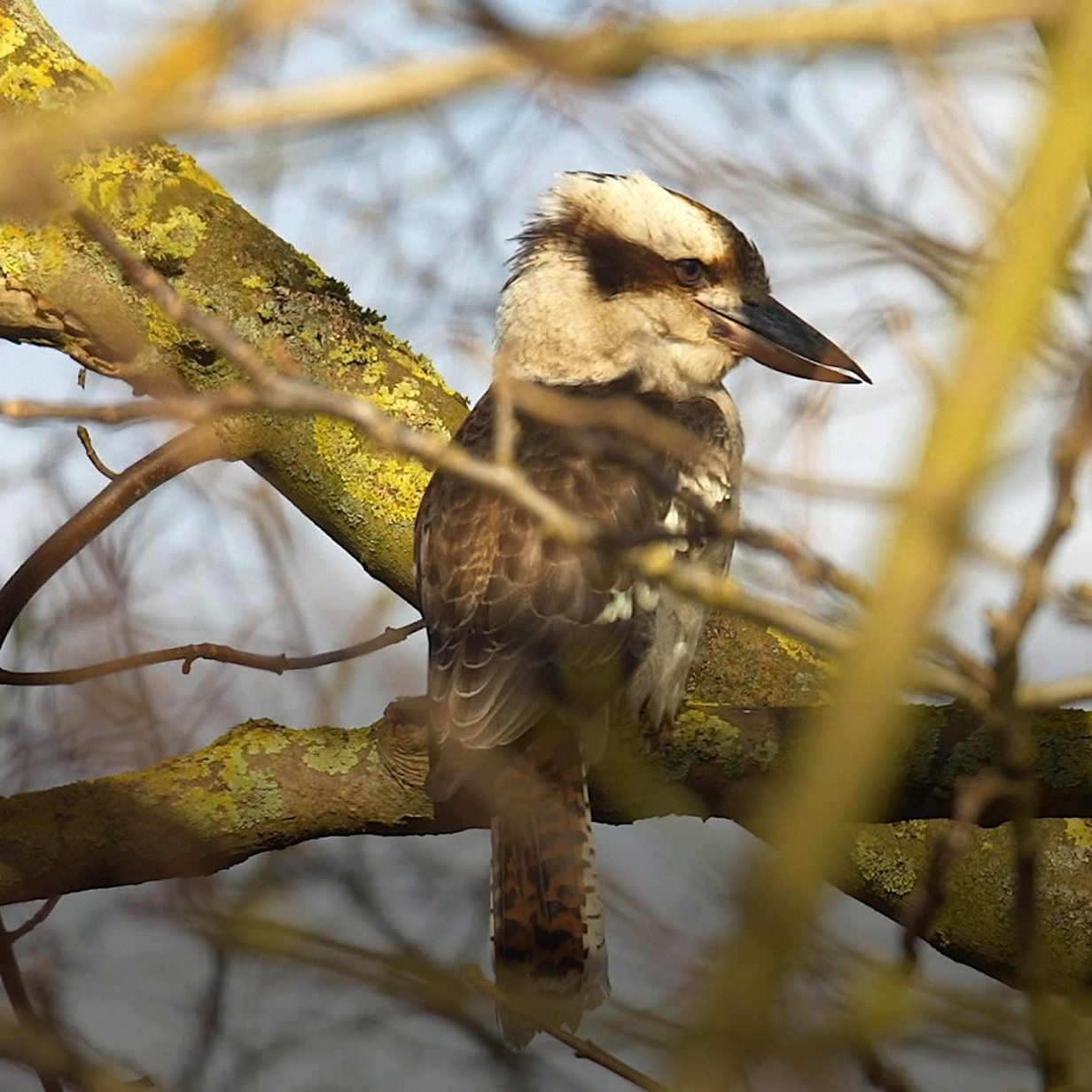
The laughing kookaburra (Dacelo novaeguineae) is a bird in the kingfisher subfamily Halcyoninae. It is a large kingfisher with a whitish head and a brown eye-stripe.[2] The upperparts are mostly dark brown but there is a mottled light-blue patch on the wing coverts.[3][2] The underparts are cream-white and the tail is barred with rufous and black.[2]
The plumage of the male and female birds is similar. The territorial
call is a distinctive laugh that is often delivered by several birds at
the same time, and is widely used as a stock sound effect in situations that involve a jungle setting.[4]
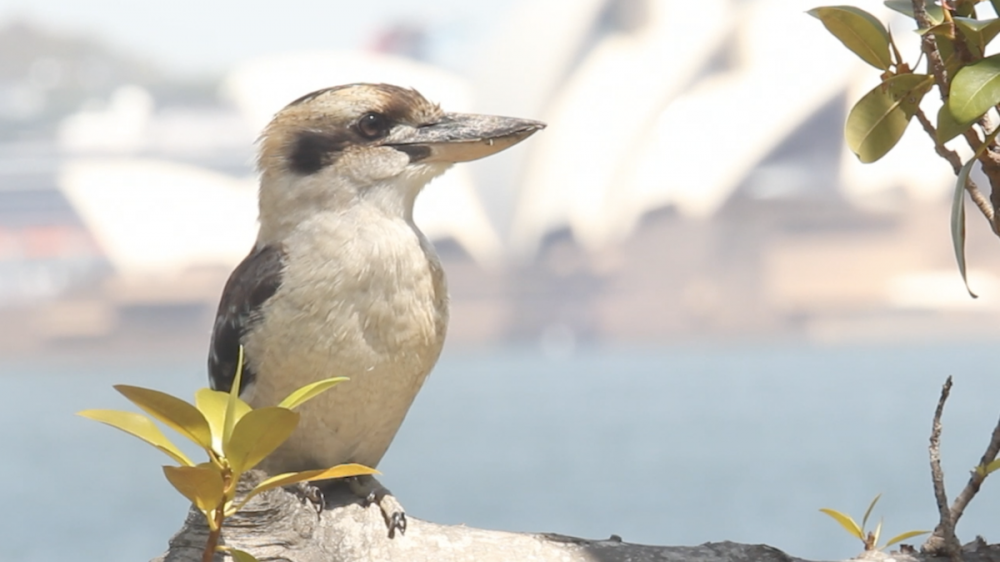
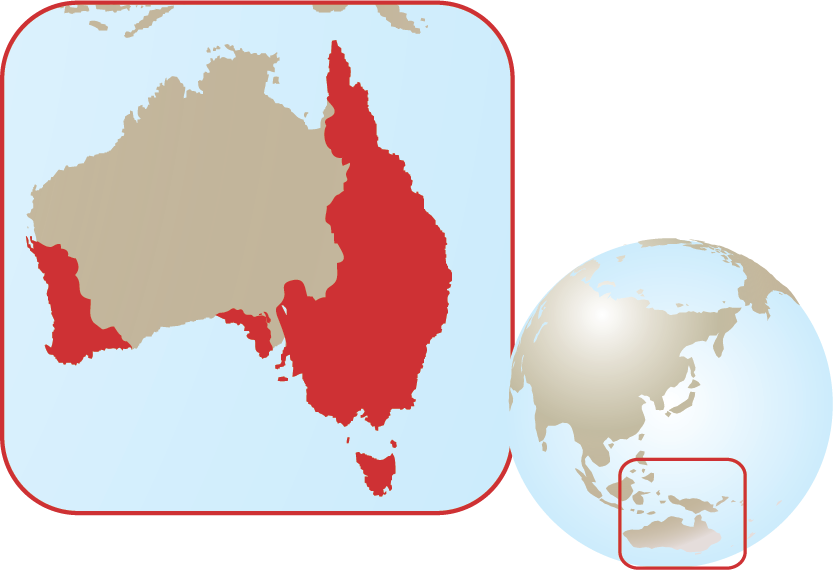
The laughing kookaburra is native to eastern mainland Australia, but has also been introduced to parts of New Zealand, Tasmania, and Western Australia.[5] It occupies dry eucalypt forest, woodland, city parks and gardens.[5] This species is sedentary and occupies the same territory throughout the year. It is monogamous,
retaining the same partner for life. A breeding pair can be accompanied
by up to five fully grown non-breeding offspring from previous years
that help the parents defend their territory and raise their young.[5] The laughing kookaburra generally breeds in unlined tree holes or in excavated holes in arboreal termite nests.[5] The usual clutch
is three white eggs. The parents and the helpers incubate the eggs and
feed the chicks. The youngest of the three nestlings or chicks is often
killed by the older siblings. When the chicks fledge they continue to be fed by the group for six to ten weeks until they are able to forage independently.[6]
A predator of a wide variety of small animals, the laughing
kookaburra typically waits perched on a branch until it sees an animal
on the ground and then flies down and pounces on its prey.[3] Its diet includes lizards, insects, worms, snakes, mice and it is known to take goldfish out of garden ponds.
The laughing kookaburra was first described and illustrated (in black and white) by the French naturalist and explorer Pierre Sonnerat in his Voyage à la nouvelle Guinée, which was published in 1776.[7][8] He claimed to have seen the bird in New Guinea.
In fact Sonnerat never visited New Guinea and the laughing kookaburra
does not occur there. He probably obtained a preserved specimen from one
of the naturalists who accompanied Captain James Cook to the east coast of Australia.[9]Edme-Louis Daubenton and François-Nicolas Martinet included a coloured plate of the laughing kookaburra based on Sonnerat's specimen in their Planches enluminées d'histoire naturelle. The plate has the legend in French "Martin-pecheur, de la Nouvelle Guinée" (Kingfisher from New Guinea).[10]
In 1783, the French naturalist Johann Hermann provided a formal description of the species based on the coloured plate by Daubenton and Martinet. He gave it the scientific name Alcedo novæ Guineæ.[11][12] The current genusDacelo was introduced in 1815 by the English zoologist William Elford Leach,[13][14] and is an anagram of Alcedo, the Latin word for a kingfisher. The specific epithet novaeguineae combines the Latin novus for new with Guinea,[15] based on the erroneous belief that the specimen had originated from New Guinea.[8] For many years it was believed that the earliest description was by the Dutch naturalist Pieter Boddaert and his scientific name Dacelo gigas was used in the scientific literature,[16] but in 1926 the Australian ornithologist Gregory Mathews showed that a description by Hermann had been published earlier in the same year, 1783, and thus had precedence.[8][17]
The inaccurate impression of geographic distribution given by the name
in current usage had not by 1977 been considered an important enough
matter to force a change in favour of D. gigas.[8]
In the 19th century this species was commonly called the "laughing jackass", a name first recorded (as Laughing Jack-Ass) in An Account of the English Colony in New South Wales by David Collins which was published in 1798.[18][19] In 1858 the ornithologist John Gould used "great brown kingfisher", a name that had been coined by John Latham in 1782.[20][21] Another popular name was "laughing kingfisher".[19]
ne-gine by Collins in 1798,[18]Cuck'anda by René Lesson in 1828[22] and Gogera or Gogobera by George Bennett in 1834.[23] In the early years of the 20th century "kookaburra" was included as an alternative name in ornithological publications,[24][25] but it was not until 1926 in the second edition of the Official Checklist of Birds of Australia that the Royal Australasian Ornithologists Union officially adopted the name "laughing kookaburra".[19] The name comes from Wiradjuri, an endangered Aboriginal language.[19]
The laughing kookaburra is the largest species of kingfisher, outsizing even the giant kingfisher in body mass.[6][29] It is a stout, stocky bird 41–47 cm (16–19 in) in length, with a large head, prominent brown eyes, and a long and robust bill.[2]
The sexes are very similar, although the female is usually larger and
has less blue to the rump than the male. The male weighs 196–450 g
(6.9–15.9 oz), mean 307 g (10.8 oz) and the female 190–465 g
(6.7–16.4 oz), mean 352 g (12.4 oz).[30]
They have a white or cream-coloured body and head with a dark brown
stripe across each eye and more faintly over the top of the head. The
wings and back are brown with sky blue spots on the shoulders. The tail
is rusty reddish-orange with dark brown bars and white tips on the
feathers. The heavy bill is black on top and bone-coloured on the
bottom. The subspecies D. n. minor has a similar plumage to the nominate but is smaller in size.[6]
In Royal National Park, NSW
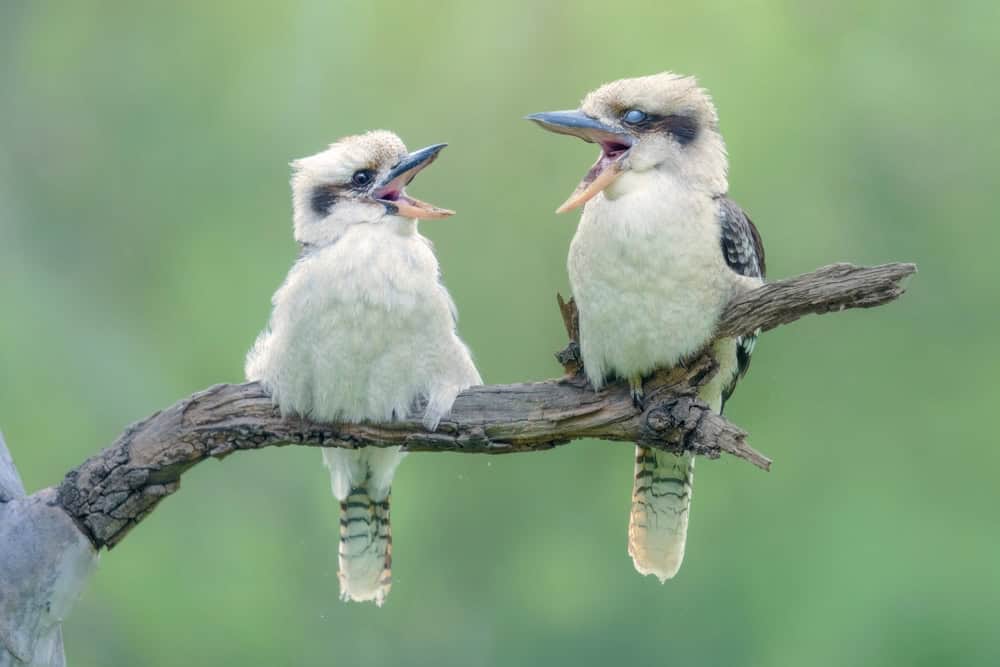
The name "laughing kookaburra" refers to the bird's "laugh",
which it uses to establish territory among family groups. It can be
heard at any time of day, but most frequently at dawn and dusk.[6]
This species possesses a tracheo-bronchial syrinx, which creates
two sources of vibrations so it can produce two frequencies at the same
time with multiple harmonics.[5]
The laughing kookaburras call is made through a complex sound
production system, by forcing air from the lungs into the bronchial
tubes.[5] While the structure for producing calls is present from an early age, the kookaburra's song is a learned behavior.[31]
The breeding pair within a riot of kookaburra teach the fledglings to
produce the signature laughing call after the young have left the nest.[31] The adult male will sing a short portion of the call while the offspring mimics this call, usually unsuccessfully.[31] The singing lessons tend to last two weeks before the fledgling can properly sing and take part in crepuscular choral songs.[31] Once mastered, the young can join in crepuscular chorus songs that aid in establishing territory.[31]
One bird starts with a low, hiccuping chuckle, then throws its head back in raucous laughter: often several others join in.[3][30] If a rival tribe is within earshot and replies, the whole family soon gathers to fill the bush with ringing laughter.[2]
The laughing chorus has 5 variable elements: 1. "Kooa"; 2. "Cackle"; 3.
"Rolling", a rapidly repeated "oo-oo-oo"; 4. Loud "Ha-ha"; followed by
5. Male's call of "Go-go" or female's call of "Gurgle".[30]
Hearing kookaburras in full voice is one of the more extraordinary
experiences of the Australian bush, something even locals cannot ignore;
some visitors, unless forewarned, may find their calls startling.
Those calls are produced to attract/guard mates, establish and
maintain the social hierarchy, and declare and defend a territory, as
their calls are more often correlated with aggressiveness.[32] Calls are utilized as neighbour/kin recognition to exhibit that groups are still inhabiting a territory.[31] These calls also demonstrate to receivers that highly coordinated groups are of better quality and health.[33]
Acoustic communication between laughing kookaburras increases 2–3
months before the breeding season, September to January, because male
aggression also increases.[5]
The duetting call requires higher levels of cooperation within the group.[5]
The coordination of calls amongst kookaburras has been hypothesized to
strengthen the main long-term pair bond and may have evolved as a
mechanism to solidify the group's bonds since it is energetically costly
to learn a new song.[33]
Neighbouring groups exhibit degrees of cooperation as well since chorus
songs between neighbours are delivered without any overlap, alternating
between groups.[31]
Squawking is another common form of acoustic communication in D. novaeguineae that is used in a slew of different contexts.[30]
Laughing kookaburras have been noted to squawk when nesting, exhibiting
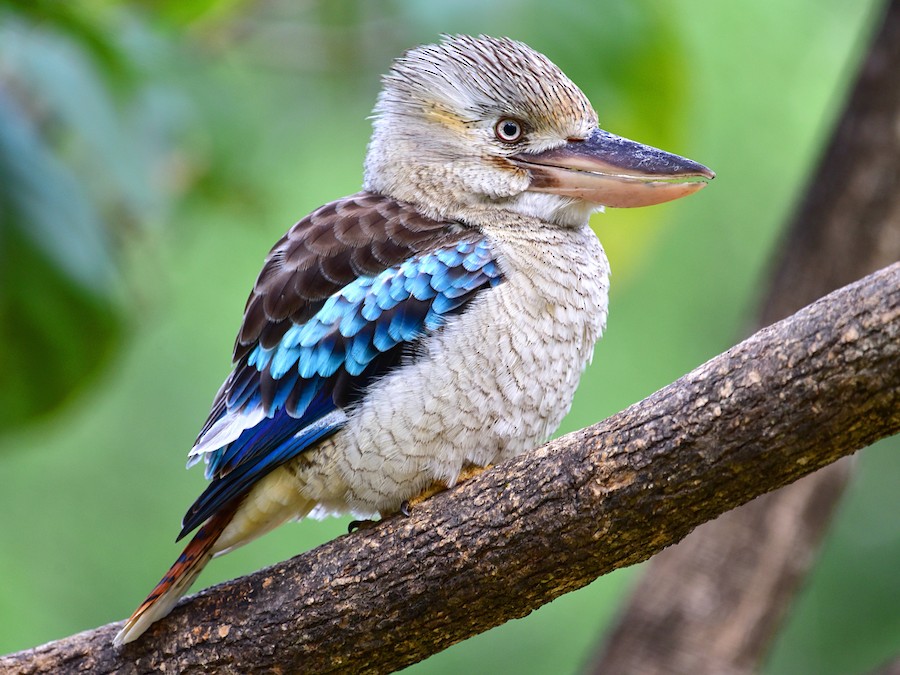
submissive behavior, and when fledglings are waiting to be fed.[30] Laughing kookaburras have a greater repertoire of calls than other kookaburra species like the Blue-winged kookaburra (Dacelo leachii) that produces two simple types of calls: "barks" and "hiccups".[34]
This large range of calls is highlighted through cadencing, intonation,
and frequency modulations that allow more detailed information to be
It has been introduced into many other areas probably because of
its reputation for killing snakes. In December 1891, the Western
Australian parliament included 'Laughing Jackass' in the schedule of
strictly preserved Australian native birds in the Game Bill, moved by Horace Sholl, member for North District. He described it as native of the North West.[37] His nomination is, therefore, certainly a reference to the blue-winged kookaburra (Dacelo leachii), not the laughing kookaburra (Dacelo novaeguineae). The Game Act, 1892
(Western Australia), "An Act to provide for the preservation of
imported birds and animals, and of native game," provided that
proclaimed Australian native birds and animals listed in the First
Schedule of the Act could be declared protected from taking. Laughing
Jackass was one of 23 Australian native bird species named in the
schedule.
Laughing kookaburras from Eastern States were released to the South West as early as 1883,[38] with birds being noted between Perth and Fremantle, as well as up in Mullewa around 1896.[39]
The Acclimatization Society (or Animal and Bird Acclimatization
committee of WA) imported and released hundreds of birds between 1897
and 1912.[40] Mainly via Ernest Le Souef
who was Secretary of the Acclimatization Society and Director of Perth
Zoological Gardens, an enthusiastic supporter of the Kookaburra who
admitted to releasing hundreds from the Zoo, including 50 in 1900 at the
Royal request of the visiting Duke of York.
By 1912 breeding populations had been established in a number of
areas. The present range in Western Australia is southwest of a line
joining Geraldton on the west coast and Hopetoun on the south coast.[5] In Tasmania
the laughing kookaburra was introduced at several locations beginning
in 1906. It now mainly occurs northeast of a line joining Huonville, Lake Rowallan, Waratah and Marrawah.[5] It was introduced on Flinders Island in around 1940, where it is now widespread, and on Kangaroo Island in 1926.[5]
In the 1860s, during his second term as governor of New Zealand, George Grey arranged for the release of laughing kookaburras on Kawau Island. The island lies in the Hauraki Gulf, about 40 km (25 mi) north of Auckland on the North Island
of New Zealand. It was thought that the introduction had been
unsuccessful but in 1916 some birds were discovered on the adjacent
mainland.[36][41] It now breeds in a small region on the western side of the Hauraki Gulf between Leigh and Kumeu.[36]
The usual habitat is open sclerophyll forest and woodland. It is more common where the understory
is open and sparse or where the ground is covered with grass.
Tree-holes are needed for nesting. It also occurs near wetlands and in
partly cleared areas or farmland with trees along roads and fences. In
urban areas it is found in parks and gardens.[42] The range of the laughing kookaburra overlaps with that of the blue-winged kookaburra in an area of eastern Queensland that extends from the Cape York Peninsula south to near Brisbane.
Around Cooktown the laughing kookaburra tends to favour areas near
water while the blue-winged kookaburra keeps to drier habitats.[6]
A single individual has been recorded in the English county of Suffolk since at least 2015, being most recently sighted in 2024.[43] Additional sightings of laughing kookaburras have been recorded in Scotland,[44] suggesting that individuals of the species may have been intentionally or accidentally released.
Kookaburra with a captured
Kookaburras occupy woodland territories (including forests) in loose
family groups, and their laughter serves the same purpose as a great
many other bird calls—to mark territorial borders. Most species of
kookaburras tend to live in family units, with offspring helping the
parents hunt and care for the next generation of offspring.
During mating season, the laughing kookaburra reputedly indulges in behaviour similar to that of a wattlebird.
The female adopts a begging posture and vocalises like a young bird.
The male then offers her his current catch accompanied with an "oo oo
oo" sound. However, some observers maintain that the opposite happens –
the female approaches the male with her current catch and offers it to
him. Nest-building may start in August with a peak of egg-laying from
September to November.[5] If the first clutch fails, they will continue breeding into the summer months.[5]
The female generally lays a clutch of three semi-glossy, white,
rounded eggs, measuring 36 mm × 45 mm (1.4 in × 1.8 in), at about
two-day intervals.[3] Both parents and auxiliaries incubate the eggs for 24–26 days.[5] Hatchlings are altricial and nidicolous, fledging by day 32–40.[5]
If the food supply is not adequate, the third egg will be smaller and
the third chick will also be smaller and at a disadvantage relative to
its larger siblings. Chicks have a hook on the upper mandible, which
disappears by the time of fledging. If the food supply to the chicks is
not adequate, the chicks will quarrel, with the hook being used as a
weapon. The smallest chick may even be killed by its larger siblings.[5] If food is plentiful, the parent birds spend more time brooding the chicks, so the chicks are not able to fight
Kookaburras hunt much as other kingfishers (or indeed Australasian robins) do, by perching on a convenient branch or wire and waiting patiently for prey to pass by. Common prey include mice and similar-sized small mammals, a large variety of invertebrates (such as insects, earthworms and snails), yabbies, small fish, lizards, frogs, small birds and nestlings, and most famously, snakes.[5][30] Small prey are preferred, but kookaburras sometimes take large creatures, including venomous snakes, much longer than their bodies.[5]
When feeding their young, adult laughing kookaburras will make "Chuck
calls", which are deep, guttural calls that differ significantly from
their daily chorus songs.[30]
To further enhance territorial behavior, kookaburras will partake in two types of aerial displays: trapeze and circular flights.[45]
Trapeze flights are aptly named after the swooping motion that
neighbouring kookaburras will make towards one another in midair when
defending territory.[45]
During trapeze flights, an individual from each riot will perch on
branches bordering the others' territory and fly back and forth between
trees within their established home range and trees bordering
neighbouring kookaburras territory.[45]
These displays have been observed to last up to a half an hour and are
usually accompanied by calls from the sender and members of that
individual's riot.[45]
Circle flights are initiated when an individual circumnavigates a
neighbouring territory by flying over the area and then quickly invading
neighbouring territory.[45]
Once inside the neighbouring territory, the individual will fly in
circles around the other kookaburras inhabiting the area, which results
in a typical laughing call or squawking depending on whether the
neighbours' dominance status.[45]
Flight displays are useful for communicating over long distances, but
other forms of visual signals can be effective for short-range
communication.
Close range visual signals can be used to convey aggression or indicate incoming threats to the flock.[45]
Aggressive posturing is used as a warning before attacking, a signal
that is commonly received by foreign kookaburras encroaching on another
groups' territory.[46]
Laughing kookaburras will splay out their wings and propel their head
forward while shaking their tail feathers to exhibit dominance and ward
off intruders.[46] The aggressive posturing is followed up by chasing off the unwanted individual before attacking.[5] Visual displays are also used to communicate vigilance and the presence of threats via alert postures.[5]D. novaeguineae will open its beak, ruffle up the feathers surrounding its cap, and angle their heads towards the direction of the threat.[5]
Depending on the urgency of the threat, alarm postures may be followed
by loud laugh-like calls to warn other members of the flock.[5]
Laughing kookaburras are a common sight in suburban gardens and urban
settings, even in built-up areas, and are so tame that they will often
eat out of a person's hands, and allow them to rub their bellies. It is
not uncommon for kookaburras to snatch food out of people's hands
without warning, by swooping in from a distance. People often feed them
pieces of raw meat. Laughing kookaburras are often kept in
The kookaburra is also the subject of a popular Australian children's song, the "Kookaburra" which was written by Marion Sinclair in 1934.[47]
Recordings of this bird have been edited into Hollywood movies
for decades, usually in jungle settings, beginning with the Tarzan
series in the 1930s, and more recently in the film The Lost World: Jurassic Park (1997).[4]
The population density of the laughing kookaburra in Australia varies
between 0.04 and 0.8 birds/ha depending on the habitat. Assuming an
average of 0.3 birds/ha the total population may be as large as 65
million individuals.[6]
However, this may represent a severe over-estimate since the population
of the laughing kookaburra seems to be undergoing a marked decline with
Birdata showing a 50% drop in sightings from 2000 to 2019, and a drop
in the reporting rate from 25% to 15% over the same period.[48] The population in New Zealand is relatively small and is probably less than 500 individuals.[49] Given the extended range and the large stable population, the species is evaluated as of "least concern" by the International Union for Conservation of Nature.[1]
Distribution within Australia Dark green: native Light green: introduced
 The individual and geographic variation observed in the southern
tamandua have made the taxonomic description of these animals a
difficult task. Animals from the southeastern part of the range are
"strongly vested", meaning they have black markings from shoulder to
rump; the black patch widens near the shoulders and encircles the
forelimbs. The rest of the body can be blonde, tan, or brown. Animals
from northern Brazil and Venezuela to west of the
The individual and geographic variation observed in the southern
tamandua have made the taxonomic description of these animals a
difficult task. Animals from the southeastern part of the range are
"strongly vested", meaning they have black markings from shoulder to
rump; the black patch widens near the shoulders and encircles the
forelimbs. The rest of the body can be blonde, tan, or brown. Animals
from northern Brazil and Venezuela to west of the