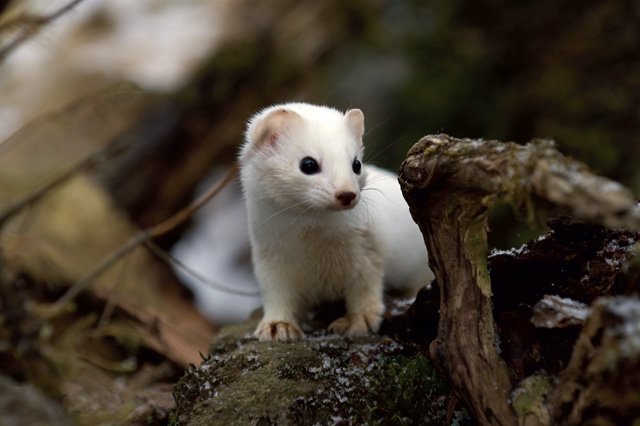
The Haida ermine (Mustela haidarum) is a mustelid species endemic to a few islands off the Pacific Northwest of North America, namely Haida Gwaii in Canada and the southern Alexander Archipelago in the U.S. state of Alaska.[5]
In the Haida language, this species is known as daayáats’ in its brown summer coat and tlag in its winter coat.[6]
The three subspecies of the Haida ermine were originally considered subspecies of the common stoat (M. erminea).
However, in 2013, they were recognized as distinct from any other
ermine, and a 2021 study further found them to comprise a distinct
species. M. haidarum is thought have originated about 375,000 years ago (during the Pleistocene), and is thought to be the result of ancient hybrid speciation between the Beringian ermine (M. erminea) and American ermine (M. richardsonii). The islands are thought to have been glacial refugia during the Last Glacial Maximum, with both species of ermine being isolated on the islands and hybridizing
with one another, while the ice sheets separated them from the rest of
the world—thus leading to the formation of a new species.[7][8][9][10] It is recognized as a distinct species by the American Society of Mammalogists.[5]

The species is found on a few islands off the coast of British Columbia and southeast Alaska. In Canada, it is found on the Haida Gwaii archipelago in Graham and Moresby islands, while in Alaska it is found on Prince of Wales Island and possibly Suemez Island.[7] It is found in a temperate rainforest habitat.
Aside from genetic differences, M. haidarum can be distinguished from M. erminea and M. richardsonii by its elongated skull.[10]

 |
|
|
|
|
|---|
|
|
|
|
|
|
|
|
|
|
 |
|
|
|
|
The
habitat for the Haida ermine has been intensively reduced over the past
few centuries due to old-growth timber harvest in the Tongass National Forest,
an important protected area for the species, as well as
industrial-scale mining on the islands, which disproportionately affects
insular endemics such as M. haidarum. Expanding human populations and increasing tourism may increase the risk of pathogen spillover to M. haidarum, including pathogens common to pets such as canine distemper and parvoviruses,
which have negatively impacted other wild mustelids. Due to the
rudimentary understanding of the true level of endemism in these
northern archipelagos, these threats must be better quantified to
protect species from them. The Pacific martens (M. caurina) inhabiting Haida Gwaii
also represent a distinct lineage from other populations, indicating
that the habitat of the islands may have allowed other distinct species
or subspecies

The
Haida ermine traverse their environment with quick momentum from their
small legs. They root around in search of holes and crevices often
scouting their surroundings on their hind legs. They hunt in short
periods often in ten to fourteen minute increments up to four hours,
interchanging between break periods every three to five hours of the
day. They typically hunt prey that are several times their own weight by
precise lunges at the neck. Except for rabbits which have too much fur
around their neck for the bite to penetrate but instead are gripped at
the nape and scratched with their hind legs. Haida ermine are known to
lick the blood created by them off their prey first. They kill when
given the chance and store what isn't required at the time in their
nests.


No comments:
Post a Comment
Note: Only a member of this blog may post a comment.