
The martens constitute the genus Martes within the subfamily Guloninae, in the family Mustelidae. They have bushy tails and large paws with partially retractile claws. The fur varies from yellowish to dark brown, depending on the species, and is valued by trappers for the fur trade. Martens are slender, agile animals, adapted to living in the taiga, and inhabit coniferous and northern deciduous forests across the Northern Hemisphere.

 Yellow-throated marten (Martes flavigula), Thailand
Results of DNA research indicate that the genus Martes is polyphyletic, with some studies placing Martes americana outside the genus and allying it with Eira and Gulo, to form a new New World clade.[1][2] The genus first evolved up to seven million years ago during the Miocene epoch.
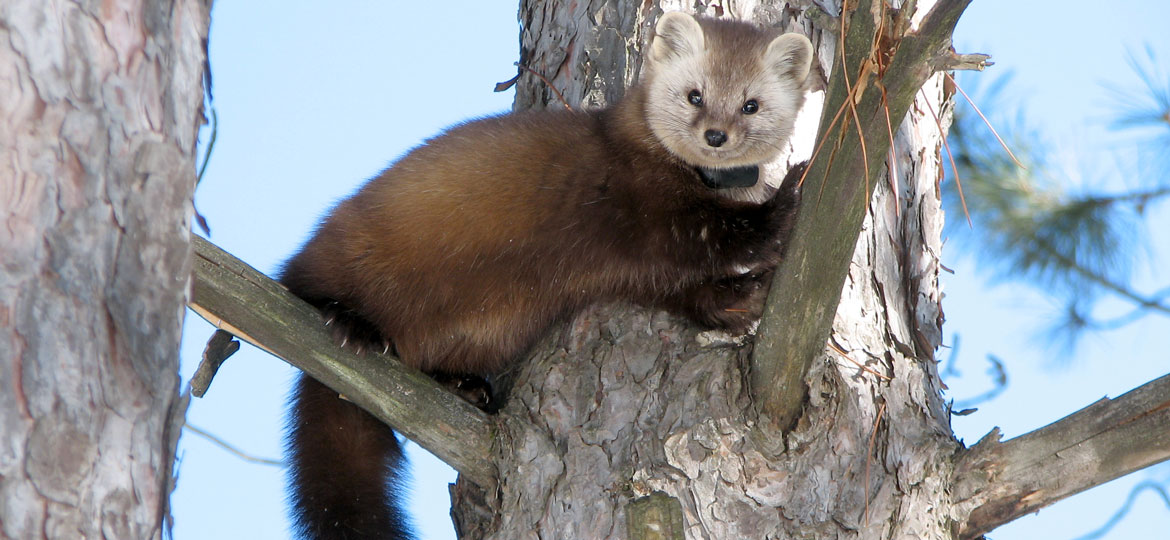

Martens are solitary animals, meeting only to breed in late spring or early summer. Litters of up to five blind and nearly hairless kits are born in early spring. They are weaned after around two months, and leave the mother to fend for themselves at about three to four months of age. Due to their habit of seeking warm and dry places and to gnaw on soft materials, martens cause damage to soft plastic and rubber parts in cars and other parked vehicles, annually costing millions of euros in Central Europe alone, thus leading to the offering of marten-damage insurance, "marten-proofing", and electronic repellent devices.[3][4][5][6] They are omnivorous.

The marten is popular in the northern Ontario community of Big Trout Lake. During the fur trade, commissioned by the Hudson Bay Company in the 17th and 18th centuries, the marten pelt was typically fashioned into mittens. The marten is still traded locally. The locals place a high value on this pelt, typically trading it for consumable goods.[citation needed]

A running marten is shown on the coat of arms of Slavonia and subsequently on the modern design of the coat of arms of Croatia. The official seal of the Croatian Sabor (parliament) from 1497 until the late 18th century had a similar design.[9][10]



The Latin word for helmet, galea,
originally meant "marten pelt," although it is unclear whether early
Romans wore these helmets for symbolical reasons or for their fine fur.[12]
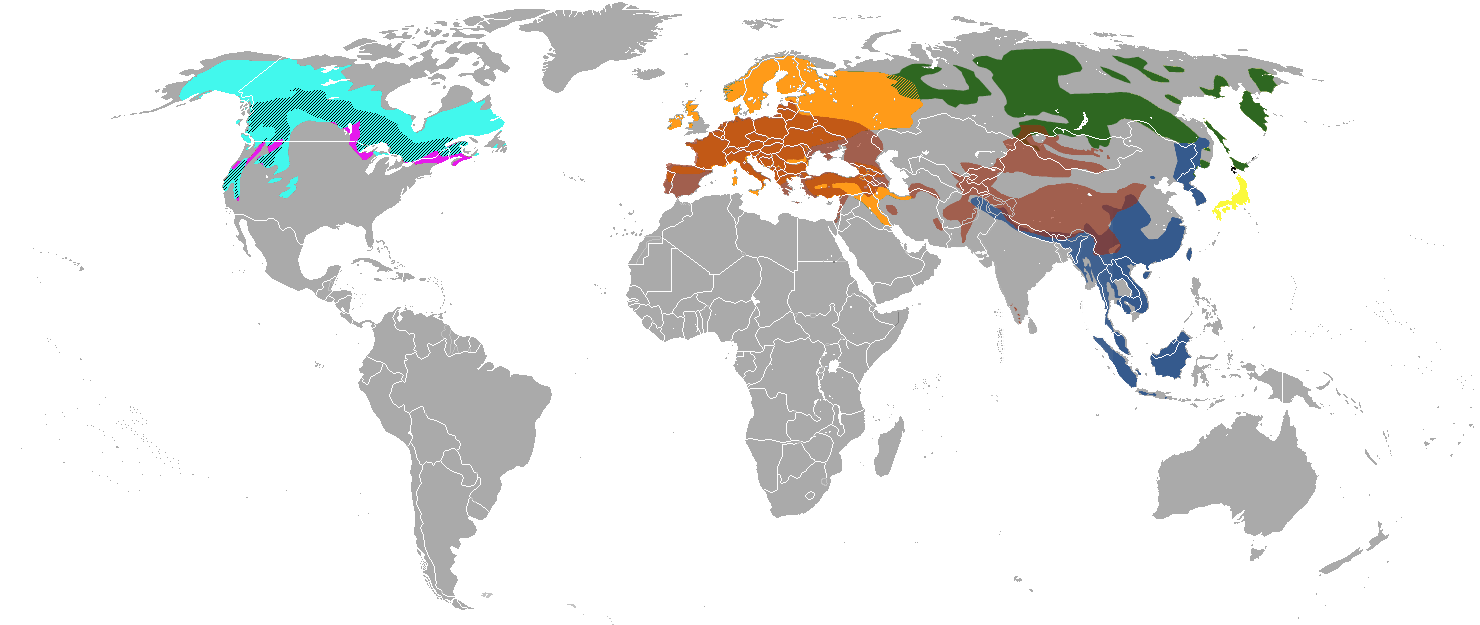
Marten ranges:
- M. americana = cyan & teal
- M. flavigula = dark blue & sepia
- M. foina = rust, brown & sepia
- M. gwatkinsii
- M. martes = orange, rust & grass-green
- M. melampus = yellow
- M. pennanti = purple & teal
- M. zibellina = green & grass-gree


No comments:
Post a Comment
Note: Only a member of this blog may post a comment.