
The weasel sportive lemur (Lepilemur mustelinus), also known as the greater sportive lemur, weasel lemur, or greater weasel lemur, is a species of lemur endemic to Madagascar. Like all members of its genus, it is nocturnal and largely folivorous.[4] Described by Isidore Geoffroy Saint-Hilaire in 1851, it is the type species of genus Lepilemur.[5] It is threatened by habitat loss, climate change and hunting.[1]
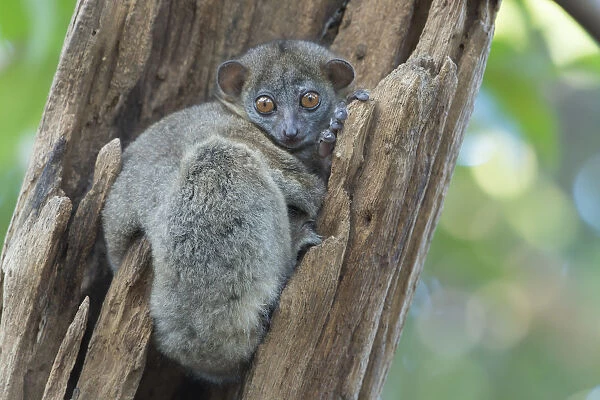
 Lepilemur mustelinus in a tree cavity
Phylogenetic studies show that the weasel sportive lemur diverged from its closest relatives, the Betsileo sportive lemur (L. betsileo) and James' sportive lemur (L. jamesi), approximately 1.18 million years ago. These three species are further nested within a clade containing all the Lepilemur species that inhabit Madagascar's eastern rainforests, with the exception of the small-toothed sportive lemur (L. microdon).[6]

The weasel sportive lemur has long, dense fur that is chestnut-brown on the back, often displaying a dark midline stripe. The face is gray or brown, with the cheeks, throat and abdomen slightly lighter. The tail darkens towards the tip. There have also been reports of bright orange morphs in otherwise normally colored populations.[4] It is a relatively large Lepilemur, with a total length of 51–59 cm (20–23 in), of which 26–30 cm (10–12 in) is the body and 25–29 cm (9.8–11.4 in) is the tail.[4][7] It weighs 0.8–1.2 kg (1.8–2.6 lb).[8]


The main threats facing the weasel sportive lemur are habitat loss, hunting and climate change. The rainforests in which the species inhabit have lost approximately 30% of their tree cover over the last three generations of the species and appears to be accelerating. Bushmeat hunting also poses a threat, and weasel sportive lemurs are hunted at a rate of 0.02 individuals per household per year in surveyed areas of their distribution.[1] Additionally, climate change is expected to reduce the weasel sportive lemur's distribution by 3% by 2080 through habitat alteration.[9] While no species-specific conservation actions have been implemented, the species is known to occur in multiple national parks and other reserves.[4]


Distribution of L. mustelinus

No comments:
Post a Comment
Note: Only a member of this blog may post a comment.