An
antelope is a member of a number of
even-toed ungulate species indigenous to various regions in
Africa and
Eurasia. Antelopes comprise a
wastebasket taxon (miscellaneous group) within the family
Bovidae, encompassing those
Old World species that are not
cattle,
sheep,
buffalo,
bison, or
goats. A group of antelope is called a
herd.
[1]
Etymology
The English word "antelope" first appeared in 1417 and is derived from the
Old French antelop, itself derived from
Medieval Latin ant(h)alopus, which in turn comes from the
Byzantine Greek word
anthólops, first attested in
Eustathius of Antioch (
circa 336), according to whom it was a
fabulous animal
"haunting the banks of the Euphrates, very savage, hard to catch and
having long, saw-like horns capable of cutting down trees".
[2] It perhaps derives from Greek
anthos (flower) and
ops (eye), perhaps meaning "beautiful eye" or alluding to the animals' long eyelashes. This, however, may be a later
folk etymology. The word
talopus and
calopus, from Latin, came to be used in
heraldry. In 1607, it was first used for living,
cervine animals.
Species
The 91 species, most of which are native to Africa, occur in about 30
genera. The classification of tribes or subfamilies within
Bovidae is still a matter of debate, with several alternative systems proposed.
Antelope are not a
cladistic
or taxonomically defined group. The term is used to describe all
members of the family Bovidae that do not fall under the category of
sheep,
cattle, or
goats. Usually, all species of the
Alcelaphinae,
Antilopinae,
Hippotraginae,
Reduncinae,
Cephalophinae, many
Bovinae, the
grey rhebok, and the
impala are called antelopes.
Distribution and habitat
No antelope species is native to
Australasia or
Antarctica, nor do any extant species occur in the
Americas, though the nominate
saiga subspecies occurred in North America during the Pleistocene. North America is currently home to the native
pronghorn, which taxonomists do not consider a member of the antelope group, but which is locally referred to as such (e.g.
Antelope Valley). In
Europe, several extinct species occur in the fossil record, and the
saiga was found widely during the
Pleistocene but did not persist into the later
Holocene,
[3] except in Russian
Kalmykia and
Astrakhan Oblast.
[4] More species of antelope are native to Africa than to any other continent, almost exclusively in
savannahs, with 20-35 species co-occurring over much of East Africa.
[5]
Because savannah habitat in Africa has expanded and contracted five
times over the last three million years, and the fossil record indicates
this is when most extant species evolved, it is believed that isolation
in refugia during contractions was a major driver of this
diversification.
[6] Other species occur in Asia: the
Arabian Peninsula is home to the
Arabian oryx and
Dorcas gazelle. India is home to the
nilgai,
chinkara,
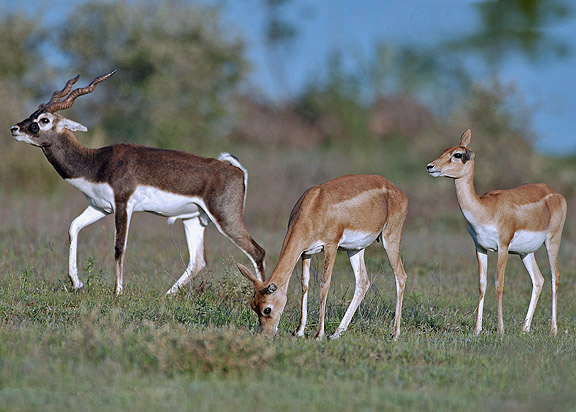
blackbuck,
Tibetan antelope, and
four-horned antelope, while Russia and Central Asia have the Tibetan antelope, and saiga.
Many species of antelopes have been imported to other parts of the
world, especially the United States, for exotic game hunting. With some
species possessing spectacular leaping and evasive skills, individuals
may escape.
Texas
in particular has many game ranches, as well as habitats and climates,
that are very hospitable to African and Asian plains antelope species.
Accordingly, wild populations of blackbuck antelope,
gemsbok, and nilgai may be found in Texas.
[7]
Antelope live in a wide range of habitats. Numerically, most live in
the African savannahs. However, many species are more secluded, such as
the forest antelope, as well as the extreme cold-living saiga, the
desert-adapted Arabian oryx, the rocky
koppie-living
klipspringer, and semiaquatic
sitatunga.
[8]
Species living in forests, woodland, or bush tend to be sedentary,
but many of the plains species undertake long migrations. These enable
grass-eating species to follow the rains and thereby their food supply.
The
gnus and
gazelles of
East Africa perform some of the most impressive mass migratory circuits of all mammals.
[9]
Morphology
Gerenuks can stand erect on their hind legs to browse on high foliage.
For example, a male
common eland can measure 178 cm (70 in) at the shoulder and weigh almost 950 kg (2,090 lb), whereas an adult
royal antelope may stand only 24 cm (9.4 in) at the shoulder and weigh a mere 1.5 kg (3.3 lb).
Not surprisingly for animals with long, slender yet powerful legs,
many antelopes have long strides and can run fast. Some (e.g.
klipspringer) are also adapted to inhabiting rock koppies and crags.
Both
dibatags and
gerenuks habitually stand on their two hind legs to reach
acacia
and other tree foliage. Different antelope have different body types,
which can affect movement. Duikers are short, bush-dwelling antelope
that can pick through dense foliage and dive into the shadows rapidly.
Gazelles and springbok are known for their speed and leaping abilities.
Even larger antelope, such as nilgai,
elands, and
kudus, are capable of jumping 2.4 m (7.9 ft) or greater, although their running speed is restricted by their greater mass.
Antelope have a wide variety of coverings, though most have a dense
coat of short fur. In most species, the coat (pelage) is some variation
of a brown colour (or several shades of brown), often with white or pale
underbodies. Exceptions include the zebra-marked
zebra duiker, the grey, black, and white
Jentink's duiker, and the
black lechwe.
Most of the "spiral-horned" antelopes have pale, vertical stripes on
their backs. Many desert and semidesert species are particularly pale,
some almost silvery or whitish (e.g. Arabian oryx); the
beisa and
southern oryxes have gray and black pelages with vivid black-and-white faces. Common features of various
gazelles
are white rumps, which flash a warning to others when they run from
danger, and dark stripes midbody (the latter feature is also shared by
the springbok and beira). The springbok also has a pouch of white,
brushlike hairs running along its back, which opens up when the animal
senses danger, causing the dorsal hairs to stand on end.
Antelope are
ruminants, so have well-developed
molar teeth, which grind
cud
(food balls stored in the stomach) into a pulp for further digestion.
They have no upper incisors, but rather a hard upper gum pad, against
which their lower incisors bite to tear grass stems and leaves.
Like many other
herbivores,
antelopes rely on keen senses to avoid predators. Their eyes are placed
on the sides of their heads, giving them a broad radius of vision with
minimal binocular vision. Their horizontally elongated pupils also help
in this respect. Acute senses of smell and hearing give antelope the
ability to perceive danger at night out in the open (when predators are
often on the prowl). These same senses play an important role in contact
between individuals of the same species; markings on their heads, ears,
legs, and rumps are used in such communication. Many species "flash"
such markings, as well as their tails; vocal communications include loud
barks, whistles, "moos", and trumpeting; many species also use
scent marking to define their
territories or simply to maintain contact with their relatives and neighbors.
Many antelope are sexually dimorphic. In most species, both sexes
have horns, but those of males tend to be larger. Males tend to be
larger than the females, but exceptions in which the females tend to be
heavier than the males include the
bush duiker,
dwarf antelope,
Cape grysbok, and
oribi, all rather small species. A number of species have hornless females (e.g.
sitatunga,
red lechwe, and
suni). In some species, the males and females have differently coloured pelages (e.g.
blackbuck and
nyala).
The size and shape of antelope horns varies greatly. Those of the
duikers and dwarf antelopes tend to be simple "spikes", but differ in
the angle to the head from backward curved and backward pointing (e.g.
yellow-backed duiker) to straight and upright (e.g.
steenbok). Other groups have twisted (e.g.
common eland), spiral (e.g.
greater kudu), "recurved" (e.g. the
reedbucks), lyrate (e.g.
impala), or long, curved (e.g. the
oryxes) horns. Horns are not shed and their bony cores are covered with a thick, persistent sheath of
horny material, both of which distinguish them from antlers.
[10]
Horns are efficient weapons, and tend to be better developed in those
species where males fight over females (large herd antelope) than in
solitary or
lekking
species. With male-male competition for mates, horns are clashed in
combat. Males more commonly use their horns against each other than
against another species. The boss of the horns is typically arranged in
such a way that two antelope striking at each other's horns cannot crack
each other's skulls, making a fight via horn more ritualized than
dangerous. Many species have ridges in their horns for at least
two-thirds the length of their horns, but these ridges are not a direct
indicator of age.
Behavior
Mating strategies
Antelope are often classified by their reproductive behavior.
Small antelope, such as
dik-diks,
tend to be monogamous. They live in a forest environment with patchy
resources, and a male is unable to monopolize more than one female due
to this sparse distribution. Larger forest species often form very small
herds of two to four females and one male.
Some species, such as
lechwes,
pursue a lek breeding system, where the males gather on a lekking
ground and compete for a small territory, while the females appraise
males and choose one with which to mate.
Large grazing antelope, such as
impala or
wildebeest, form large herds made up of many females and a single breeding male, which excludes all other males, often by combat.
Defense
Fast-running
gazelles prefer open grassland habitat.
Antelope pursue a number of defense strategies, often dictated by their morphology.
Large antelope that gather in large herds, such as wildebeest, rely
on numbers and running speed for protection. In some species, adults
will encircle the offspring, protecting them from predators when
threatened. Many forest antelope rely on
cryptic
coloring and good hearing to avoid predators. Forest antelope often
have very large ears and dark or striped colorations. Small antelope,
especially
duikers, evade predation by jumping into dense bush where the predator cannot pursue.
[11] Springboks use a behavior known as
stotting to confuse predators.
Open grassland species have nowhere to hide from predators, so they tend to be fast runners. They are
agile and have good
endurance—these are advantages when pursued by sprint-dependent predators such as
cheetahs,
which are the fastest of land animals, but tire quickly. Reaction
distances vary with predator species and behaviour. For example,
gazelles may not flee from a
lion
until it is closer than 200 m (650 ft)—lions hunt as a pride or by
surprise, usually by stalking; one that can be seen clearly is unlikely
to attack. However, sprint-dependent cheetahs will cause gazelles to
flee at a range of over 800 metres (
1⁄2 mile).
[12]
Status
About 25 species are rated by the
IUCN as
endangered,
[13] such as the
dama gazelle and
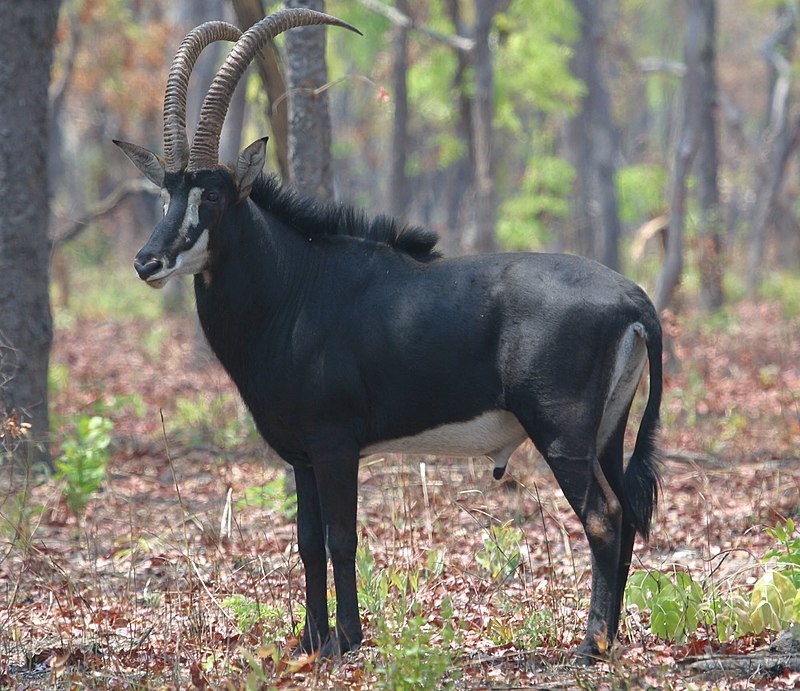
mountain nyala. A number of subspecies are also endangered, including the
giant sable antelope and the
mhorr gazelle. The main causes for concern for these species are habitat loss, competition with cattle for grazing, and trophy hunting.
The chiru or
Tibetan antelope is hunted for its pelt, which is used in making
shahtoosh,
an incredibly fine material used in shawls. Since the fur can only be
removed from dead animals, and each animal yields very little of the
downy fur, several antelope must be killed to make a single shawl. This
unsustainable demand has led to enormous declines in the chiru
population.
The saiga is hunted for its horns, which are considered an
aphrodisiac
by some cultures. Only the males have horns, and have been so heavily
hunted that some herds contain up to 800 females to one male. The
species has shown a steep decline and is critically endangered.
Lifespan
It is difficult to determine how long antelope live in the wild. With
the preference of predators towards old and infirm individuals, which
can no longer sustain peak speeds, few wild prey-animals live as long as
their biological potential. In captivity, wildebeest have lived beyond
20 years old, and impalas have reached their late teens.
[14]
Humans
Culture
The antelope's horn is prized for medicinal and magical powers in
many places. The horn of the male saiga, in Eastern practice, is ground
as an aphrodisiac, for which it has been hunted nearly to extinction.
[15] In the
Congo,
it is thought to confine spirits. Christian iconography sometimes uses
the antelope's two horns as a symbol of the two spiritual weapons
Christians possess: the
Old Testament and the
New Testament. The antelope's ability to run swiftly has also led to their association with the
wind, such as in the
Rig Veda, as the steeds of the
Maruts and the wind god
Vayu.
There is, however, no scientific evidence that the horns of any
antelope have any change on a human's physiology or characteristics.
Domestication
Domestication of animals requires certain traits in the animal that
antelope do not typically display. Most species are difficult to contain
in any density, due to the territoriality of the males, or in the case
of
oryxes
(which have a relatively hierarchical social structure), an aggressive
disposition; they can easily kill a human. Because many have extremely
good jumping abilities, providing adequate fencing is a challenge. Also,
antelope will consistently display a fear response to perceived
predators, such as humans, making them very difficult to herd or handle.
Although antelope have diets and rapid growth rates highly suitable for
domestication, this tendency to
panic and their non
hierarchical social structure explains why farm-raised antelope are uncommon. Ancient Egyptians kept herds of gazelles and
addax
for meat, and occasionally pets. It is unknown whether they were truly
domesticated, but it seems unlikely, as no domesticated gazelles exist
today.
However, humans have had success taming certain species, such as the
elands.
These antelope sometimes jump over each other's backs when alarmed, but
this incongruous talent seems to be exploited only by wild members of
the species; tame elands do not take advantage of it and can be enclosed
within a very low fence. Their meat, milk, and hides are all of
excellent quality, and experimental eland husbandry has been going on
for some years in both the Ukraine and Zimbabwe. In both locations, the
animal has proved wholly amenable to domestication.
[16]
Similarly, European visitors to Arabia reported "tame gazelles are very
common in the Asiatic countries of which the species is a native; and
the poetry of these countries abounds in allusions both to the beauty
and the gentleness of the gazelle."
[17] Other antelope that have been tamed successfully include the gemsbok,
[18] the kudu,
[19] and the springbok.
[19] Nor are the characteristics described above necessarily barriers to domestication; for further information, see
animal domestication.
Hybrid antelope
A wide variety of antelope
hybrids
have been recorded in zoos, game parks, and wildlife ranches, due to
either a lack of more appropriate mates in enclosures shared with other
species or a misidentification of species. The ease of hybridization
shows how closely related some antelope species are. With few
exceptions, most hybrid antelope occur only in captivity.
Most hybrids occur between species within the same genus. All
reported examples occur within the same subfamily. As with most mammal
hybrids, the less closely related the parents, the more likely the
offspring will be sterile.
[14]
Arms of the duke of
Abercorn in Scotland, featuring two silver antelopes.
Heraldry
Antelopes are a common symbol in
heraldry, though they occur in a highly distorted form from nature. The heraldic antelope has the body of a
stag and the tail of a
lion,
with serrated horns, and a small tusk at the end of its snout. This
bizarre and inaccurate form was invented by European heralds in the
Middle Ages, who knew little of foreign animals and made up the rest.
The antelope was mistakenly imagined to be a monstrous beast of prey;
the 16th century poet
Edmund Spenser referred to it as being "as fierce and fell as a
wolf."
[20]
Antelopes can all also occur in their natural form, in which case
they are termed "natural antelopes" to distinguish them from the more
usual heraldic antelope.
[21] The arms previously used by the
Republic of South Africa featured a natural antelope, along with an
oryx.


