Sunday, August 29, 2021

THE YELLOW- RUMPED HONEYGUIDE

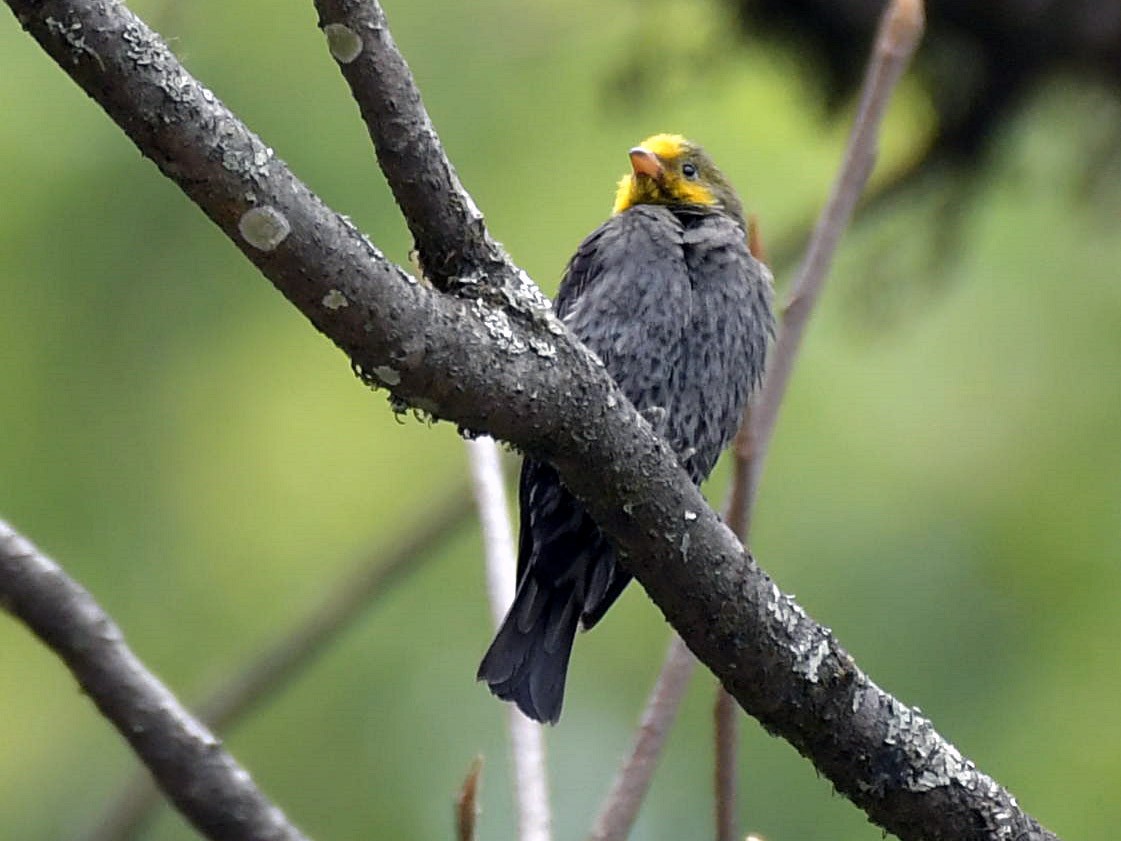
 Yellow-rumped Honeyguide - eBird

The yellow-rumped honeyguide (Indicator xanthonotus) is a sparrow-sized bird in the honeyguide family that is found in Asia, mainly in montane forests along the Himalayas. They are very finch-like but the feet are strong and zygodactyl, with two toes facing forward and two backward. They perch on honeycombs and feed on wax. Males tend to be territorial and stay near honeycombs while females and juveniles forage widely. They are brood parasites, laying their eggs in the nests of tree-hole breeders, possibly barbets.

Description

From Pabyuk-Naitam, East Sikkim, India.
John Gould.

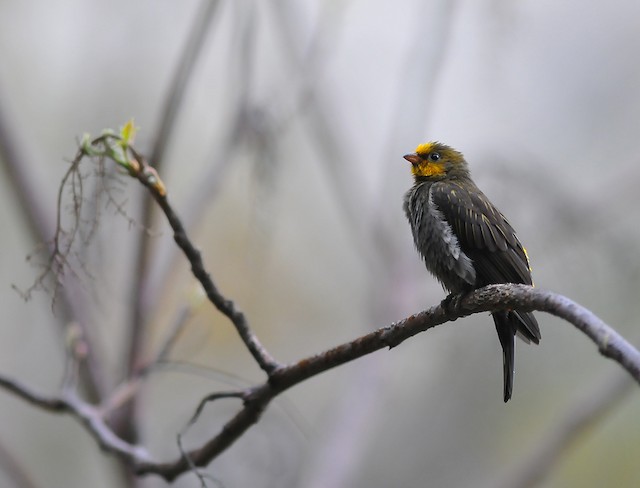
The yellow-rumped honeyguide is sparrow sized and has a stout finch-like bill. The plumage is largely dusky olive and the forehead and lores are orange while the upper plumage. There is a streaked appearance to the wing feathers. The rump is deep orange and extends into the back grading to sulphur yellow. The chin and throat are yellowish while the lower plumage is pale grey with dark streaks. The bill is yellow but dark towards the tip. Females have less extensive yellow on the face and the rump is yellow and lacks the orange. Allan Octavian Hume described the subspecies radcliffi (after Colonel E. Delmé-Radcliffe[2]) based on specimens from Hazara but no specimens or information from the region have subsequently been obtained putting it in some doubt. The species was described by Blyth based on specimens from near Darjeeling. Ripley described specimens from the Naga Hills as subspecies fulvus (not always recognized), said to be smaller and darker, with the streaking on the abdomen reduced and the yellow on the forehead restricted to the anterior.[3] This population may be identical to the nominate of the eastern Himalayas.[4][5] They have twelve tail feathers and nine primaries. The wing is long and pointed.[6][7]
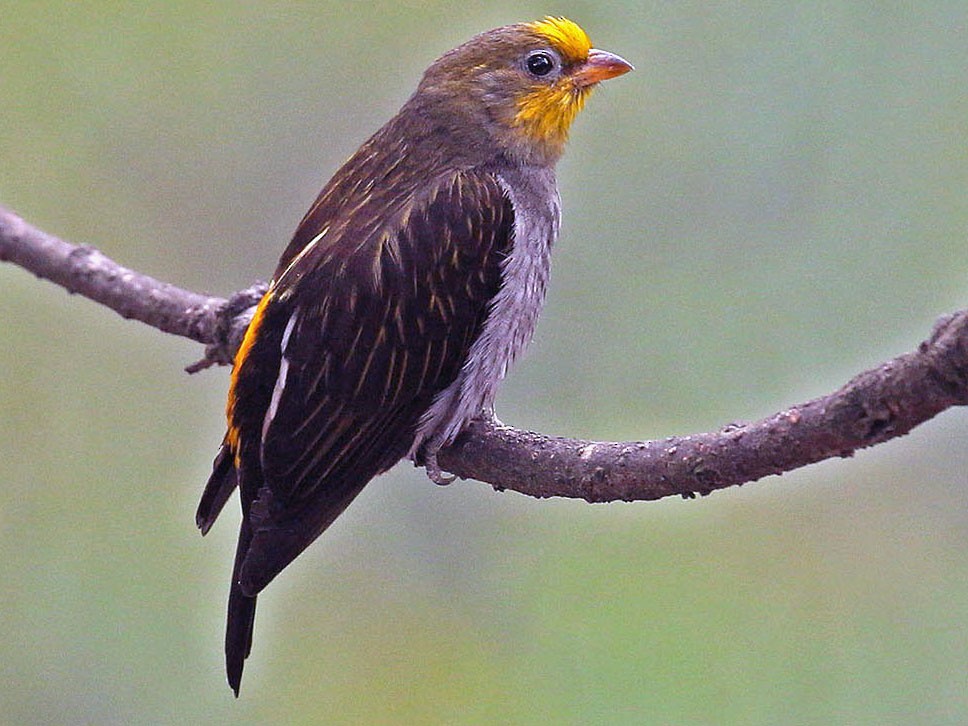
 Yellow-rumped Honeyguide - eBird

Behaviour and ecology

Head

A chipping call is produced in flight and when agitated. The flight is straight (may sometimes be undulating[5]) and direct, sometimes in flocks of 20 to 30 birds. At deserted honeycombs, the bird clings tight and presses its tail on the surface of the comb. They feed mainly on the foundation wax of Apis laboriosa that attach the comb to rocks. They feed on active beehives without disturbing the bees much.[4] They have been observed to make use of the attacks of Vespa mandarinia on Apis laboriosa colonies.[8]

A display of a male involved fluffing its feathers, holding the bill high and flicking wings while swaying from side to side. A female was observed flicking its tail and pressing it down with wings drooped before being mounted by a male.[4] They are brood parasites, laying their eggs in the nest of host species. The host species for the yellow-rumped honeyguide are as yet unknown and undocumented. Young birds of honeyguide species have bill-hooks with which they destroy the eggs and chicks of the host.[5] The male holds territories around hives and are polygynous, allowing females with whom it had mated and their young into the territories. This mating system has been termed as "resource-based non-harem polygyny".[9]

Unlike other honeyguides, this species has not been observed to lead humans and bears to bee hives.[5]
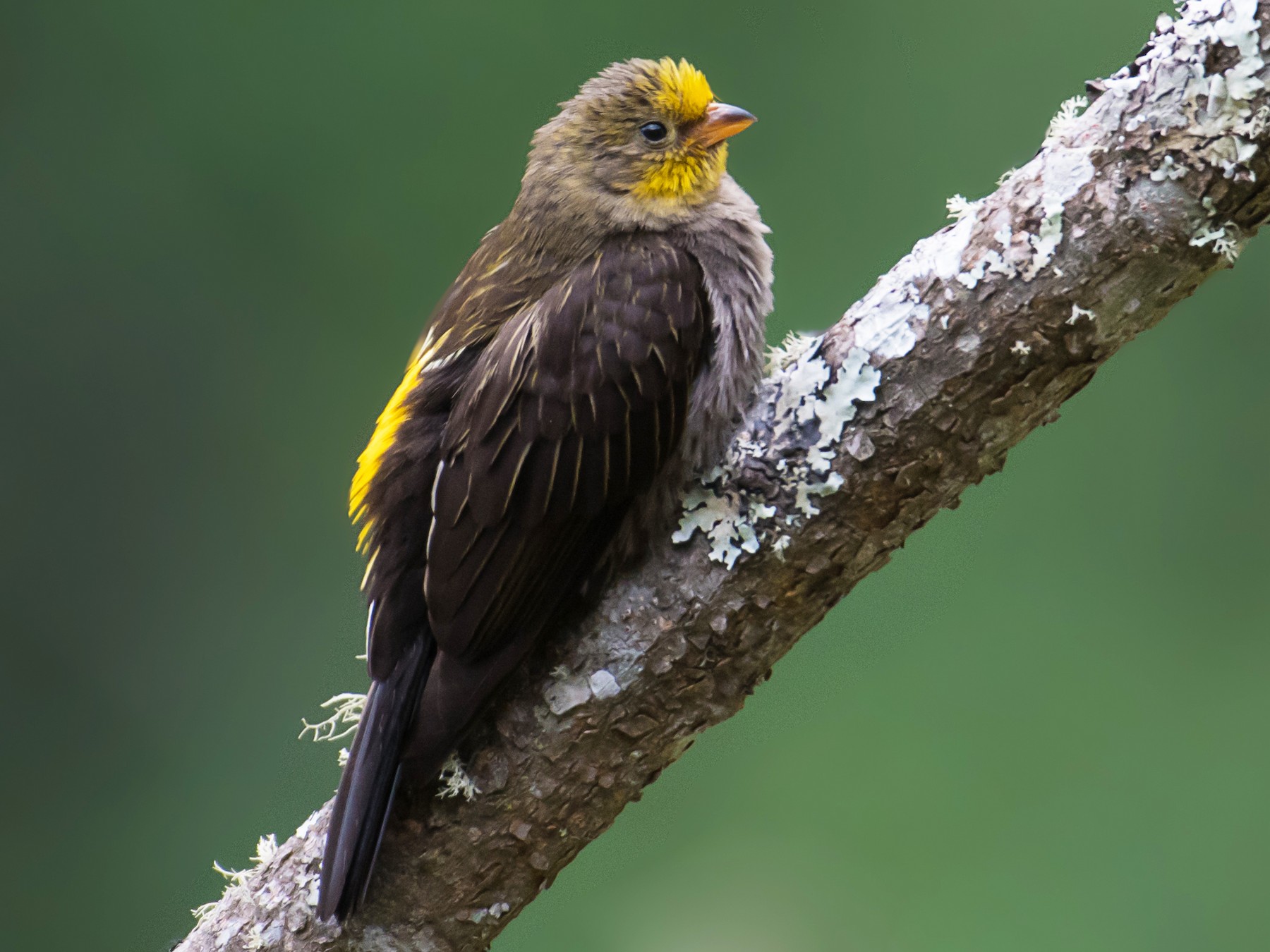
 Yellow-rumped Honeyguide - eBird

Distribution and habitat

Adult photographed in West Sikkim, India

The species has been recorded from northern Pakistan (Hazara and Murree Hills[10]) but the population here may have been extirpated[5] and then in the Himalayan regions of India from western Uttar Pradesh and Himachal Pradesh extending into Nepal, Sikkim, Arunachal Pradesh and Bhutan (where it is relatively common). It is also found in southeastern Tibet and northern Myanmar.[5] It is found in coniferous and dry-deciduous forest with rocky boulders and cliffs. May make altitudinal movements seasonally.[6]
 Yellow-rumped Honeyguide - eBird


 Birding and Wildlife Tours of Bhutan - Soar Excursions


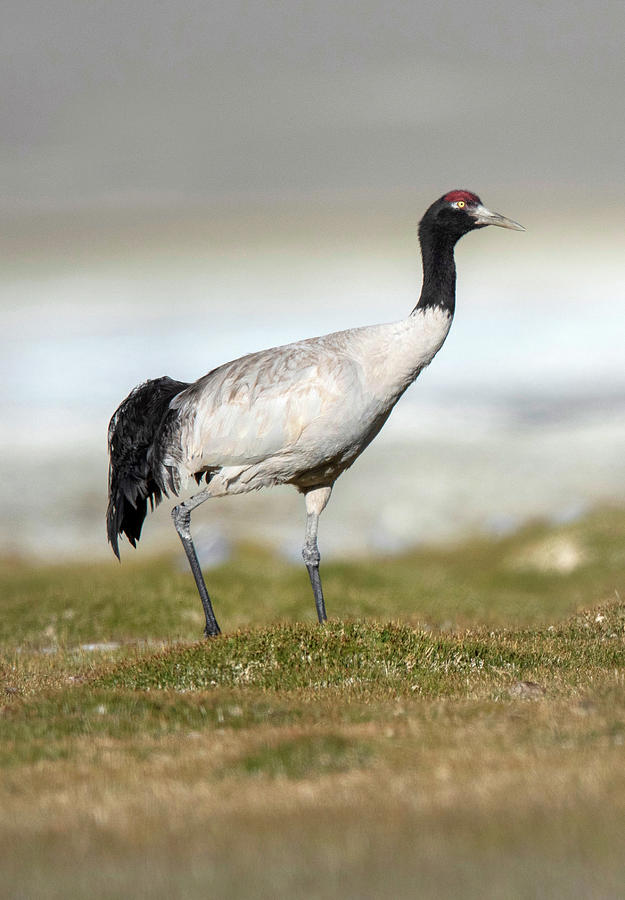
Black-necked Crane, Grus nigricollis, Ladakh Photograph by Yogesh Bhandarkar


Wednesday, August 4, 2021

THE RUFOUS- BELLIED EAGLE

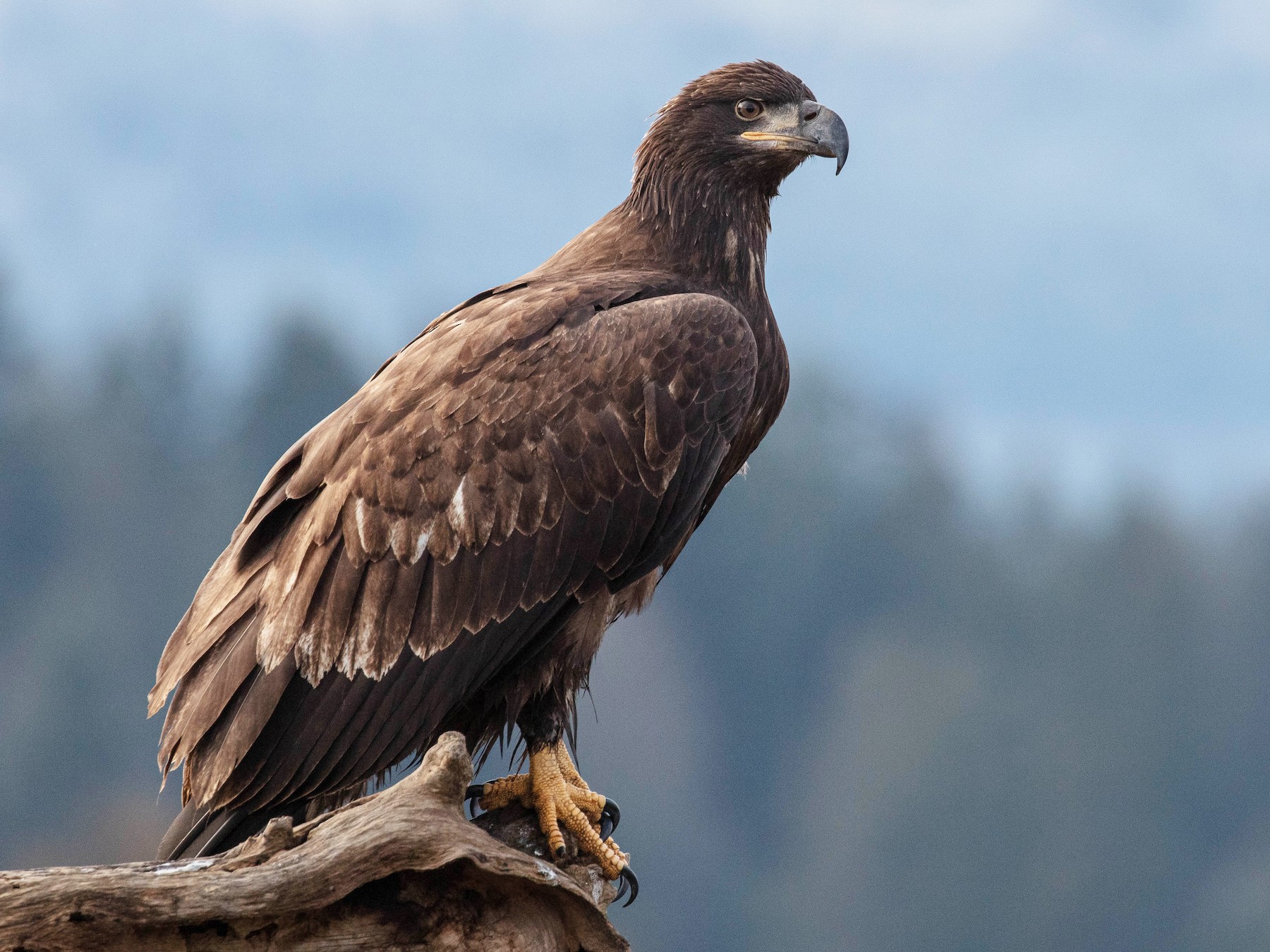
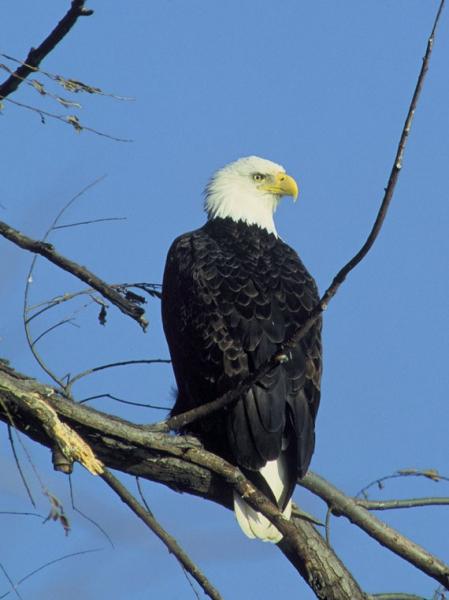
 Bald Eagle - eBird

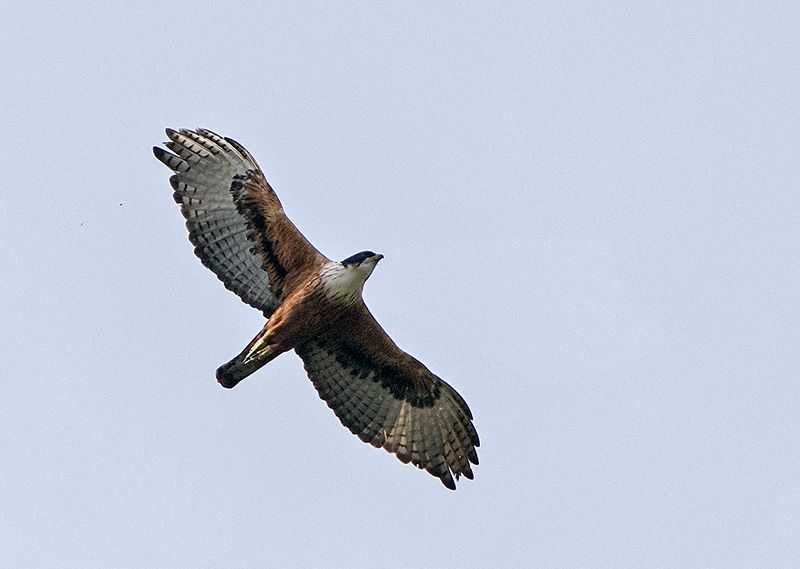
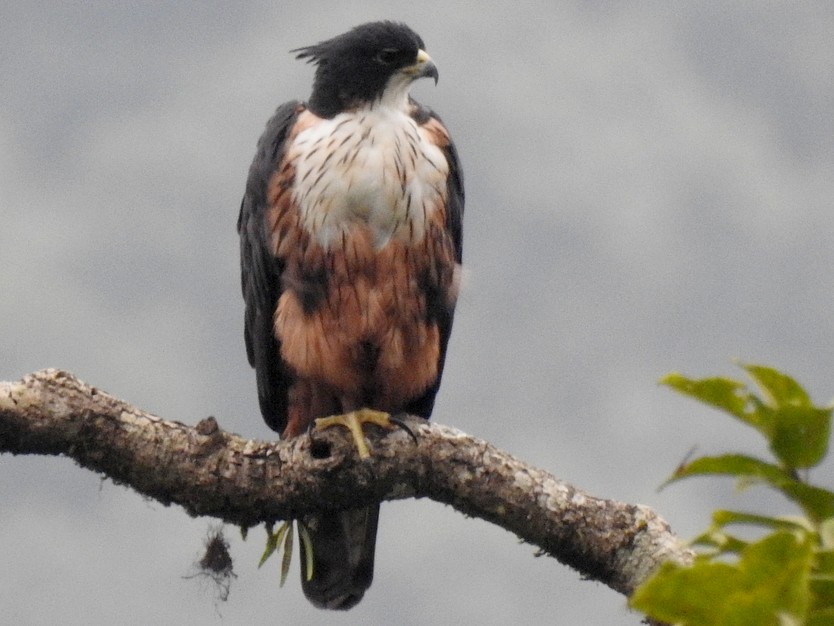
The rufous-bellied eagle or rufous-bellied hawk-eagle (Lophotriorchis kienerii) is a bird of prey in the family Accipitridae that is found in the forested regions of tropical Asia. Relatively small for eagles and contrastingly patterned like a falcon, this species was earlier placed in the genus Hieraaetus and sometimes also in the genus Aquila but thought to be distinctive enough to belong to a separate genus.

Taxonomy and systematics

A captive adult rufous-bellied eagle.

This eagle was originally described as Astur kienerii on the basis of a specimen from the Himalayas. It was later moved to Limnaetus by Jerdon, the genus Lophotriorchis and still later to Hieraaetus, the so-called "hawk-eagles".[5] A study of the phylogeny of some Hieraaetus species and other eagles indicated that they were nested within the Aquila clade of eagles, resulting in their repositioning. Another molecular study of the eagles suggested that kienerii was distinctive enough to be retained in a separate genus[4] for which the name Kienastur had been suggested[6] but as this occurred in a thesis it is invalid for taxonomic purposes, and in any case Lophotriorchis was proposed much earlier (though originally shared with the Black-and-chestnut eagle which is nowadays placed in Spizaetus).

Within its wide range, two subspecies are recognized although there is no marked plumage difference. The nominate kienerii of India and Sri Lanka (the northern birds are larger); and formosus described by Erwin Stresemann in 1924 which is widely distributed across Southeast Asia from Burma to Sulawesi.[7]

 Rufous-bellied Eagle - eBird India

Description

 The bald eagle, an American national symbol, is now also a successful  conservation story

Adult rufous-bellied eagles are distinctive in their pattern. They have a black hood with a short crest. Chestnut underparts and wing coverts contrast with the white on the throat and breast. The sexes are almost indistinguishable in plumage but females are slightly larger and have more black on the face. They perch in a very upright stance and the wingtip almost reaches the tail. The tarsus is fully feathered. Juveniles have very white underparts with dark markings on the sides of the body, head mask and edge of underwing coverts. They can appear similar to a booted eagle (Aquila pennata). In flight, the underwing lining is dark and the greater coverts are black. The flight feathers are thinly barred with a black edge. The tail is dark and barred.[8][9]


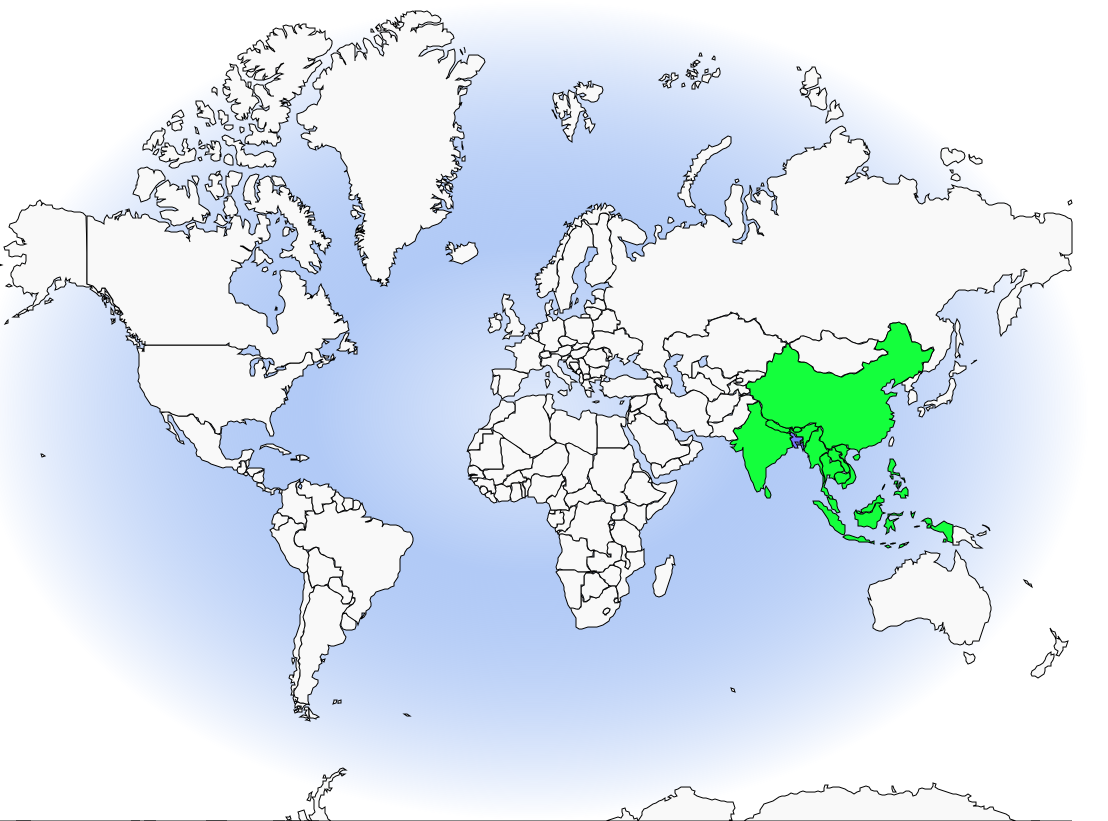
The rufous-bellied eagle is found in southern and south-eastern Asia and its range also extends to Sulawesi.

This species is associated mainly with hill forests. In India, they are commoner in the Western Ghats than along the Himalayas where they occur from Nepal to Assam. They also occur in parts of the Eastern Ghats.[10][11]

 Eagle pulled by the head! - Eagle Hawk nest 20 June 2017 Sidney B.C. -  YouTube

Behaviour and ecology

 Bald Eagle Guide - New York Natural Heritage Program


  Rufous-bellied eagles are usually seen in flight, soaring high over the forest canopy. They dive to capture prey that can include birds and mammals in the air, canopy, or forest floor. Birds the size of the Sri Lanka wood pigeon, Kalij pheasant and junglefowl have been recorded as prey.[12][13] The breeding season of the eagles is in winter with the young fledging in spring when the prey species are also breeding. The display flight involves stooping and wing-quivering. Their calls include a series of high pitched fwick, fwick... notes followed by a thin sweek!. They nest on a large, often bare tree,[14] building a large platform of dry sticks and branches that they break off.[8][15][16] The nest is lined with green leaves and a single egg is laid. Both parents take turns in incubation, feeding and nest defence.[9]


 Wahlberg's Eagle | Outdoor family photography, Outdoor photography, Family  outdoor


Distribution of Rufous-bellied eagle Hieraaetus kienerii in India.... |  Download Scientific Diagram 


Rufous-bellied Hawk-Eagle (Lophotriorchis kienerii) – Planet of Birds 


 Prunus ceylanica rufous-bellied eagle Archives | RoundGlass | Sustain 


 Rufous-bellied Eagle : Geographic range


 Bald eagle family in French Creek to get a new home – Saanich News