Sunday, August 31, 2014

MANATEES KNOWN AS SEA COWS

Manatees (family Trichechidae, genus Trichechus) are large, fully aquatic, mostly herbivorous marine mammals sometimes known as sea cows. There are three accepted living species of Trichechidae, representing three of the four living species in the order Sirenia: the Amazonian manatee (Trichechus inunguis), the West Indian manatee (Trichechus manatus), and the West African manatee (Trichechus senegalensis). They measure up to 13 feet (4.0 m) long, weigh as much as 1,300 pounds (590 kg),[1] and have paddle-like flippers. The name manatí comes from the Taíno, a pre-Columbian people of the Caribbean, meaning "breast".[2]

FL fig04.jpg

Taxonomy

Manatees comprise three of the four living species in the order Sirenia. The fourth is the Eastern Hemisphere's dugong. The Sirenia are thought to have evolved from four-legged land mammals over 60 million years ago, with the closest living relatives being the Proboscidea (elephants) and Hyracoidea (hyraxes).[3]
The Amazonian's hair color is brownish gray, and they have thick wrinkled skin often with coarse hair, or "whiskers". Photos are rare; although very little is known about this species, scientists think they are similar to West Indian manatees.

Description

A skeleton of a manatee and calf, on display at The Museum of Osteology, Oklahoma City, Oklahoma
Skull of a West Indian manatee on display at The Museum of Osteology, Oklahoma City, Oklahoma.
Manatees have a mass of 400 to 550 kilograms (880 to 1,210 lb), and mean length of 2.8 to 3.0 metres (9.2 to 9.8 ft), with maxima of 3.6 metres (12 ft) and 1,775 kilograms (3,913 lb) seen (the females tend to be larger and heavier). When born, baby manatees have an average mass of 30 kilograms (66 lb). They have a large, flexible, prehensile upper lip. They use the lip to gather food and eat, as well as using it for social interactions and communications. Manatees have shorter snouts than their fellow sirenians, the dugongs. Their small, widely spaced eyes have eyelids that close in a circular manner. The adults have no incisor or canine teeth, just a set of cheek teeth, which are not clearly differentiated into molars and premolars. These teeth are continuously replaced throughout life, with new teeth growing at the rear as older teeth fall out from farther forward in the mouth. This process is known as polyphyodonty and amongst the other mammals, only occurs in the kangaroo[4] and elephant.[5][6] At any given time, a manatee typically has no more than six teeth in each jaw of its mouth.[6] Its tail is paddle-shaped, and is the clearest visible difference between manatees and dugongs; a dugong tail is fluked, similar in shape to a that of a whale. Females have two teats, one under each flipper,[7] a characteristic that was used to make early links between the manatee and elephants.
Manatees are unusual amongst mammals in possessing just six cervical vertebrae,[8] which may be due to mutations in the homeotic genes.[9] All other mammals have seven cervical vertebrae,[10] other than the two-toed and three-toed sloths.
Like horses, they have a simple stomach, but a large cecum, in which they can digest tough plant matter. In general, their intestines have a typical length of about 45 meters, which is unusually long for animals of their size.[11] Manatees produce enormous amounts of gas, which contributes to their barrel-shape, to aid in the digestion of their food.[12]
Manatees are the only animal known to have a vascularized cornea.[13]

Behavior

Apart from mothers with their young, or males following a receptive female, manatees are generally solitary animals.[6] Manatees spend approximately 50% of the day sleeping submerged, surfacing for air regularly at intervals of less than 20 minutes. The remainder of the time is mostly spent grazing in shallow waters at depths of 1–2 metres (3.3–6.6 ft). The Florida subspecies (T. m. latirostris) has been known to live up to 60 years.

Locomotion

Generally, manatees swim at about 5 to 8 kilometres per hour (3 to 5 mph). However, they have been known to swim at up to 30 kilometres per hour (20 mph) in short bursts.

Intelligence and learning

Manatee postures in captivity.
Manatees are capable of understanding discrimination tasks and show signs of complex associative learning. They also have good long-term memory.[14] They demonstrate discrimination and task-learning abilities similar to dolphins and pinnipeds in acoustic and visual studies.[15]

Reproduction

Manatees typically breed once every two years; generally only a single calf is born. Gestation lasts about 12 months and a further 12 to 18 months to wean the calf.[6]

Communication

Manatees emit a wide range of sounds used in communication, especially between cows and their calves. Adults communicate to maintain contact and during sexual and play behaviors. Taste and smell, in addition to sight, sound, and touch, may also be forms of communication.[citation needed]

Diet

Manatees are herbivores and eat over 60 different freshwater ( e.g. floating hyacinth, pickerel weed, alligator weed, water lettuce, hydrilla, water celery, musk grass, mangrove leaves) and saltwater plants (e.g. sea grasses, shoal grass, manatee grass, turtle grass, widgeon grass, sea clover, and marine algae). Using their divided upper lip, an adult manatee will commonly eat up to 10%-15% of their body weight (about 50 kg) per day. Consuming such an amount requires the manatee to graze for up to seven hours a day.[16] Manatees have been known to eat small amounts of fish from nets.[17]

Feeding behavior

Manatee plate
Manatees use their flippers to "walk" along the bottom whilst they dig for plants and roots in the substrate. When plants are detected, the flippers are used to scoop the vegetation toward the manatee's lips. The manatee has prehensile lips; the upper lip pad is split into left and right sides which can move independently. The lips use seven muscles to manipulate and tear at plants. Manatees use their lips and front flippers to move the plants into the mouth. The manatee does not have front teeth, however, behind the lips, on the roof of the mouth, there are dense, ridged pads. These horny ridges, and the manatee's lower jaw, tear through ingested plant material.[16]

Dentition

Manatees have four rows of teeth. There are 6 to 8 high-crowned, open-rooted molars located along each side of the upper and lower jaw giving a total of 24 to 32 flat, rough-textured teeth. Eating gritty vegetation abrades the teeth, particularly the enamel crown, however, research indicates that the enamel structure in manatee molars is weak. To compensate for this, manatee teeth are continually replaced. When anterior molars wear down, they are shed. Posterior molars erupt at the back of the row and slowly move forward to replace these like enamel crowns on a conveyor belt. This process continues throughout the manatee's lifetime. The rate at which the teeth migrate forward depends on how quickly the anterior teeth abrade. Some studies indicate that the rate is about 1 cm/month although other studies indicate 0.1 cm/month.[16] This process of teeth being continually replaced is known as polyphyodonty and amongst other mammals, only occurs in elephants and kangaroos.

Ecology

Range and habitat

Map drawing showing range of three manatee populations
Approximate distribution of Trichechus; T. manatus in green; T. inunguis in red; T. senegalenis in orange
Manatees inhabit the shallow, marshy coastal areas and rivers of the Caribbean Sea and the Gulf of Mexico (T. manatus, West Indian manatee), the Amazon Basin (T. inunguis, Amazonian manatee), and West Africa (T. senegalensis, West African manatee).[18]
West Indian manatees prefer warmer temperatures and are known to congregate in shallow waters. They frequently migrate through brackish water estuaries to freshwater springs. They cannot survive below 15 °C (60 °F). Their natural source for warmth during winter is warm, spring-fed rivers.
Underwater photo of three manatees swimming along bottom
A group of three manatees

West Indian

The coast of the state of Georgia is usually the northernmost range of the West Indian manatees because their low metabolic rate does not protect them in cold water. Prolonged exposure to water temperatures below 68 °F (20 °C) can bring about "cold stress syndrome" and death.[19]
Florida manatees can move freely between salinity extremes.
Manatees have been seen as far north as Cape Cod, and in 2006, one was seen in New York City and Rhode Island's Narragansett Bay, as cited in The Boston Globe. According to Memphis, Tennessee's The Commercial Appeal newspaper, one manatee was spotted in the Wolf River harbor near the Mississippi River in downtown Memphis on October 23, 2006, though it was later found dead 10 miles downriver in McKellar Lake.[citation needed]
The West Indian manatee migrates into Florida rivers, such as the Crystal, the Homosassa, and the Chassahowitzka Rivers. The headsprings of these rivers maintain a 22 °C (72 °F) temperature all year. During November to March, about 400 West Indian manatees (according to the National Wildlife Refuge) congregate in the rivers in Citrus County, Florida.[citation needed]
During winter, manatees often congregate near the warm-water outflows of power plants along the coast of Florida instead of migrating south as they once did. Some conservations are concerned these manatees have become too reliant on these artificially warmed areas.[20] The U.S. Fish and Wildlife Service is trying to find a new way to heat the water for manatees that are dependent on plants that have closed. The main water treatment plant in Guyana has four manatees that keep storage canals clear of weeds; there are also some in the ponds of the National Park in Georgetown, Guyana.
Studies suggest Florida manatees must have some access to fresh water for proper regulation of water and salts within their bodies.
Accurate population estimates of the Florida manatee (T. manatus) are difficult. They have been called scientifically weak[21] due to widely varying counts from year to year, some areas showing increases, others decreases and little strong evidence of increases except in two areas. Manatee counts are highly variable without an accurate way to estimate numbers: In Florida in 1996, a winter survey found 2,639 manatees, in 1997, a January survey found 2,229, and a February survey found 1,706.[15] A statewide synoptic survey in January 2010 found 5,067 manatees living in Florida, which was a new record count.[22]
Population viability studies conducted in 1997 found that decreasing adult survival and eventual extinction is a probable future outcome for Florida manatees, without additional protection.[23]
Fossil remains of Florida manatee ancestors date back about 45 million years.[citation needed]

Amazonian

The freshwater Amazonian manatee (T. inunguis) inhabits the Amazon River and its tributaries, and never ventures into salt water.

West African

They are found in coastal marine and estuarine habitats, and in freshwater river systems along the west coast of Africa from the Senegal River south to the Kwanza River in Angola. They live as far upriver on the Niger River as Gao, Mali.[citation needed]

Predation

Overall, predation does not present a significant threat to the survival of any manatee species.

Relation to humans

Photo of manatee next to kayak
Young manatees can be curious; this individual is inspecting a kayak
Profile photo of out-of-water manatee
Antillean manatee

Threats

The main causes of death for manatees are human-related issues, such as habitat destruction and human objects. Natural causes of death include adverse temperatures and disease.

Ship strikes

Their slow-moving, curious nature, coupled with dense coastal development, has led to many violent collisions with propeller-driven boats and ships, leading frequently to maiming, disfigurement, and even death. As a result, a large proportion of manatees exhibit spiral cutting propeller scars on their backs, usually caused by larger vessels that do not have skegs in front of the propellers like the smaller outboard and inboard-outboard recreational boats have. They are now even identified by humans based on their scar patterns. Many manatees have been cut in half by large vessels like ships and tug boats, even in the highly populated lower St. Johns River's narrow channels. Some are concerned that the current situation is inhumane, with upwards of 50 scars and disfigurements from vessel strikes on a single manatee.[24] Often, the cuts lead to infections, which can prove fatal. Internal injuries stemming from being trapped between hulls and docks and impacts have also been fatal.
Manatees hear on a higher frequency than would be expected for such large marine mammals. Many large boats emit very low frequencies, which confuse the manatee and explain their lack of awareness around boats. The Lloyd's mirror effect results in low frequency propeller sounds not being discernible near the surface, where most accidents occur. Research indicates that when a boat has a higher frequency the manatees rapidly swim away from danger.[25]
In 2003, a population model was released by the United States Geological Survey that predicted an extremely grave situation confronting the manatee in both the Southwest and Atlantic regions where the vast majority of manatees are found. It states,
"In the absence of any new management action, that is, if boat mortality rates continue to increase at the rates observed since 1992, the situation in the Atlantic and Southwest regions is dire, with no chance of meeting recovery criteria within 100 years."[26]
"Hurricanes, cold stress, red tide poisoning and a variety of other maladies threaten manatees, but by far their greatest danger is from watercraft strikes, which account for about a quarter of Florida manatee deaths," said study curator John Jett.[27]
According to marine mammal veterinarians:
"The severity of mutilations for some of these individuals can be astounding – including long term survivors with completely severed tails, major tail mutilations, and multiple disfiguring dorsal lacerations. These injuries not only cause gruesome wounds, but may also impact population processes by reducing calf production (and survival) in wounded females – observations also speak to the likely pain and suffering endured".[15] In an example, they cited one case study of a small calf "with a severe dorsal mutilation trailing a decomposing piece of dermis and muscle as it continued to accompany and nurse from its mother...by age 2 its dorsum was grossly deformed and included a large protruding rib fragment visible."[15]
These veterinarians go on to state:
"the overwhelming documentation of gruesome wounding of manatees leaves no room for denial. Minimization of this injury is explicit in the Recovery Plan, several state statutes, and federal laws, and implicit in our society's ethical and moral standards."[15]
In 2009, of the 429 Florida manatees recorded dead, 97 were killed by commercial and recreational vessels, which broke the earlier record number of 95 set in 2002.[28][29]

Red tide

Another cause of manatee deaths is the red tide, a term used for the proliferation, or "blooms", of the microscopic marine algae of the species Karenia brevis, a member of the dinoflagellates that produces brevetoxins that can have toxic effects on the central nervous systems of creatures in the area of the algae bloom.[30]
In 1996, a red tide was responsible for 151 manatee deaths.[31] The epidemic began on March 5 and continued through April 28, wiping out approximately 15% of the known population of manatees along South Florida's western coast.[32] In 1982, another outbreak resulted in 37 deaths,[33] and in 2005, 44 more deaths were attributed to the blooms.

Additional threats

Manatees occasionally ingest fishing gear (hooks, metal weights, etc.) while feeding. These foreign materials do not appear to harm manatees, except for monofilament line or string, which can clog a manatee's digestive system and slowly kill it.
Manatees can also be crushed in water control structures (navigation locks, floodgates, etc.), drown in pipes and culverts, and are occasionally killed by entanglement in fishing gear, primarily crab pot float lines.
While humans are allowed to swim with manatees in one area of Florida,[34] there have been numerous charges of people harassing and disturbing the manatees.[35]
The African manatee's only significant threats are due to poaching, habitat loss, and other environmental impacts.[citation needed] They occasionally get stranded as the river dries up at the end of rainy season.

Conservation

All three species of manatee are listed by the World Conservation Union as vulnerable to extinction.
It is illegal under federal and Florida law to injure or harm a manatee. They are classified as "endangered" by both the state and the federal governments.
The MV Freedom Star and MV Liberty Star, ships used by NASA to tow space shuttle solid rocket boosters back to Kennedy Space Center, are propelled only by water jets to protect the endangered manatee population that inhabits regions of the Banana River where the ships are based.
Brazil outlawed hunting in 1973 in an effort to preserve the species. Deaths by boat strikes are still common.

Hunting

Underwater profile photo of light-colored animal with small flippers
Trichechus sp.
Manatees were traditionally hunted by indigenous Caribbean people. When Christopher Columbus arrived in the region, hunting was already an established trade, although this is less common today.[36]
The primary hunting method was for the hunter to approach in a dugout canoe, offering bait to attract it close enough to temporarily stun it with a blow near the head from an oar-like pole. Many times the creature would flip over, leaving it vulnerable to further attacks.
From manatee hides, Native Americans made war shields, canoes, and shoes, though manatees were predominantly hunted for their abundant meat.
Later, manatees were hunted for their bones, which were used to make "special potions". Until the 1800s, museums paid as much as $100 for bones or hides. Though hunting was banned in 1893, poaching continues today.

Captivity

Underwater photo of manatee
A manatee at SeaWorld, Florida
The oldest manatee in captivity is Snooty, at the South Florida Museum's Parker Manatee Aquarium in Bradenton, Florida. Born at the Miami Aquarium and Tackle Company on July 21, 1948 (age 65), Snooty was one of the first recorded captive manatee births. Raised entirely in captivity, Snooty will never be released into the wild. So he is the only manatee at the Aquarium, and one of a select few captive manatees in the United States, that is allowed to interact with human handlers. This makes him uniquely suitable to manatee research and education.[37]
Manatees can also be viewed in a number of European zoos, such as the Tierpark in Berlin, the Nuremberg Zoo, in ZooParc de Beauval in France and in the Aquarium of Genoa in Italy. The River Safari at Singapore features seven of them.[38] They are also included in the plans for a new National Wildlife Conservation Park in Bristol, England, whose first exhibit is due to open in summer 2013[39] with the manatees as an addition as early as 2015.[40]

Culture

The manatee has been linked to folklore on mermaids. Native Americans ground the bones to treat asthma and earache. In West African folklore, they were considered sacred and thought to have been once human. Killing one was taboo and required penance.[41]

Monday, August 25, 2014

THE SERVAL CATS

The serval /ˈsɜrvəl/ (Leptailurus serval) is a medium-sized African wild cat. DNA studies have shown that the serval is closely related to the African golden cat and the caracal.[3]


Leptailurus serval -Serengeti National Park, Tanzania-8.jpg

Description


Serval in Tanzania
The serval is a medium-sized cat, measuring 59 to 92 cm (23 to 36 in) in head-body length, with a relatively short, 20 to 45 cm (7.9 to 17.7 in) tail, and a shoulder height of about 54 to 66 cm (21 to 26 in).[4] Weight ranges from about 7 to 12 kg (15 to 26 lb) in females, and from 9 to 18 kg (20 to 40 lb) in males.[5]
It is a strong yet slender animal, with long legs and a fairly short tail. Due to its leg length, it is relatively one of the tallest cats. The head is small in relation to the body, and the tall, oval ears are set close together. The pattern of the fur is variable. Usually, the serval is boldly spotted black on tawny, with two or four stripes from the top of the head down the neck and back, transitioning into spots. The "servaline" form has much smaller, freckled spots, and was once thought to be a separate species. The backs of the ears are black with a distinctive white bar. In addition, melanistic servals are quite common in some parts of the range, giving a similar appearance to the "black panther" (melanistic leopard).[5]
White servals have never been documented in the wild and only five have been documented in captivity. One was born and died at the age of two weeks in Canada in the early 1990s. Three males were born at Big Cat Rescue in Tampa, Florida in 1997 (Kongo and Tonga) and 1999 (Pharaoh).[6][7][8] Another is owned by a family living in Regina, Saskatchewan, Canada.[9]

White serval at Big Cat Rescue
Servals have the longest legs of any cat, relative to their body size. Most of this increase in length is due to the greatly elongated metatarsal bones in the feet. The toes are also elongated, and unusually mobile, helping the animal to capture partially concealed prey. Another distinctive feature of the serval is the presence of large ears and auditory bullae in the skull, indicating a particularly acute sense of hearing.[5]

Distribution and habitat

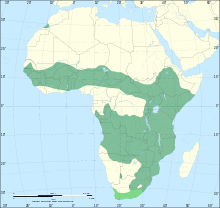
The serval is native to Africa, where it is widely distributed south of the Sahara. It was once also found in Tunisia, and Algeria,[5] but may have been extirpated from Algeria and remains in Tunisia only because of a reintroduction program.[2] The serval became extinct in the Cape provinces of South Africa over the last century mainly due to habitat loss, hunting and poaching. However private game reserves in the Eastern Cape have begun re-introducing the species in the hopes of contributing to the eventual re-establishment of these wild cats in the region.[citation needed] In 2013, the serval was spotted and photographed in the Middle Atlas mountain region of Morocco.[10]
Its main habitat is the savanna, although melanistic individuals are more usually found in mountainous areas at elevations up to 3,000 metres (9,800 ft). The serval needs watercourses within its territory, so it does not live in semi-deserts or dry steppes. Servals also avoid dense equatorial jungles, although they may be found along forest fringes. They are able to climb and swim, but seldom do so.[5]

Subspecies

Nineteen subspecies were recognized in Mammal Species of the World,[1] but some authorities treat several of these as synonyms (a few have even treated the serval as monotypic).[11]
  • Leptailurus serval serval, Cape Province;
  • Leptailurus serval beirae, Mozambique;
  • Leptailurus serval brachyurus, West Africa, Sahel to Ethiopia;
  • Leptailurus serval constantinus, Algeria, Morocco and Tunisia;
  • Leptailurus serval faradjius;
  • Leptailurus serval ferrarii;
  • Leptailurus serval hamiltoni, eastern Transvaal;
  • Leptailurus serval hindei, Tanzania;
  • Leptailurus serval kempi, Uganda;
  • Leptailurus serval kivuensis, Congo;
  • Leptailurus serval lipostictus, northern Angola;
  • Leptailurus serval lonnbergi, southern Angola;
  • Leptailurus serval mababiensis, northern Botswana;
  • Leptailurus serval pantastictus;
  • Leptailurus serval phillipsi;
  • Leptailurus serval pococki;
  • Leptailurus serval robertsi, western Transvaal;
  • Leptailurus serval tanae, Ethiopia, Eritrea and Somalia;
  • Leptailurus serval togoensis, Togo and Benin.

Hunting and diet


A serval from the Sabi Sands area of South Africa: Note the large ears adapted for hearing small prey.
The serval is nocturnal, so hunts mostly at night, unless disturbed by human activity or the presence of larger nocturnal predators. Although it is specialized for hunting rodents, it is an opportunistic predator whose diet also includes birds, hares, hyraxes, reptiles, insects, fish, and frogs.[12] Over 90% of the serval's prey weighs less than 200 g (7 oz).[13] The serval eats very quickly, sometimes too quickly, causing it to gag and regurgitate due to clogging in the throat.[citation needed] Small prey are devoured whole. With larger prey, small bones are consumed, but organs and intestines are avoided along with fur, feathers, beaks, feet or hooves. The serval uses an effective plucking technique in which it repeatedly tosses captured birds in the air while simultaneously thrashing its head from side-to-side, removing mouthfuls of feathers, which it discards.[citation needed]
As part of its adaptations for hunting in the savannas, the serval boasts long legs (the longest of all cats, relative to body size) for jumping, which also help it achieve a top speed of 80 km/h (50 mph),[citation needed] and has large ears with acute hearing. Its long legs and neck allow the serval to see over tall grasses, while its ears are used to detect prey, even those burrowing underground. They have been known to dig into burrows in search of underground prey, and to leap 2 to 3 m (7 to 10 ft) into the air to grab birds in flight.[5] While hunting, the serval may pause for up to 15 minutes at a time to listen with eyes closed. Its pounce is a distinctive and precise vertical 'hop', which may be an adaptation for capturing flushed birds.[14] It is able to leap up to 3.6 m (12 ft) horizontally from a stationary position, landing precisely on target with sufficient force to stun or kill its prey upon impact.[5] The serval is an efficient killer, catching prey on an average of 50% of attempts, compared to an average of 38% for leopards and 30% for lions.[citation needed]
The serval is extremely intelligent, and demonstrates remarkable problem-solving ability,[citation needed] making it notorious for getting into mischief,[citation needed] as well as easily outwitting its prey, and eluding other predators. The serval often plays with its captured prey for several minutes before consuming it. In most situations, it ferociously defends its food against attempted theft by others. Males can be more aggressive than females.

Behavior


A serval viewed from behind: Note the white markings on the ears (ocelli) used to signal kittens when hunting.
Like most cats, the serval is a solitary, nocturnal animal. It is known to travel as much as 3 to 4 km (1.9 to 2.5 mi) each night in search of food. The female defends home ranges of 9.5 to 19.8 km2 (3.7 to 7.6 sq mi), depending on local prey availability, while the male defends larger territories of 11.6 to 31.5 km2 (4.5 to 12.2 sq mi), and marks its territory by spraying urine onto prominent objects such as bushes, or, less frequently, by scraping fresh urine into the ground with its claws. Threat displays between hostile servals are often highly exaggerated, with the animals flattening their ears and arching their backs, baring their teeth, and nodding their heads vigorously. In direct confrontation, they lash out with their long fore legs and make sharp barking sounds and loud growls.[5]
Like many cats, the serval is able to purr.[15] It also has a high-pitched chirp, and can hiss, cackle, growl, grunt, and meow.[5]

Reproduction and life history

Oestrus in the serval lasts for up to four days, and is typically timed so the kittens are born shortly before the peak breeding period of local rodent populations. A serval is able to give birth to multiple litters throughout the year, but commonly does so only if the earlier litters die shortly after birth. Gestation lasts from 66 to 77 days and commonly results in the birth of two kittens, although sometimes as few as one or as many as four have been recorded.[5]
The kittens are born in dense vegetation or sheltered locations such as abandoned aardvark burrows. If such an ideal location is not available, a place beneath a shrub may be sufficient. The kittens weigh around 250 g (8.8 oz) at birth, and are initially blind and helpless, with a coat of greyish woolly hair. They open their eyes at 9 to 13 days of age, and begin to take solid food after around a month. At around six months, they acquire their permanent canine teeth and begin to hunt for themselves; they leave their mother at about 12 months of age. They may reach sexual maturity from 12 to 25 months of age.[5]
Life expectancy is about 10 years in the wild, and up to 20 years in captivity.[16] The longest recorded life of an African serval in the wild is 23 years of age. In captivity, average lifespan is 22.4 years.[17]

Serval range IUCN.svg 


Conservation


Servals have dwindled in numbers due to human population taking over their habitat and hunting them for their pelts. The serval is sometimes preyed upon by the leopard and other large cats. It is listed in CITES Appendix 2, indicating it is "not necessarily now threatened with extinction, but that may become so unless trade is closely controlled."[18] It is still common—locally even expanding—in much of sub-Saharan Africa,[2] but is extinct in the Cape Province in South Africa. Private game reserves in the Eastern Cape have begun reintroducing the species in the hopes of contributing to the eventual re-establishment of these wild cats in the region. North of the Sahara, it occurs in only Morocco and Algeria, but has now possibly disappeared from the latter country[2] and the subspecies from this region (L. s. constantina) is considered endangered under the US Endangered Species Act.[19] It formerly occurred naturally in Tunisia, but now only through a reintroduction program based on servals from East Africa.[2]

Heraldry and literature

The serval (Italian gattopardo) was the symbol of the Tomasi family, princes of Lampedusa, whose best-known member was Giuseppe Tomasi di Lampedusa, author of one of the most famous Italian novels of the 20th century, Il Gattopardo. Opération Serval, a 2013 French military operation in the Northern Mali conflict, was named after the African cat.

THE GREVY' S ZEBRAS

The Grévy's zebra (Equus grevyi), also known as the imperial zebra, is the largest extant wild equid and the largest and most endangered of the three species of zebra, the other two being the plains zebra and the mountain zebra. Named after Jules Grévy, it is the sole extant member of the subgenus Dolichohippus. The Grévy's zebra is found in Kenya and Ethiopia. Compared with other zebras, it is tall, has large ears, and its stripes are narrower.
The Grévy's zebra lives in semi-arid grasslands where it feeds on grasses, legumes, and browse; it can survive up to five days without water. It differs from the other zebra species in that it does not live in harems and has few long-lasting social bonds. Male territoriality and mother–foal relationships form the basis of the social system of the Grévy's zebra. This zebra is considered to be endangered. Its population has declined from 15,000 to 3,000 since the 1970s. However, as of 2008 the population is stable.

Grevy's Zebra Stallion.jpg

Taxonomy and naming

The Grévy's zebra was first described by French naturalist Émile Oustalet in 1882. He named it after Jules Grévy, then president of France, who, in the 1880s, was given one by the government of Abyssinia. Traditionally, this species was classified in the subgenus Dolichohippus with plains zebra and mountain zebra in Hippotigris. Fossils of zebra-like equids have been found throughout Africa and Asia in the Pliocene and Pleistocene deposits.[3] Notable examples include E. sanmeniensis from China, E. cautleyi from India, E. valeriani from central Asia and E. oldowayensis from East Africa.[3] The latter, in particular is very similar to the Grévy's zebra and may have been its ancestor.[3] The modern Grévy's zebra arose in the early Pleistocene.[3] Zebras appear to be a monophyletic linage[4][5][6] and recent (2013) phylogenies have placed Grevy's zebra in a sister taxon with the plains zebra.[4] In areas where Grévy's zebras are sympatric with plains zebras, the two may gather in same herds[7] and fertile hybrids do occur.[8]

Description

Detail of head
From left to right: a cranium, a complete skeleton, a left forefoot frontal, and a left forefoot lateral from a Grévy's zebra.
The Grévy's zebra is the largest of all wild equines. It is 2.5–3 m (8–9.8 ft) from head to tail with a 38–75 cm (15–30 in) tail, and stands 1.45–1.60 m (4'7"–5'3"; 13 to 16 hands) high at the shoulder. These zebras weigh 350–450 kg (770–990 lb).[7][9] Grévy's zebra differs from the other two zebras in its more primitive characteristics.[10]:147 It is particularly mule-like in appearance; the head is large, long, and narrow with elongated nostril openings;[10]:147 the ears are very large, rounded, and conical and the neck is short but thick.[11] The zebra's muzzle is ash-grey to black in color with the lips having whiskers. The mane is tall and erect; juveniles have a mane that extends to the length of the back and shortens as they reach adulthood.[11]
As with all zebra species, the Grevy's zebra's pelage has a black and white striping pattern. The stripes are narrow and close-set, being broader on the neck, and they extend to the hooves.[11] The belly and the area around the base of the tail lack stripes which is unique to the Grevy's zebra. Foals are born with brown and white striping, with the brown stripes darkening as they grow older.[11] Embryological evidence has shown that the zebra's background color is dark and the white is an addition.[3] The stripes of the zebra may serve to make it look bigger than it actually is or disrupt its outline. It appears that a stationary zebra can be inconspicuous at night or in shade.[11] Experiments have suggested that the stripes polarize light in such a way that it discourages biting horse-flies in a manner not shown with other coat patterns.[12] Other studies suggest that when moving the stripes may confuse observers, such as mammalian predators and biting insects, via two visual illusions, the wagon wheel effect, where the perceived motion is inverted, and the barber pole illusion, where the perceived motion is in a wrong direction.[13]

Ecology and behavior

Zebra in dense brush
The Grévy’s zebra largely inhabits northern Kenya, with some isolated populations in Ethiopia.[10]:147[11] It was extirpated from Somalia and Djibouti and its status in South Sudan is uncertain.[2] It lives in Acacia-Commiphora bushlands and barren plains.[7] Ecologically, this species is intermediate between the arid-living African wild ass and the water-dependent plains zebra.[10]:147[7] Lactating females and non-territorial males use areas with green, short grass and medium, dense bush more often than non-lactating females and territorial males.[14]
Grévy's zebras rely on grasses, legumes, and browse for nutrition.[11] They commonly browse when grasses are not plentiful.[7][15] Their hindgut fermentation digestive system allows them to subsist on diets of lower nutritional quality than that necessary for ruminant herbivores. Grevy's zebras can survive up to five days without water, but will drink daily when it is plentiful.[16] They often migrate to better watered highlands during the dry season.[7] Females require significantly more water when they are lactating.[17] During droughts, the zebras will dig water holes and defend them.[7] Grévy's zebras are preyed on by lions, hyenas, wild dogs, cheetahs and leopards.[11] In addition, they are susceptible to various gastro-intestinal parasites, notably of the Trichostrongylus genus.[18]
Herd of zebras
Adult males mostly live in territories during the wet seasons but some may stay in them year round if there's enough water left.[7] Stallions that are unable to establish territories are free-ranging[10]:151 and are known as bachelors. Females, young and non-territorial males wander through large home ranges. The females will wander from territory to territory preferring the ones with the highest-quality food and water sources.[19] Up to nine males may compete for a female outside of a territory.[11]
Territorial stallions will tolerate other stallions who wander in their territory, however when an estrous female is present the territorial stallion keeps other males at bay.[7][10]:151 Non-territorial males may avoid territorial ones because of harassment.[14] When females are not around, a territorial stallion will seek the company of other stallions. The stallion shows his dominance with an arched neck and a high-stepping gait and the least dominant stallions submit by extending their tail, lowering their heads and nuzzling their superior's chest or groin.[10]:151 The call of the Grévy's zebra has been described as "something like a hippo's grunt combined with a donkey's wheeze".[7] To get rid of flies or parasites, they roll in dust, water or mud or, in the case of flies, twitch their skin. They also rub against trees, rocks and other objects to get rid of irritations like itchy skin, hair or parasites.[11] Although Grévy's zebras do not perform mutual grooming, they do sometimes rub against a conspecific.[11]

Reproduction

Zebra foal resting
Grévy's zebras can mate and give birth year-round, but most mating takes place in the early rainy seasons and births mostly take place in August or September after the long rains.[11] An estrous mare may visit though as many as four territories a day[19] and will mate with the stallions in them. Among territorial stallions, the most dominant ones control territories near water sources, which mostly attract mares with dependant foals,[20] while more subordinate stallions control territories away from water with greater amounts of vegetation, which mostly attract mares without dependant foals.[20]
Zebra mare near younger zebras
The resident stallions of territories will try to subdue the entering mares with dominance rituals and then continue with courtship and copulation.[7] Grévy's zebra stallions have large testicles and can ejaculate a large amount of semen to replace the sperm of other males.[19] This is a useful adaptation for a species whose females mate polyandrously. Bachelors or outside territorial stallions sometimes "sneak" copulation of mares in another stallion’s territory.[19] While female associations with individual males are brief and mating is promiscuous, females who have just given birth will reside with one male for long periods and mate exclusively with that male.[19] Lactating females are harassed by males more often than non-lactating ones and thus associating with one male and his territory provides an advantage as he will guard against other males.[21]
Gestation of the Grévy's zebra normally lasts 390 days,[11] with a single foal being born. A newborn zebra will follow anything that moves, so new mothers prevent other mares from approaching their foals while imprinting their own striping pattern, scent and vocalization on them.[11] Females with young foals may gather into small groups.[17] Mares may leave their foals in "kindergartens" while searching for water.[17] The foals will not hide, so they can be vulnerable to predators.[7] However, kindergartens tend to be protected by an adult, usually a territorial male.[17] A female with a foal stays with one dominant territorial male who has exclusive mating rights to her. While the foal will not likely be his, the stallion will look after it to ensure that the female stays in his territory.[22] To adapt to a semi-arid environment, Grévy's zebra foals have longer nursing intervals and wait until they are 3 months of age before they start drinking water.[17] Although foals became less dependant on their mothers after half a year, associations with them continue for up to three years.[7]

Relationship with humans

Drawing of the zebra given to Jules Grévy and kept at the Ménagerie du Jardin des Plantes in 1882
The Grévy's zebra was known to the Europeans in antiquity and was used by the Romans in circuses.[3] It was subsequently forgotten in the Western world for a thousand years.[3] In the seventeenth century, the king of Shoa (now central Ethiopia) exported two zebras; one to the Sultan of Turkey and another to the Dutch governor of Jakarta.[3] A century later in 1882, the government of Abyssinia sent one to French president Jules Grévy. It was at that time that the animal was recognized as its own species and named in Grévy’s honor.[3]

Status and conservation

Grevy's zebras in Samburu National Reserve
The Grévy's zebra is considered endangered.[2] Its population was estimated to be 15,000 in the 1970s and by the early 21st century the population was lower than 3,500, a 75% decline.[23]:11 It is estimated that there are less than 2,500 Grévy's zebras still living in the wild.[2] There are also an estimated 600 Grévy's zebras in captivity.[23]:20 Captive herds have been known to thrive, like at White Oak Conservation in Yulee, Florida, United States, where more than 70 foals have been born. There, research is underway in partnership with the Conservation Centers for Species Survival on semen collection and freezing and on artificial insemination.[24] The Grévy's zebra population trend is considered stable as of 2008.[2]
The Grévy's zebra is legally protected in Ethiopia. In Kenya it is protected by the hunting ban of 1977. In the past, Grévy's zebras were threatened mainly by hunting for their skins which fetched a high price on the world market. However hunting has declined and the main threat to the zebra is habitat loss and competition with livestock. Cattle gather around watering holes and the Grévy's zebras are fenced from those areas.[23]:17 Community-based conservation efforts have shown to the most effective in preserving Grévy's zebras and their habitat. Less than 0.5% of the range of the Grévy's zebra is in protected areas. In Ethiopia, the protected areas include Alledeghi Wildlife Reserve, Yabelo Wildlife Sanctuary, Borana Controlled Hunting Area and Chalbi Sanctuary. In Kenya, important protected areas include the Buffalo Springs, Samburu and Shaba National Reserves and the private and community land wildlife conservancies in Isiolo, Samburu and the Laikipia Plateau.[2]


 Grevy's Zebra area.png