A
camel is an
even-toed ungulate within the genus
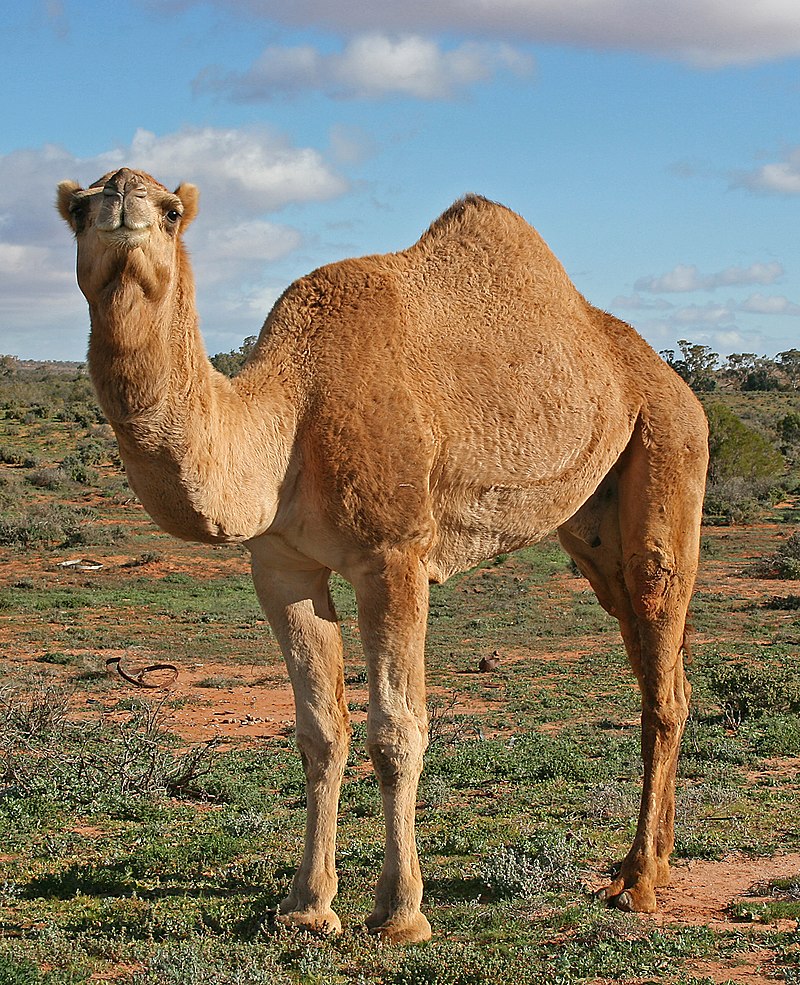
Camelus, bearing distinctive fatty deposits known as "humps" on its back. The three surviving species of camel are the
dromedary, or one-humped camel (
C. dromedarius), which inhabits the
Middle East and the
Horn of Africa; the
Bactrian, or two-humped camel (
C. bactrianus), which inhabits
Central Asia; and the critically endagered
wild Bactrian camel (
C. ferus) that has limited populations in remote areas of
northwest China and
Mongolia. Both the dromedary and the Bactrian camels have been domesticated; they provide
milk, meat,
hair for textiles or goods such as felted pouches, and are
working animals with tasks ranging from human transport to bearing loads.
The term
camel is derived via
Latin and
Greek (
camelus and κάμηλος
kamēlos respectively) from
Hebrew or
Phoenician gāmāl.
[3][4]
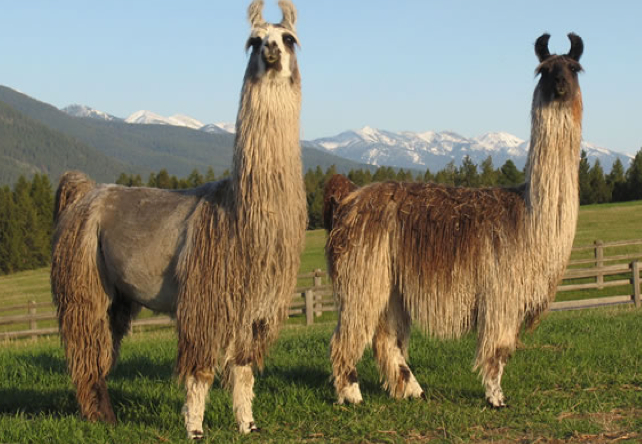
"Camel" is also used more broadly to describe any of the seven camel-like mammals in the family
Camelidae: the three true camels and the four New World camelids: the
llama,
alpaca,
guanaco, and
vicuña of South America.
[5][6]
Biology

The average
life expectancy of a camel is 40 to 50
years.
[7][8] A full-grown adult camel stands 1.85 m (6 ft 1 in) at the shoulder and 2.15 m (7 ft 1 in) at the hump.
[9] Camels can run at up to 65 km/h (40 mph) in short bursts and sustain speeds of up to 40 km/h (25 mph).
[10] Bactrian camels weigh 300 to 1,000 kg (660 to 2,200 lb) and dromedaries 300 to 600 kg (660 to 1,320 lb).
The male dromedary camel has in its throat an organ called a
dulla, a large, inflatable sac he extrudes from his mouth when in
rut to assert dominance and attract females. It resembles a long, swollen, pink tongue hanging out of the side of its mouth.
[11] Camels mate by having both male and female sitting on the ground, with the male mounting from behind.
[12] The male usually
ejaculates three or four times within a single mating session.
[13] Camelids are the only ungulates to mate in a sitting position.
[14]
Ecological and behavioral adaptations

Camels do not directly store water in their humps as was once
commonly believed. The humps are actually reservoirs of fatty tissue:
concentrating
body fat
in their humps minimizes the insulating effect fat would have if
distributed over the rest of their bodies, helping camels survive in hot
climates.
[15][16] When this tissue is metabolized, it yields more than one gram of water for every gram of fat processed. This
fat metabolization, while releasing energy, causes water to evaporate from the lungs during
respiration (as oxygen is required for the metabolic process): overall, there is a net decrease in water.
[17][18]
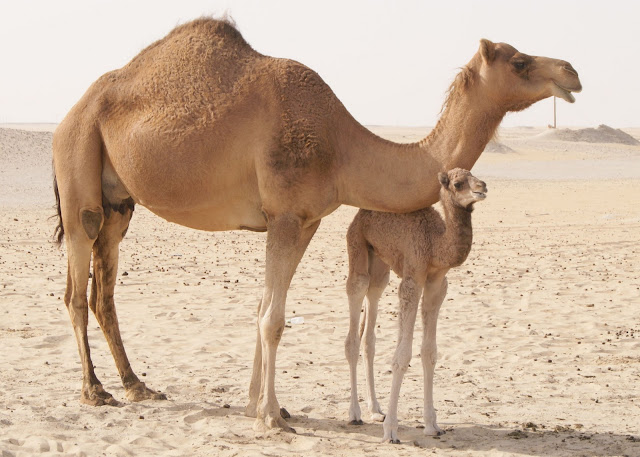
A camel's thick coat is one of its many adaptations that aid it in desert-like conditions.
Somalia has the world's largest population of camels.
[19]
Camels have a series of physiological adaptations that allow them to
withstand long periods of time without any external source of water.
[16] Unlike other mammals, their
red blood cells are oval rather than circular in shape. This facilitates the flow of red blood cells during dehydration
[20] and makes them better at withstanding high
osmotic
variation without rupturing when drinking large amounts of water: a
600 kg (1,300 lb) camel can drink 200 L (53 US gal) of water in three
minutes.
[21][22]
Camels are able to withstand changes in
body temperature
and water consumption that would kill most other animals. Their
temperature ranges from 34 °C (93 °F) at dawn and steadily increases to
40 °C (104 °F) by sunset, before they cool off at night again.
[16] Maintaining the brain temperature within certain limits is critical for animals; to assist this, camels have a
rete mirabile,
a complex of arteries and veins lying very close to each other which
utilizes countercurrent blood flow to cool blood flowing to the brain.
[23] Camels rarely sweat, even when ambient temperatures reach 49 °C (120 °F).
[7] Any sweat that does occur evaporates at the skin level rather than at the surface of their coat; the
heat of vaporization
therefore comes from body heat rather than ambient heat. Camels can
withstand losing 25% of their body weight to sweating, whereas most
other mammals can withstand only about 12–14% dehydration before
cardiac failure results from circulatory disturbance.
[22]
When the camel exhales,
water vapor becomes trapped in their
nostrils and is reabsorbed into the body as a means to conserve water.
[24]
Camels eating green herbage can ingest sufficient moisture in milder
conditions to maintain their bodies' hydrated state without the need for
drinking.
[25]
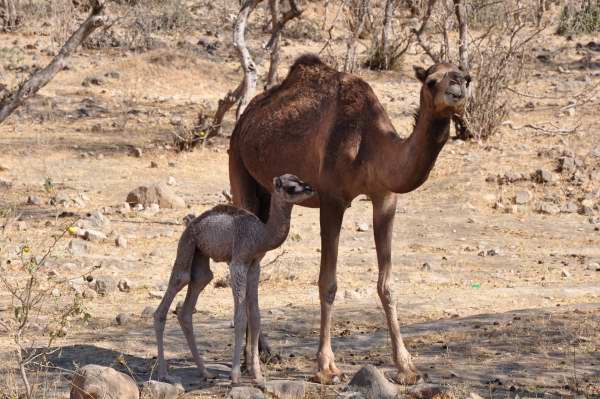
Domesticated camel calves lying in sternal recumbency, a position that aids heat loss
The camels' thick coats insulate them from the intense heat radiated
from desert sand; a shorn camel must sweat 50% more to avoid
overheating.
[26] During the summer the coat becomes lighter in color, reflecting light as well as helping avoid sunburn.
[22] The camel's long legs help by keeping its body farther from the ground, which can heat up to 70 °C (158 °F).
[27][28] Dromedaries have a pad of thick tissue over the
sternum called the
pedestal.
When the animal lies down in a sternal recumbent position, the pedestal
raises the body from the hot surface and allows cooling air to pass
under the body.
[23]
Camels' mouths have a thick leathery lining, allowing them to chew
thorny desert plants. Long eyelashes and ear hairs, together with
nostrils that can close, form a barrier against sand. If sand gets
lodged in their eyes, they can dislodge it using their
transparent third eyelid. The camels' gait and widened feet help them move without sinking into the sand.
[27][29][30]
The
kidneys and
intestines
of a camel are very efficient at reabsorbing water. Camel urine comes
out as a thick syrup, and camel feces are so dry that they do not
require drying when the
Bedouins use them to fuel fires.
[31][32][33][34]
Camels'
immune system differs from those of other mammals. Normally, the Y-shaped
antibody
molecules consist of two heavy (or long) chains along the length of the
Y, and two light (or short) chains at each tip of the Y. Camels, in
addition to these, also have antibodies made of only two heavy chains, a
trait that makes them smaller and more durable. These
"heavy-chain-only" antibodies, discovered in 1993, are thought to have
developed 50 million years ago, after camelids split from ruminants and
pigs.
[35]

Genetics
The
karyotypes of different camelid species have been studied earlier by many groups,
[36][37][38][39][40][41] but no agreement on chromosome nomenclature of camelids has been reached. A 2007 study
flow sorted
camel chromosomes, building on the fact that camels have 37 pairs of
chromosomes (2n=74), and found that the karyotime consisted of one
metacentric, three submetacentric, and 32 acrocentric autosomes. The
Y is a small metacentric chromosome, while the
X is a large metacentric chromosome.
[42]

The
hybrid camel,
a hybrid between Bactrian and dromedary camels, has one hump, though it
has an indentation 4–12 cm (1.6–4.7 in) deep that divides the front
from the back. The hybrid is 2.15 m (7 ft 1 in) at the shoulder and
2.32 m (7 ft 7 in) tall at the hump. It weighs an average of 650 kg
(1,430 lb) and can carry around 400 to 450 kg (880 to 990 lb), which is
more than either the dromedary or Bactrian can.
[43]
According to molecular data, the New World and Old World camelids diverged 11 million years ago.
[44] In spite of this, these species can still hybridize and produce fertile offspring.
[45] The
cama is a camel–llama hybrid bred by scientists who wanted to see how closely related the parent species were.
[46] Scientists
collected semen from a camel via an artificial vagina and inseminated a llama after stimulating ovulation with
gonadotrophin injections.
[47] The cama has ears halfway between the length of camel and llama ears, no hump, longer legs than the llama, and partially
cloven hooves.
[48][49] According to cama breeder Lulu Skidmore, cama have "the fleece of the llamas" and "the strength and patience of the camel".
[47] Like the
mule, camas are sterile, despite both parents having the same number of chromosomes.
[47]
Evolution
The earliest known camel, called
Protylopus, lived in North America 40 to 50 million years ago (during the
Eocene).
[13] It was about the size of a rabbit and lived in the open woodlands of what is now
South Dakota.
[50][51] By 35 million years ago, the
Poebrotherium was the size of a goat and had many more traits similar to camels and llamas.
[52][53] The hoofed
Stenomylus, which walked on the tips of its toes, also existed around this time, and the long-necked
Aepycamelus evolved in the
Miocene.
[54]
The direct ancestor of all modern camels,
Procamelus, existed in the upper Miocene and lower Pliocene.
[55] Around 3–5 million years ago, the North American Camelidae spread to South America via the
Isthmus of Panama, where they gave rise to
guanacos and related animals, and to Asia via the
Bering land bridge.
[13][50][51] Surprising finds of fossil
Paracamelus on
Ellesmere Island
beginning in 2006 in the high Canadian Arctic indicate the dromedary is
descended from a larger, boreal browser whose hump may have evolved as
an adaptation in a cold climate.
[56][57] This creature is estimated to have stood around nine feet tall.
[58]
The last camel native to North America was
Camelops hesternus, which vanished along with
horses,
short-faced bears,
mammoths and
mastodons,
ground sloths,
sabertooth cats, and many other megafauna, coinciding with the migration of humans from Asia.
[59][60]
Domestication
Camels are used as draft animals in
Pakistan.
Like the horse, before their extinction in their native land, camels
spread across the Bering land bridge, moving the opposite direction from
the Asian immigration to America, to survive in the Old World and
eventually be domesticated and spread globally by humans. Most camels
surviving today are domesticated.
[34][61] Along with many other megafauna in North America, the original wild camels were wiped out during the spread of
Native Americans from Asia into North America, 12,000 to 10,000 years ago.
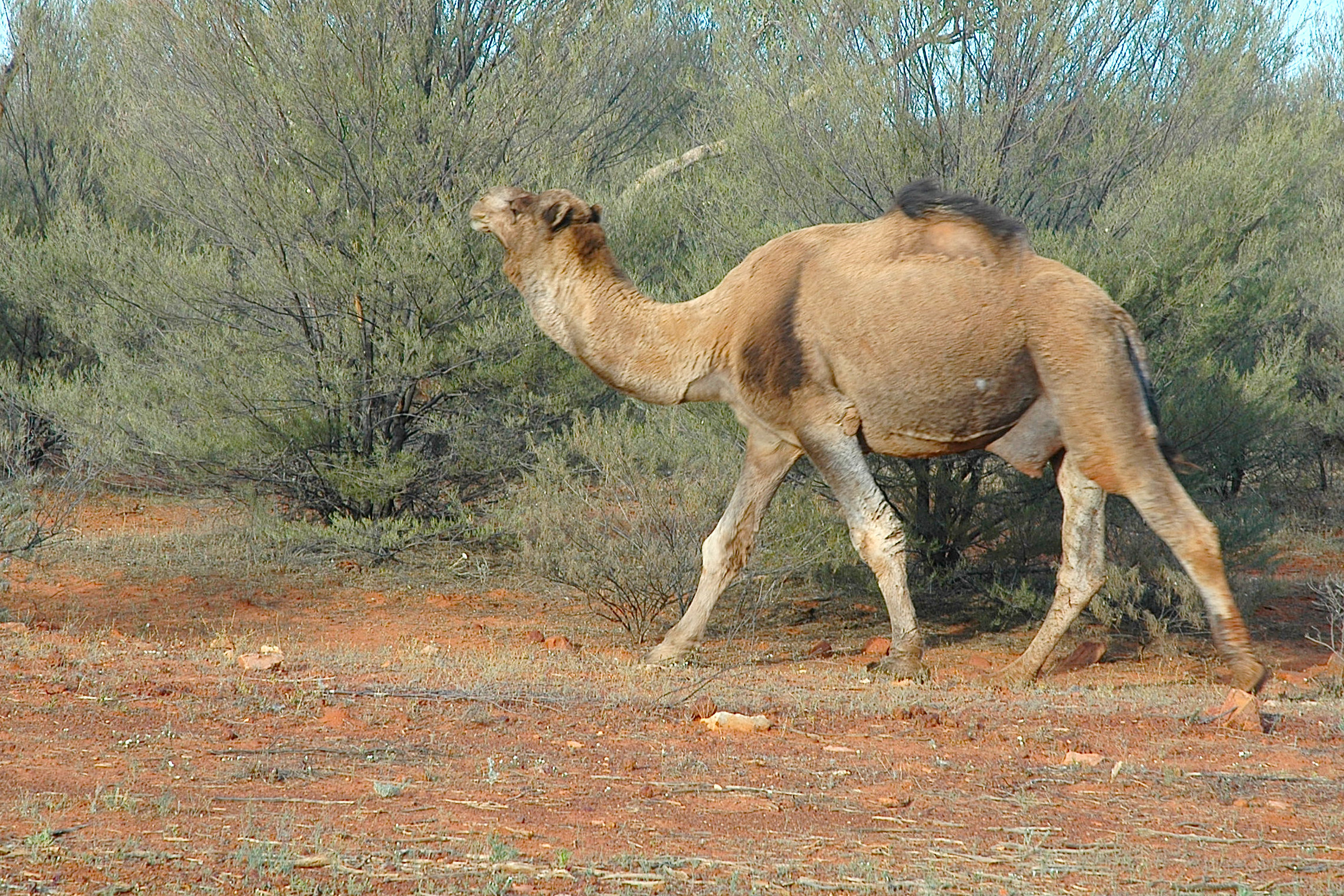
[59][60] Although feral populations exist in Australia, India and Kazakhstan, the only wild camels left are the
wild Bactrian camels of the
Gobi Desert.
[8]
Dromedaries may have first been domesticated by humans in Somalia and southern Arabia, around 3,000 BC, the Bactrian in
central Asia around 2,500 BC,
[13][62][63][64] as at Shar-i Sokhta (also known as the Burnt City),
Iran.
[65]
Discussions concerning camel domestication in
Mesopotamia are often related to mentions of camels in the
Hebrew Bible. The
International Standard Bible Encyclopedia: E-J
for instance mentions that "In accord with patriarchal traditions,
cylinder seals from Middle Bronze Age Mesopotamia showed riders seated
upon camels."
[66][67]
Martin Heide's 2010 work on the domestication of the camel
tentatively concludes that the bactrian camel was domesticated by at
least the middle of the third millennium somewhere east of the
Zagros Mountains,
then moving into Mesopotamia, and suggests that mentions of camels "in
the patriarchal narratives may refer, at least in some places, to the
Bactrian camel." while noting that the camel is not mentioned in
relationship to Canaan.
[68]
Recent excavations in the
Timna Valley
by Lidar Sapir-Hen and Erez Ben-Yosef discovered what may be the
earliest domestic camel bones found in Israel or even outside the
Arabian peninsula, dating to around 930 BC. This garnered considerable
media coverage as it was described as evidence that the stories of
Abraham,
Joseph,
Jacob and
Esau were written after this time.
[69][70]
The existence of camels in Mesopotamia but not in Israel is not a new idea. According to an article in
Time Magazine, the historian
Richard Bulliet
wrote in his 1975 book "The Camel and the Wheel" that "the occasional
mention of camels in patriarchal narratives does not mean that the
domestic camels were common in the Holy Land at that period."
[71] The archaeologist
William F. Albright writing even earlier saw camels in the Bible as an anachronism.
[72]
The official report by Sapir-Hen and Ben-Joseph notes that "The
introduction of the dromedary camel (Camelus dromedarius) as a pack
animal to the southern Levant signifies a crucial juncture in the
history of the region; it substantially facilitated trade across the
vast deserts of Arabia, promoting both economic and social change (e.g.,
Kohler 1984; Borowski 1998: 112-116; Jasmin 2005). This, together with
the depiction of camels in the Patriarchal narrative, has generated
extensive discussion regarding the date of the earliest domestic camel
in the southern Levant (and beyond) (e.g., Albright 1949: 207; Epstein
1971: 558-584; Bulliet 1975; Zarins 1989; Köhler-Rollefson 1993;
Uerpmann and Uerpmann 2002; Jasmin 2005; 2006; Heide 2010; Rosen and
Saidel 2010; Grigson 2012). Most scholars today agree that the dromedary
was exploited as a pack animal sometime in the early Iron Age (not
before the 12th century BCE)" and concludes that "Current data from
copper smelting sites of the Aravah Valley enable us to pinpoint the
introduction of domestic camels to the southern Levant more precisely
based on stratigraphic contexts associated with an extensive suite of
radiocarbon dates. The data indicate that this event occurred not
earlier than the last third of the 10th century BCE and most probably
during this time. The coincidence of this event with a major
reorganization of the copper industry of the region—attributed to the
results of the campaign of Pharaoh Shoshenq I—raises the possibility
that the two were connected, and that camels were introduced as part of
the efforts to improve efficiency by facilitating trade."
[70]
Military uses
A special
BSF Camel contingent during the annual Republic Day Parade in
India
British Imperial Camel Corps Brigade in Egypt
By at least 1200 BC, the first camel saddles had appeared, and
Bactrian camels
could be ridden. The first saddle was positioned to the back of the
camel, and control of the Bactrian camel was exercised by means of a
stick. However, between 500–100 BC, Bactrian camels attained military
use. New saddles, which were inflexible and bent, were put over the
humps and divided the rider's weight over the animal. In the seventh
century BC, the military Arabian saddle appeared, which improved the
saddle design again slightly.
[73]
Camel cavalries have been used in wars throughout Africa, the Middle East, and into modern-day
Border Security Force of
India (though as of July 2012, the BSF has planned the replacement of camels with
ATVs). The first use of camel cavalries was in the
Battle of Qarqar in 853 BC.
[74][75][76] Armies have also used camels as freight animals instead of horses and mules.
[77][78]
In the
East Roman Empire, the Romans used
auxiliary forces known as
dromedarii, whom they recruited in desert provinces.
[79][80]
The camels were used mostly in combat because of their ability to scare
off horses at close ranges (horses are afraid of the camels' scent),
[14] a quality famously employed by the
Achaemenid Persians when fighting
Lydia in the
Battle of Thymbra.
[43][81][82]
19th and 20th centuries
- The United States Army established the U.S. Camel Corps, which was stationed in California in the late 19th century.[14] One may still see stables at the Benicia Arsenal in Benicia, California, where they nowadays serve as the Benicia Historical Museum.[83] Though the experimental use of camels was seen as a success (John B. Floyd, Secretary of War in 1858, recommended that funds be allocated towards obtaining a thousand more camels), the outbreak of the American Civil War
saw the end of the Camel Corps: Texas became part of the Confederacy,
and most of the camels were left to wander away into the desert.[78]
- France created a méhariste camel corps in 1912 as part of the Armée d'Afrique in the Sahara[84] in order to exercise greater control over the camel-riding Tuareg and Arab insurgents, as previous efforts to defeat them on foot had failed.[85] The camel-mounted units remained in service until the end of French rule over Algeria in 1962.[86]
- In 1916, the British created the Imperial Camel Corps. It was originally used to fight the Senussi, but was later used in the Sinai and Palestine Campaign in World War I.
The Imperial Camel Corps comprised infantrymen mounted on camels for
movement across desert, though they dismounted at battle sites and
fought on foot. After July 1918, the Corps began to become run down,
receiving no new reinforcements, and was formally disbanded in 1919.[87]
- In World War I, the British Army also created the Egyptian Camel Transport Corps, which consisted of a group of Egyptian camel drivers and their camels. The Corps supported British war operations in Sinai, Palestine, and Syria by transporting supplies to the troops.[88][89][90]
- The Somaliland Camel Corps was created by colonial authorities in British Somaliland in 1912; it was disbanded in 1944.[91]
- Bactrian camels were used by Romanian forces during World War II in the Caucasian region.[92]
- The Bikaner Camel Corps of British India fought alongside the British Indian Army in World Wars I and II.[93]
- The Tropas Nómadas (Nomad Troops) were an auxiliary regiment of Sahrawi tribesmen serving in the colonial army in Spanish Sahara (today Western Sahara). Operational from the 1930s until the end of the Spanish presence in the territory in 1975, the Tropas Nómadas
were equipped with small arms and led by Spanish officers. The unit
guarded outposts and sometimes conducted patrols on camelback.[94][95]
Food uses
Dairy
Camel calf feeding on its mother's milk
Camel milk is a
staple food
of desert nomad tribes and is sometimes considered a meal in and of
itself; a nomad can live on only camel milk for almost a month.
[14][31][96][97] Camel milk is rich in vitamins, minerals, proteins, and immunoglobulins;
[98] compared to cow's milk, it is lower in fat and lactose,
[99] and higher in potassium, iron, and vitamin C.
[9] Bedouins believe the curative powers of camel milk are enhanced if the camel's diet consists of certain desert plants.
[14][100] Camel milk can readily be made into a drinkable
yogurt, as well as butter or cheese, though the yields for cheese tend to be low.
[14][99]
Camel milk cannot be made into
butter by the traditional churning method. It can be made if it is soured first, churned, and a
clarifying agent is then added.
[14] Until recently, camel milk could not be made into
camel cheese because
rennet was unable to coagulate the milk proteins to allow the collection of
curds.
[101] Developing less wasteful uses of the milk, the
FAO commissioned Professor J.P. Ramet of the
École Nationale Supérieure d'Agronomie et des Industries Alimentaires, who was able to produce curdling by the addition of
calcium phosphate and vegetable rennet.
[99] The cheese produced from this process has low levels of cholesterol and is easy to digest, even for the lactose intolerant.
[102][103]
The sale of camel cheese is limited owing to the small output of the
few dairies producing camel cheese and the absence of camel cheese in
local (West African) markets.
[99]
Cheese imports from countries that traditionally breed camels are
difficult to obtain due to restrictions on dairy imports from these
regions.
[104]
Additionally, camel milk has been made into
ice cream in a
Netherlands camel farm.
[105]
Meat
A
Somali camel meat and rice dish.
Camel meat
pulao, from Pakistan.
A camel
carcass
can provide a substantial amount of meat. The male dromedary carcass
can weigh 300–400 kg (661–882 lb), while the carcass of a male Bactrian
can weigh up to 650 kg (1,433 lb). The carcass of a female dromedary
weighs less than the male, ranging between 250 and 350 kg (550 and
770 lb).
[13] The brisket, ribs and loin are among the preferred parts, and the hump is considered a delicacy.
[106] The hump contains "white and sickly fat", which can be used to make the
khli (preserved meat) of mutton, beef, or camel.
[107] Camel meat is reported to taste like coarse beef, but older camels can prove to be very tough,
[9][13] although camel meat becomes more tender the more it is cooked.
[108] The
Abu Dhabi Officers' Club serves a camel burger mixed with beef or lamb fat in order to improve the texture and taste.
[109] In
Karachi, Pakistan, some restaurants prepare
nihari from camel meat.
[110] In
Syria and
Egypt, there are specialist camel butchers.
[111]
Camel meat has been eaten for centuries. It has been recorded by
ancient Greek writers as an available dish at banquets in ancient
Persia, usually roasted whole.
[112] The ancient
Roman emperor
Heliogabalus enjoyed camel's heel.
[31] Camel meat is still eaten in certain regions, including
Eritrea,
Somalia,
Djibouti,
Saudi Arabia,
Egypt,
Syria,
Libya,
Sudan,
Ethiopia,
Kazakhstan, and other arid regions where alternative forms of protein may be limited or where camel meat has had a long cultural history.
[13][31][106] Camel blood is also consumable, as is the case among pastoralists in northern
Kenya, where camel blood is drunk with milk and acts as a key source of
iron,
vitamin D, salts and minerals.
[13][106][113] Camel meat is also occasionally found in
Australian cuisine: for example, a camel
lasagna is available in
Alice Springs.
[112][113]
A 2005 report issued jointly by the Saudi
Ministry of Health and the United States
Centers for Disease Control and Prevention details cases of human
bubonic plague resulting from the ingestion of raw camel liver.
[114]
Religion
Islam
Camel meat is
halal for
Muslims. However, according to some
Islamic schools of thought, a state of impurity is brought on by the consumption of it. Consequently, these schools hold that Muslims must perform
wudhu (ablution) before the next time they
pray after eating camel meat.
[115]
Also, some Islamic schools of thought consider it
haraam for a Muslim to perform
salat in places where camels lie, as it is said to be a dwelling place of
shaytan.
[115]
According to Suni
ahadith collected by
Bukhari and
Muslim,
Muhammad ordered a certain group of people to drink camel milk and urine as a medicine.
[116][117][118][119][120][121] However, according to
Abū Ḥanīfa, the drinking of camel urine, while not forbidden (
ḥaram), is disliked (
makrūh) in Islam.
[122]
Camel urine is sold as traditional medicine in shops in Saudi Arabia.
[123][124][125][126][127][128] The Sunni scholar
Muhammad Al-Munajjid's
IslamQA.info
recommends camel urine as beneficial to curing certain diseases and to
human health and cited Ahadith and scientific studies as justification.
[129][130][131][132]
King Abdulaziz University researcher Dr. Faten Abdel-Rajman Khorshid
has claimed that cancer and other diseases could be treated with camel
urine as recommended by the Prophet.
[133][134][135][136][137][138] It is believed to combat cancer by King Abdulaziz University staff and serves as medicine and shampoo.
[139] The United Arab Emirates "Arab Science and Technology Foundation" reported that cancer could be treated with camel urine.
[140][141] Camel urine was also prescribed as a treatment by
Zaghloul El-Naggar, a religious scholar.
[142][143] Camel urine is the only urine which is permitted to be drunk according to the
Hanbali madhhab of Sunni Islam.
[144] The
World Health Organization said that camel urine consumption may be a factor in the
spread of the MERS virus in Saudi Arabia.
[145][146][147][148][149][150][151] The Gulf Times writer Ahmad al-Sayyed wrote that various afflictions are dealt with camel urine by people.
[152] Camel urine was used to clean hair by
Bedouin.
[153] Dandruff, scalp ailments, hair, sores, and wounds were recommended to be treated with camel urine by
Ibn Sina.
[154]
Arab American University Professor of Cell Biology and Immunology
Bashar Saad (PhD) along with Omar Said (PhD) wrote that medicinal use of
camel urine is approved of and promoted by Islam since it was
recommended by the prophet.
[155] A test on mice found that cytotoxic effects similar to cyclophosphamide were induced on bone marrow by camel urine.
[156] Besides for consumption as a medicinal drink, camel urine is believed to help treat hair.
[157][158] Bites from insects were warded off with camel urine, which also served as a shampoo.
[159] Camel urine is also used to help treat asthma, infections, treat hair, sores, hair growth and boost
libido.
[160][161]
Several Sunni Ahadith mention camel urine:
[162][163][164][165][166]
Sunni Ahadith on drinking camel milk and urine
[show]
Some Shia criticized Wahhabis for camel urine treatment.
[175][176] Shia scholars also recommend the medicinal use of camel urine.
[177][178] Shia Hadith on Imam
Ja'far al-Sadiq reported that shortness of breath (asthma) was treated with camel urine.
[179][180][181] Shia Marja Ayatollah Sistani said that for medicinal purposes only, sheep, cow, and camel urine can be drunk.
[182]
Shia Ahadith on drinking camel urine
[show]
Judaism
According to
Jewish tradition, camel meat and milk are not
kosher.
[183] Camels possess only one of the two
kosher criteria; although they
chew their cud, they do not possess
cloven hooves:
[184]
Nevertheless these shall ye not eat of them that only chew the cud,
or of them that only part the hoof: the camel, because he cheweth the
cud but parteth not the hoof, he is unclean unto you.
Distribution and numbers
There are around 14 million camels alive as of 2010, with 90% being dromedaries.
[186] Dromedaries alive today are
domesticated animals (mostly living in the
Horn of Africa, the
Sahel,
Maghreb,
Middle East and
South Asia). The Horn region alone has the largest concentration of camels in the world,
[19] where the dromedaries constitute an
important part of local nomadic life. They provide nomadic people in Somalia (which has the largest camel herd in the world)
[13] and Ethiopia with milk, food, and transportation.
[97][187][188][189]
Commercial camel market headcount in 2003
The Bactrian camel is, as of 2010, reduced to an estimated 1.4 million animals, most of which are domesticated.
[34][186][190]
The only truly wild (as opposed to feral) camel is the wild Bactrian
camel, which number approximately 1400, which inhabits the Gobi and
Taklamakan Deserts in China and Mongolia.
[8][191]
The
largest population of feral camels is in Australia. There are around 700,000 feral dromedary camels in central parts of
Australia, descended from those introduced as a method of transport in the 19th and early 20th centuries.
[113][186][192] This population is growing about 8% per year.
[193]
Representatives of the Australian government have culled more than
100,000 of the animals in part because the camels use too much of the
limited resources needed by sheep farmers.
[194]
A small population of introduced camels, dromedaries and Bactrians, wandered through
Southwest United States after having been imported in the 1800s as part of the
U.S. Camel Corps
experiment. When the project ended, they were used as draft animals in
mines and escaped or were released. Twenty-five U.S. camels were bought
and imported to Canada during the
Cariboo Gold Rush.
[78]


 The camelid lineage has a good fossil record. Camel-like animals have
been traced from the thoroughly differentiated, modern species back
through early Miocene
forms. Their characteristics became more general, and they lost those
that distinguished them as camelids; hence, they were classified as
ancestral artiodactyls.[citation needed] No fossils of these earlier forms have been found in the Old World, indicating that North America was the original home of camelids, and that Old World camels crossed over via the Bering Land Bridge. The formation of the Isthmus of Panama three million years ago allowed camelids to spread to South America as part of the Great American Interchange, where they evolved further. Meanwhile, North American camelids died out at the end of the Pleistocene.[11]
The camelid lineage has a good fossil record. Camel-like animals have
been traced from the thoroughly differentiated, modern species back
through early Miocene
forms. Their characteristics became more general, and they lost those
that distinguished them as camelids; hence, they were classified as
ancestral artiodactyls.[citation needed] No fossils of these earlier forms have been found in the Old World, indicating that North America was the original home of camelids, and that Old World camels crossed over via the Bering Land Bridge. The formation of the Isthmus of Panama three million years ago allowed camelids to spread to South America as part of the Great American Interchange, where they evolved further. Meanwhile, North American camelids died out at the end of the Pleistocene.[11]