Thursday, May 19, 2022

THE RED KANGAROO

 Why are there no kangaroos in the Kimberley? - ABC News

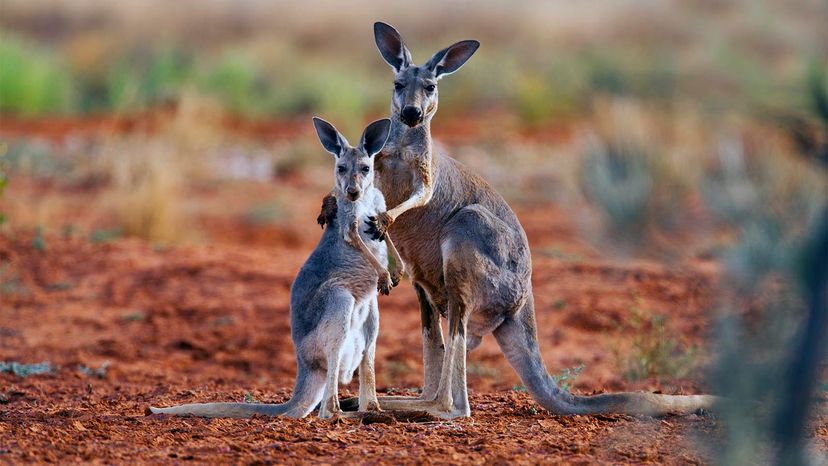
The red kangaroo (Osphranter rufus[5]) is the largest of all kangaroos, the largest terrestrial mammal native to Australia, and the largest extant marsupial. It is found across mainland Australia, except for the more fertile areas, such as southern Western Australia, the eastern and southeastern coasts, and the rainforests along the northern coast.

 Red Kangaroo | National Geographic

Taxonomy

 RedKangaroo1.jpgA female at the Nashville Zoo in Nashville, Tennessee

The initial description of the species by A.G. Desmarest was published in 1822. The type location was given as an unknown location west of the Blue Mountains. The author assigned the new species to the genus Kangurus. In 1842, Gould reassigned the species to the genus Osphranter,[6] a taxon later submerged as a subgenus of Macropus.[7] A taxonomic restructure in 2015 in Taxonomy of Australian Mammals by Jackson and Groves [8] promoted Osphranter back to genus level, redefining the red kangaroo, among others, as species within the genus Osphranter.[5] This was further supported by genetic analysis in 2019.[9]

 Red Kangaroo (Macropus rufus) · iNaturalist

Description


A female red kangaroo at Botanic Garden Zoo in Wagga Wagga, Australia

This species is a very large kangaroo with long, pointed ears and a square shaped muzzle [snout/nose]. They are sexually dimorphic as the males have short, red-brown fur, fading to pale buff below and on the limbs. Females are smaller than males and are blue-grey with a brown tinge, pale grey below, although arid zone females are coloured more like males. It has two forelimbs with small claws, two muscular hind-limbs, which are used for jumping, and a strong tail which is often used to create a tripod when standing upright. The red kangaroo's legs work much like a rubber band, with the Achilles tendon stretching as the animal comes down, then releasing its energy to propel the animal up and forward, enabling the characteristic bouncing locomotion. The males can cover 8–9 m (26.2–29.5 ft) in one leap while reaching heights of 1.8–3 m (5.9–9.8 ft), though the average is 1.2–1.9 m (3.9–6.2 ft).[10][11]

Males grow up to a head-and-body length of 1.3–1.6 m (4.3–5.2 ft) with a tail that adds a further 1.2 m (3.9 ft) to the total length and are referred to by Australians as "Big Reds".[12] Females are considerably smaller, with a head-and-body length of 85–105 cm (33–41 in) and tail length of 65–85 cm (26–33 in).[11][13] Females can weigh from 18 to 40 kg (40 to 88 lb), while males typically weigh about twice as much at 55 to 90 kg (121 to 198 lb).[13][14] The average red kangaroo stands approximately 1.5 m (4.9 ft) tall to the top of the head in upright posture.[15] Large mature males can stand more than 1.8 m (5.9 ft) tall, with the largest confirmed one having been around 2.1 m (6.9 ft) tall and weighed 91 kg (201 lb).[14]

The red kangaroo maintains its internal temperature at a point of homeostasis about 36 °C (97 °F) using a variety of physical, physiological, and behavioural adaptations. These include having an insulating layer of fur, being less active and staying in the shade when temperatures are high, panting, sweating, and licking its forelimbs.

The red kangaroo's range of vision is approximately 300° (324° with about 25° overlap), due to the position of its eyes.[16]

 Kangaroos Facts & Information - Bush Heritage Australia

Ecology and habitat

A red kangaroo in an arid environment
A red kangaroo at Desert Park, Alice Springs

The red kangaroo ranges throughout western and central Australia. Its range encompasses scrubland, grassland, and desert habitats. It typically inhabits open habitats with some trees for shade.[17] Red kangaroos are capable of conserving enough water and selecting enough fresh vegetation to survive in an arid environment. The kangaroo's kidneys efficiently concentrate urine, particularly during summer.[18] Red kangaroo primarily eat green vegetation, particularly fresh grasses and forbs, and can get enough even when most plants look brown and dry.[19] One study of kangaroos in Central Australia found that green grass makes up 75–95% of the diet, with Eragrostis setifolia dominating at 54%. This grass continues to be green into the dry season.[20] Kangaroos also primarily consumed this species, along with Enneapogon avanaceus, in western New South Wales where they comprised much as 21–69% of its diet according to a study.[21] During dry times, kangaroos search for green plants by staying on open grassland and near watercourses.[19] While grasses and forbs are preferred, red kangaroos will also eat certain species of chenopods, like Bassia diacantha and Maireana pyramidata, and will even browse shrubs when its favoured foods are scarce.[19] However, some perennial chenopods, such as round-leaf chenopod Kochia are avoided even when abundant.[22]

A big male red kangaroo named Quincy hopping in Dresden Zoo, Germany

At times, red kangaroos congregate in large numbers; in areas with much forage, these groups can number as much as 1,500 individuals. Red kangaroos are mostly crepuscular and nocturnal, resting in the shade during the day.[23] However, they sometimes move about during the day. Red kangaroos rely on small saltbushes or mulga bushes for shelter in extreme heat rather than rocky outcrops or caves.[19] Grazing takes up most of their daily activities. Like most kangaroo species, they are mostly sedentary, staying within a relatively well-defined home range. However, great environmental changes can cause them to travel great distances.[19] Kangaroos in New South Wales have weekly home ranges of 258–560 ha, with the larger areas belonging to adult males.[24] When forage is poor and rainfall patchy, kangaroos will travel 25–30 km to more favourable feeding grounds.[21] Another study of kangaroos in central Australia found that most of them stay close to remaining vegetation but disperse to find fresh plants after it rains.[25] The red kangaroo is too big to be subject to significant non-human predation. They can use their robust legs and clawed feet to defend themselves from attackers with kicks and blows. However, dingoes and eagles can kill and eat joeys. Joeys are thus protected in their mother's pouch. The red kangaroo does have some major predators, like crocodiles. Extinct predators include the marsupial lion, the thylacine, Megalania, and the wonambi. Kangaroos are adept swimmers, and often flee into waterways if threatened by a predator. If pursued into the water, a kangaroo may use its forepaws to hold the predator underwater so as to drown it.[26]

Behaviour

A mob of red kangaroos at the Wagga Wagga Botanic Gardens

Red kangaroos live in groups of 2–4 members. The most common groups are females and their young.[19] Larger groups can be found in densely populated areas and females are usually with a male.[27] Membership of these groups is very flexible, and males (boomers) are not territorial, fighting only over females (flyers) that come into heat. Males develop proportionately much larger shoulders and arms than females.[28] Most agonistic interactions occur between young males, which engage in ritualised fighting known as boxing. They usually stand up on their hind limbs and attempt to push their opponent off balance by jabbing him or locking forearms. If the fight escalates, they will begin to kick each other. Using their tail to support their weight, they deliver kicks with their powerful hind legs. Compared to other kangaroo species, fights between red kangaroo males tend to involve more wrestling.[29] Fights establish dominance relationships among males, and determine who gets access to estrous females.[19] Alpha males make agonistic behaviours and more sexual behaviours until they are overthrown. Displaced males live alone and avoid close contact with others.[19]

Two fighting male red kangaroos

Reproduction

The red kangaroo breeds all year round. The females have the unusual ability to delay the birth of their baby until their previous joey has left the pouch. This is known as embryonic diapause. Copulation may last 25 minutes.[29] The red kangaroo has the typical reproductive system of a kangaroo. The neonate emerges after only 33 days. Usually only one young is born at a time. It is blind, hairless, and only a few centimetres long. Its hind legs are mere stumps; it instead uses its more developed forelegs to climb its way through the thick fur on its mother's abdomen into the pouch, which takes about three to five minutes. Once in the pouch, it fastens onto one of the two teats and starts to feed. Almost immediately, the mother's sexual cycle starts again. Another egg descends into the uterus and she becomes sexually receptive. Then, if she mates and a second egg is fertilised, its development is temporarily halted. Meanwhile, the neonate in the pouch grows rapidly. After approximately 190 days, the baby (called a joey) is sufficiently large and developed to make its full emergence out of the pouch, after sticking its head out for a few weeks until it eventually feels safe enough to fully emerge. From then on, it spends increasing time in the outside world and eventually, after around 235 days, it leaves the pouch for the last time.[30] While the young joey will permanently leave the pouch at around 235 days old, it will continue to suckle until it reaches about 12 months of age. A doe may first reproduce as early as 18 months of age and as late as five years during drought, but normally she is two and a half years old before she begins to breed.[31]

A joey in a pouch at the Dresden Zoo in Dresden, Germany

The female red kangaroo is usually permanently pregnant except on the day she gives birth; however, she has the ability to freeze the development of an embryo until the previous joey is able to leave the pouch. This is known as embryonic diapause, and will occur in times of drought and in areas with poor food sources. The composition of the milk produced by the mother varies according to the needs of the joey. In addition, red kangaroo mothers may "have up to three generations of offspring simultaneously; a young-at-foot suckling from an elongated teat, a young in the pouch attached to a second teat and a blastula in arrested development in the uterus".[29]

The red kangaroo has also been observed to engage in alloparental care, a behaviour in which a female may adopt another female's joey. This is a common parenting behaviour seen in many other animal species like wolves, elephants and fathead minnows.[32]

 Kangaroo with baby joey in its pouch. Australia (Photos Framed, Prints,...)  #10439878

Relationship with humans

A red kangaroo crossing a highway

The red kangaroo is an abundant species and has even benefited from the spread of agriculture and creation of man-made waterholes. However, competition with livestock and rabbits poses a threat. It is also sometimes shot by farmers as a pest, although a "destruction permit" is required from the relevant state government.[citation needed]

Kangaroos dazzled by headlights or startled by engine noise often leap in front of vehicles, severely damaging or destroying smaller or unprotected vehicles. The risk of harm to vehicle occupants is greatly increased if the windscreen is the point of impact. As a result, "kangaroo crossing" signs are commonplace in Australia.

Peak times for kangaroo/vehicle crashes are between 5:00 PM and 10:00 PM, in winter, and after extended dry-weather spells.[33]

 Eastern Grey Kangaroo With Joey Peering by Sebastian Kennerknecht

Commercial use

 Oceania - Discover Wildlife

Like all Australian wildlife, the red kangaroo is protected by legislation, but it is so numerous that there is regulated harvest of its hide and meat. Hunting permits and commercial harvesting are controlled under nationally approved management plans, which aim to maintain red kangaroo populations and manage them as a renewable resource. Harvesting of kangaroos is controversial, particularly due to the animal's popularity.[31]

 Red Kangaroo (Macropus rufus) · iNaturalist

In the year 2000, 1,173,242 animals were killed.[34] In 2009 the government put a limit of 1,611,216 for the number of red kangaroos available for commercial use. The kangaroo industry is worth about A$270 million each year, and employs over 4000 people.[35] The kangaroos provide meat for both humans and pet food. Kangaroo meat is very lean with only about 2% fat. Their skins are used for leather. 

 Red Kangaroo - Melbourne Museum

 RIDDLES YKDS 4 UNIT 4 | Baamboozle


 Binomial name


 Osphranter rufus

(Desmarest, 1822)[4]


 Red kangaroo.jpg


 Viral TikTok shows missing kangaroo in RGV

THE EASTERN GREY KANGAROO

 Eat kangaroo to keep numbers down, Australians told | World | The Times


 The eastern grey kangaroo (Macropus giganteus) is a marsupial found in the eastern third of Australia, with a population of several million. It is also known as the great grey kangaroo and the forester kangaroo. Although a big eastern grey male typically weighs around 66 kg (146 lb) and stands almost 2 m (6 ft 7 in) tall, the scientific name, Macropus giganteus (gigantic large-foot), is misleading: the red kangaroo of the semi-arid inland is larger, weighing up to 90 kg (200 lb).

Taxonomy

 Eastern Grey Kangaroo: Family Portrait | Eastern Grey Kangar… | Flickr


The eastern grey kangaroo was described by George Shaw in 1790 as Macropus giganteus.

 Kangaroos hanging about Down Under | Insight Guides Blog

Subspecies

 What's the Difference Between a Wallaby and a Kangaroo? | HowStuffWorks


There are two subspecies:[1]

  • Macropus giganteus giganteus – found in eastern and central Queensland, Victoria, New South Wales and southeastern South Australia
  • Macropus giganteus tasmaniensis – (commonly known as the Forester Kangaroo) endemic to Tasmania

 Kangaroo dies after Chinese zoo visitors hurl rocks at it in attempt to  make it hop - National | Globalnews.ca


Description


The underside of the hind foot with a sharp claw photographed at Merimbula in New South Wales

The eastern grey kangaroo is the second largest and heaviest living marsupial and native land mammal in Australia. An adult male will commonly weigh around 50 to 66 kg (110 to 146 lb) whereas females commonly weigh around 17 to 40 kg (37 to 88 lb). They have a powerful tail that is over 1 m long in adult males.[4] Large males of this species are more heavily built and muscled than the lankier red kangaroo and can occasionally exceed normal dimensions. One of these, shot in eastern Tasmania weighed 82 kg (181 lb), with a 2.64 m (8.7 ft) total length from nose to tail (possibly along the curves). The largest known specimen, examined by Lydekker, had a weight of 91 kg (201 lb) and measured 2.92 m (9.6 ft) along the curves. When the skin of this specimen was measured it had a "flat" length of 2.49 m (8.2 ft).[5]

0:10
Video of kangaroos in the wild.

The eastern grey is easy to recognise: its soft grey coat is distinctive, and it is usually found in moister, more fertile areas than the red. Red kangaroos, though sometimes grey-blue in colour, have a totally different face than eastern grey kangaroos. Red kangaroos have distinctive markings in black and white beside their muzzles and along the sides of their face. Eastern grey kangaroos do not have these markings, and their eyes seem large and wide open.

Where their ranges overlap, it is much more difficult to distinguish between eastern grey and western grey kangaroos, which are closely related. They have a very similar body and facial structure, and their muzzles are fully covered with fine hair (though that is not obvious at a distance, their noses do look noticeably different from the noses of reds and wallaroos). The eastern grey's colouration is a light-coloured grey or brownish-grey, with a lighter silver or cream, sometimes nearly white, belly. The western grey is a dark dusty brown colour, with more contrast especially around the head.[6] Indigenous Australian names include iyirrbir (Uw Oykangand and Uw Olkola) and kucha (Pakanh).[citation needed] The highest ever recorded speed of any kangaroo was 64 kilometres per hour (40 mph) set by a large female eastern grey kangaroo.[7]

 Opposition to NSW kangaroo cull grows | The West Australian

Ecology

Eastern grey kangaroos in their native habitat

Although the red is better known, the eastern grey is the kangaroo most often encountered in Australia, due to its adaptability. Few Australians visit the arid interior of the continent, while many live in and around the major cities of the southern and eastern coast, from where it is usually only a short drive to the remaining pockets of near-city bushland where kangaroos can be found without much difficulty.[citation needed] The eastern grey prefers open grassland with areas of bush for daytime shelter and mainly inhabits the wetter parts of Australia.[8] It also inhabits coastal areas, woodlands, sub-tropical forests, mountain forests, and inland scrubs.[8]

Like all kangaroos, it is mainly nocturnal and crepuscular,[6] and is mostly seen early in the morning, or as the light starts to fade in the evening.[9] In the middle of the day, kangaroos rest in the cover of the woodlands and eat there but then come out in the open to feed on the grasslands in large numbers.[6] The eastern grey kangaroo is predominantly a grazer, eating a wide variety of grasses, whereas some other species (e.g. the red kangaroo) include significant amounts of shrubs in their diet.

 File:Grey Kangaroo at Australia Zoo-1 (9097959682).jpg - Wikimedia Commons

Behaviour

Female (left) and male (right) eastern grey kangaroos at the Wagga Wagga Botanic Gardens in the Wagga Wagga, New South Wales
Video of kangaroos mating in Australia.

Eastern grey kangaroos are gregarious and form open-membership groups.[10] The groups contain an average of three individuals.[9] Smaller groups join together to graze in preferred foraging areas, and to rest in large groups around the middle of the day.[9] They exist in a dominance hierarchy and the dominant individuals gain access to better sources of food and areas of shade.[6] However, kangaroos are not territorial. Eastern grey kangaroos adjust their behaviour in relation to the risk of predation with reproductive females, individuals on the periphery of the group and individuals in groups far from cover being the most vigilant.[10] Vigilance in individual kangaroos does not seem to significantly decrease when the size of the group increases. However, there is a tendency for the proportion of individuals on the periphery of the group to decline as group size increases.[10] The open membership of the group allows more kangaroos to join and thus provide more buffers against predators.[10]

 Bans on kangaroo products are a case of emotion trumping science

Reproduction

A joey in a pouch photographed at the Jerusalem Biblical Zoo in Malha, Jerusalem

Females may form strong kinship bonds with their relatives. Females with living female relatives have a greater chance of reproducing.[11] Most kangaroo births occur during the summer.[12] Eastern grey kangaroos are obligate breeders in that they can only reproduce in one kind of habitat.[13]

The female eastern grey kangaroo is usually permanently pregnant except on the day she gives birth; however, she has the ability to freeze the development of an embryo until the previous joey is able to leave the pouch. This is known as embryonic diapause, and will occur in times of drought and in areas with poor food sources. The composition of the milk produced by the mother varies according to the needs of the joey. In addition, the mother is able to produce two different kinds of milk simultaneously for the newborn and the older joey still in the pouch. Unusually, during a dry period, males will not produce sperm, and females will only conceive if there has been enough rain to produce a large quantity of green vegetation.[14] Females take care of the young without any assistance from the males. The joeys are heavily reliant on their mothers for about 550 days, which is when they are weaned. Females sexually mature between 17 and 28 months, while males mature at around 25 months.[8]

 Kangaroos to be turned into pet food in Australian 'harvesting' program |  CNN

Status

A carcass of an eastern grey kangaroo caused by roadkill in Victoria, Australia

It is popularly thought, but not confirmed by evidence,[15][16] that kangaroo populations have increased significantly since the European colonisation of Australia because of the increased areas of grassland (as distinct from forest), the reduction in dingo numbers, and the availability of artificial watering holes. The estimated population of the species Australia-wide in 2010 was 11.4 million.[17] In some places the eastern grey is so numerous it causes overgrazing and some individual populations have been culled in some parts of Australia (see, for example, the Eden Park Kangaroo Cull).[18][19][20] Despite the commercial harvest and some culls, the eastern grey remains common and widespread. Eastern greys are common in suburban and rural areas where they have been observed to form larger groups than in natural areas.[21] It still covers the entire range it occupied when Europeans arrived in Australia in 1788[22] and it often comes into conflict with agriculture as it uses the more fertile districts that now carry crops or exotic pasture grasses, which kangaroos readily eat.[23] Kangaroo meat has also been considered to replace beef in recent years, as their soft feet are preferable to hooves in erosion prone areas.[24]

 Australia to kill 1900 Kangaroos just to control the animal's population -  DAILY SHOUT TIMES


 Eastern Grey Kangaroo - Australia Walkabout Park

 Binomial name


 Macropus giganteus

Shaw, 1790


 Eastern Grey Kangaroo Range.jpg

 Eastern grey kangaroo range

Sunday, May 1, 2022

THE BURCHELL"S ZEBRA

 Almindelig zebra - Wikipedia, den frie encyklopædi

Burchell's zebra (Equus quagga burchellii) is a southern subspecies of the plains zebra. It is named after the British explorer and naturalist William John Burchell. Common names include the bontequagga, Damaraland zebra, and Zululand zebra (Gray, 1824).[1] Burchell's zebra is the only subspecies of zebra which may be legally farmed for human consumption.[2]

Physical characteristics

Male Burchell's zebra at Etosha National Park, Namibia.

Like most plains zebras, females and males are relatively the same size, standing 1.1 to 1.4 metres (3 ft 7 in to 4 ft 7 in) at the shoulder. They weigh between 230 and 320 kilograms (500 and 700 lb).[3] Year-round reproduction observed in this subspecies in Etosha National Park, Namibia, concludes synchronization of a time budget between males and females, possibly explaining the lack of sexual dimorphism.[4]

Damara zebras are described as being striped on the head, the neck, and the flanks, and sparsely down the upper segments of the limbs then fading to white.[5] One or two shadow stripes rest between the bold, broad stripes on the haunch.[5] This main, distinguishing characteristic sets the Zululand Zebra apart from the other subspecies. Gray (1824), observed a distinct dorsal line, the tail only bristly at the end, and the body distinctly white.[1] The dorsal line is narrow and becomes gradually broader in the hinder part, distinctly margined with white on each side.[1]

Burchell's zebra pair
A pair of Burchell's zebra at Lake Nakuru National Park, Kenya.

Behavior

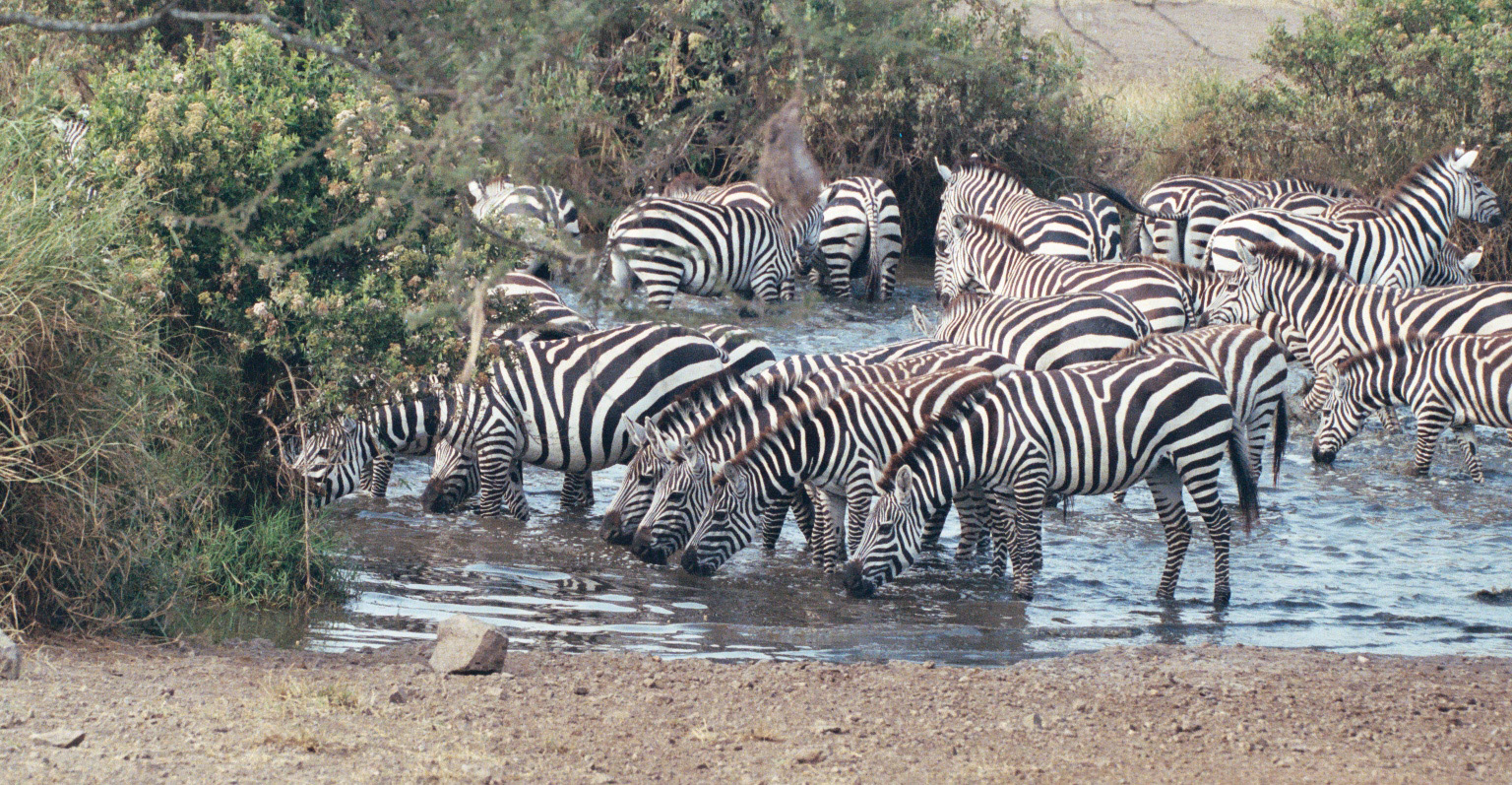
Burchell's zebra drinking at a waterhole at Etosha National Park

Like most plains zebras, Burchells live in small family groups. These can be either harem or bachelor groups, with harem groups consisting of one stallion and one to six mares and their most recent foals, and bachelor groups containing two to eight unattached stallions.[6] The males in bachelor herds are often the younger or older stallions of the population, as they are most likely not experienced enough or strong enough to defend breeding rights to a group of females from challengers. These small groups often congregate in larger herds around water and food sources, but still maintain their identity as family units while in the population gatherings.[7]

 Grant's zebra - Réserve Africaine de Sigean

Range and adaptation

 Zebra Cub Striped - Free photo on Pixabay

Formerly, the Burchell's zebra range was centered north of the Vaal/Orange river system, extending northwest via southern Botswana to Etosha and the Kaokoveld, and southeast to Eswatini and KwaZulu-Natal. Now extinct in the middle portion, it survives at the northwestern and southeastern ends of the distribution.[5]

Burchell's zebra migrates the longest distance of any terrestrial animal in Africa, making a round trip of 500 kilometres (300 mi).[8] They migrate from the Chobe River in Namibia to Nxai Pan National Park in Botswana.[8] Their migration follows a straight north–south route almost entirely within the Kavango–Zambezi Transfrontier Conservation Area[8] (KAZA).

 Zebra in Serengeti National Park Photograph by Marek Poplawski

Controversial introductions outside its historical range

 File:Zebras Serengeti.JPG - Wikimedia Commons

From 2001 until 2016 the Kissama Foundation reintroduced wildlife in the Quiçama National Park of Angola. The project was dubbed Operation Noah's Ark. Amongst the animals such as blue wildebeest, waterbuck, Cape giraffe, bush elephants, gemsbok, eland, nyala and ostrich were also Burchell's zebras.[9][10] And from 2017 until 2019 "Wildlife Vets Namibia" exported wildlife to the Democratic Republic of the Congo's capital city Kinshasa to introduce animals in Parc de la Vallée de la Nsele .[11] Wildlife Vets Namibia in partnership with Institut Congolais pour la Conservation de la Nature also established a Burchell's zebra population on Île de Mateba which is originally a rainforest Island. Both introductions in west Angola and west DRC are controversial since the park service bodies from both countries did not opt to buy the native Grant's zebra from for example countries as Zambia, Tanzania or Kenya.

 Zebra in Serengeti Tanzania Stock Photo by kjekol | PhotoDune

Extinct subpopulation

Specimens from the extinct population, 1886.

Like other plains zebras, Burchell's zebras must have populated the African plains in impressive numbers. Associations of thousands have been reported. The wild herds were thought to have disappeared by 1910, and the last known captive individual died in the Berlin Zoo in 1918. As European settlement spread northward from the Cape to colonial southern Rhodesia, this subspecies was thought to have been hunted to extinction.

However, Groves and Bell concluded in their 2004 publication that "the extinct true Burchell's zebra" is a phantom.[12] Careful study of the original zebra populations in Zululand and Swaziland, and of skins harvested on game farms in Zululand and Natal, has revealed that a certain small proportion shows similarity to what now is regarded as typical burchellii. The type localities of the two subspecies Equus quagga burchellii (Burchell's zebra) and Equus quagga antiquorum (Damaraland zebra) are so close to each other that they suggest that the two are in fact one, and therefore the older of the two names should take precedence over the younger. They therefore say that the correct name for the southernmost subspecies must be burchellii, not antiquorum.[12] The subspecies Equus quagga burchellii still exists in KwaZulu-Natal and in Etosha. Equus quagga burchellii can be found in a number of zoos in the United States including the following: the Cincinnati Zoo, Columbus Zoo, Naples Zoo, Nashville Zoo, Woodland Park Zoo, etc. 


 Serengeti Safari: Wildlife Photos from Serengeti National Park, Tanzania


 Types of Zebras Map : r/MapPorn


 Equids - ScienceDirect


 The Evolution of the Modern Horse (Equus) : r/coolguides


 The Genealogical World of Phylogenetic Networks: Producing trees from  datasets with gene flow


 Distribution of introduced equids and species richness of predators |  Download Scientific Diagram


 Horses Natural Habitat: Where Does a Horse Live?