Their small shape allows them to hide from predators through tiny
openings in the rocky terrain and also allow them to run exceptionally
fast from their predators. Although bearing fangs, Siberian musk deer are actually herbivores, with their main source of nutrients being lichens.[3]
Due to the severe amount of poaching
for its musk gland, the deer population is continuing to decrease. It
is expected that the population will be reduced to at least 30% over the
next three generations. However, efforts from each of the cited
countries are beginning to restore the musk deer's population.[1]
The
earliest findings of the musk deer belong to the Upper and Middle
Pleistocene and they all come from places in China and from the south of
the Soviet Far East.
The musk deer evolving in the mountain forests of eastern Asia
spread widely since the Pleistocene in the mountain regions of Central,
South-East Asia and in the north it spread to the south of the Soviet
Far East. The musk deer also inhabited Sakhalin Island before its
separation from the continent during the Quaternary period.[4]
Maturity and mating
It takes approximately a year for the Siberian musk deer to reach maturity, with an average deer living 10–14 years.
During breeding season, male deer will grow tusks instead of antlers.[3]
These tusks are used to compete with other males and attract females.
Tusks that are longer and stronger create a more intimidating stance and
become more attractive to females as the offspring of that male are
likely to become healthier.
Once the male and the female deer have procreated, the females
will become pregnant for over 6 months. Females can give birth to 1–3
offspring, usually between the months of May through June.[5]
Behaviors
Musk will mark their territory,[clarification needed]
warning trespassing deers not to cross the boundary. When marking their
territories, musk deer gather fallen branches, tree trunks, as well as
plant stems, and place them in a circle. While placing the various
branches around the circle, the deer will often do an olfactory
examination and turn the back of its body towards the marked
territories. Another way the Siberian musk deer will mark its territory
is by defecating in already marked territories or unclaimed territories.[6]
Habitat and diet
Most
Siberian musk deer are generally nocturnal, inhabiting the mountainous
taiga and found in shrub-covered slopes where foods are abundant. The
rocky location provides crevices and crags for the musk deer to hide
from many predators, such as lynx and wolverines.
Lichen is the primary food source for the Siberian musk deer.
Musk deer have a preference for easily digestible nutritious foods
that are both rich in protein and low in fibre. During periods of
winter, musk deer can survive in even poorer food quality ranging in
foods that are low in proteins but are high in energy and can be easily
digested.[7]
The majority of their diet consists mostly of lichens, pine
needles, leaves, and tree barks. During the winter, 99% of the musk
deer's diet is lichens. Siberian musk deer have a preference for easily
digestible nutritious foods.
Characteristics
The species is largely nocturnal and migrates only over short
distances. It prefers altitudes of more than 2,600 m (8,500 ft). Adults
are small, weighing 7–17 kg (15–37 lb).
The Siberian musk deer is classified as Vulnerable by the IUCN. It is hunted for its musk
gland, which fetches prices as high as $45,000 per kilogram. Only a few
tens of grams can be extracted from an adult male. It is possible to
remove the gland without killing the deer, but this is seldom done. In
2016, the Korean company Sooam Biotech was reported to be attempting to
clone the Siberian musk deer to help conserve the species.[8]
The most striking characteristics of the Siberian musk deer are
its tusks and kangaroo-like face. Males grow the teeth for display
instead of antlers.[9][10]
A distinct subspecies roams the island of Sakhalin.
The
decline of the Siberian musk deer's population began in China where the
deer population was most abundant. Most notably in the Sichuan plains, the musk production accounted for 80% of the domestic trade in the 1950s.[5]
New sightings of musk deer were later spotted in upper northeast Asia
and Russia; these places where the deer were spotted soon opened their
own musk markets. After the 1980s, the production begins to steadily
decline due to hunting for their musk glands. The cycle of
over-harvesting the deer's musk continued until the exploitation
severely reduced the musk deer's population.
Another threat comes from the habitat loss by deforestation. For a
long period, China cut more of its forest than they could replant. 200
million cm3[5] of China's forest resources were cut down in the past 25 years in order to harvest the timber stock in trade for commerce. Deforestation is a severe threat to the musk deer's long-term survival because the deer can only live in a few areas.
Conservation action
The
Siberian musk deer is considered vulnerable, but is slowly declining to
endangerment. In Russia, the Siberian musk deer is protected as Very
Rare under part 7.1 of the Law of the Mongolian Animal Kingdom (2000) and also under the 1995 Mongolian Hunting Law.[1]
The musk deer are also protected under the National Parks, which
account for approximately 13% of the Siberian musk deer population.
At the international level, trading musk is controlled through CITES. All trades regarding musk are subject to strict regulation to avoid exploitation of the survival of the deer.[13]
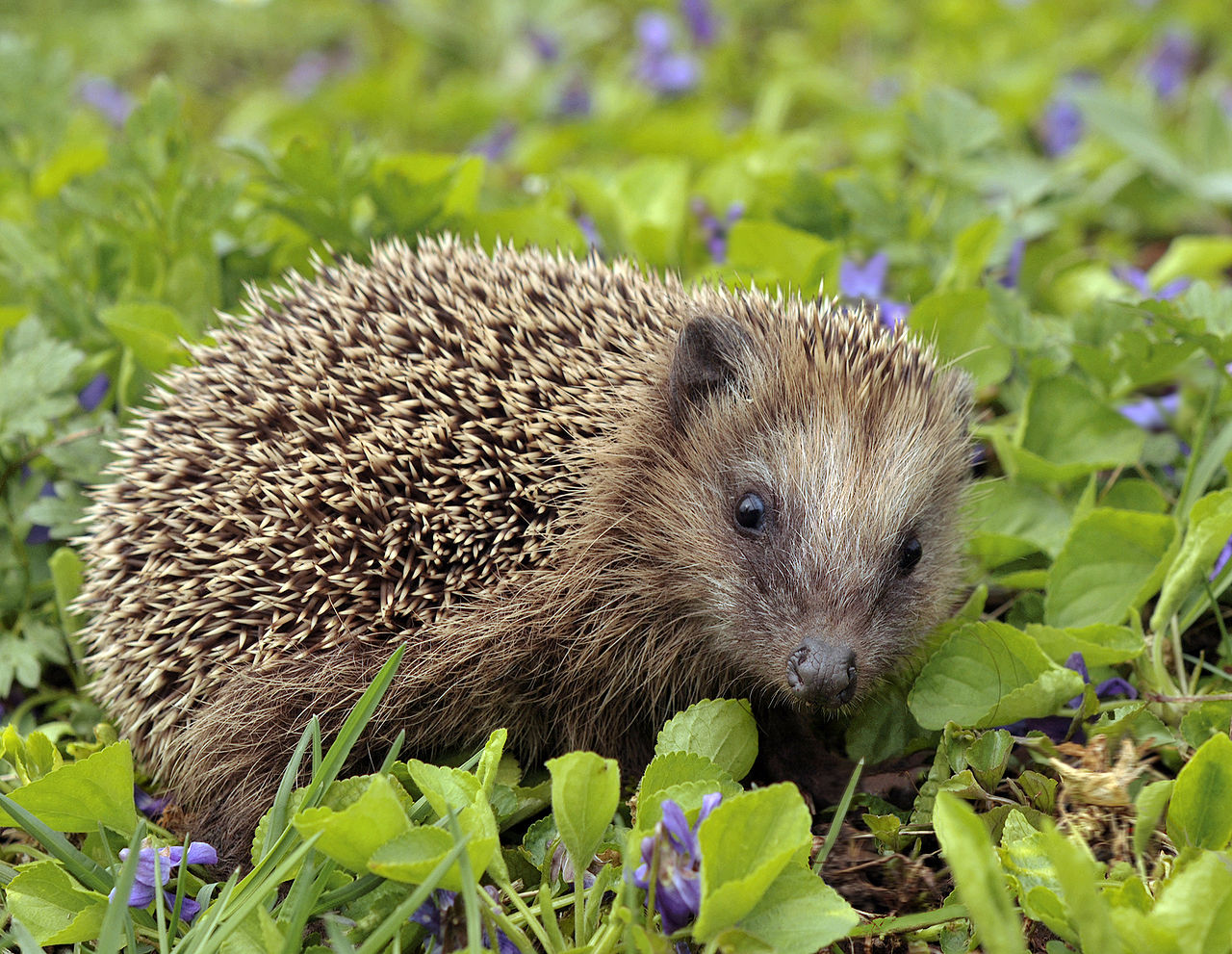
The European hedgehog (Erinaceus europaeus), also known as the West European hedgehog or common hedgehog, is a hedgehogspecies native to Europe from Iberia and Italy northwards into Scandinavia and westwards into the British Isles.[3] It is a generally common and widely distributed species that can survive across a wide range of habitat
types. It is a well-known species, and a favourite in European gardens,
both for its endearing appearance and its preference for eating a range
of garden pests. While populations are currently stable across much of
its range, it is declining severely in Great Britain[2] where it is now Red Listed[4] (classified as near to extinction).
Description
The European hedgehog has a generalised body structure with unspecialised limb girdles.[5] It appears brownish with most of its body covered by up to 6,000 brown and white spines.[6]
The length of head and body is ~160 mm (6.3 in) at weaning, increasing
to 260 mm (10 in) or more in large adults. It has an extremely short
tail as an almost vestigial feature, typically 20 to 30 mm (0.79 to
1.18 in).[7]
Weight increases from around 120 g (4.2 oz) at weaning to > 1,100 g
(2.4 lb) in adulthood. The maximum recorded weight is 2000 g (4.4 lb),
though few wild specimens exceed 1,600 g (3.5 lb) even in autumn.[5]
Adult summer weight is typically somewhat less than in autumn, with an
average of around 800 g (28 oz) and adult weights commonly as low as
500 g (18 oz).[8]
Males tend to be slightly larger than females, but sex differences in
body weight are overshadowed by enormous seasonal variation.[7]
The European hedgehog is unlike any other creature across most of its range. Where it co-exists with the northern white-breasted hedgehog (Erinaceus roumanicus), the two species are difficult to distinguish in the field, the latter having a white spot on its chest.[2] It is probably the largest hedgehog species and is possibly the heaviest member of the order Erinaceomorpha.[9]
Colour variation
Blonde hedgehog
Leucistic or 'blonde' hedgehogs occasionally occur. Such specimens are believed to have a pair of rare recessivegenes, giving rise to their black eyes and creamy-colored spines; however, they are not strictly speaking albino. They are extremely rare, except on North Ronaldsay and the Channel Island of Alderney where around 25% of the population is thought to be blonde.[10] True albino morphs of the hedgehog occur infrequently.[6]
The European hedgehog is largely nocturnal.
It has a hesitant gait, frequently stopping to smell the air. Unlike
the smaller, warmer-climate species, the European hedgehog may hibernate
in the winter. However, most wake at least once to move their nests.[11]
Diet
A European hedgehog eating fish carcass, photographed in Altai Krai
The European hedgehog is an insectivore. Its diet consists largely of earthworms as well as snails and slugs, beetles, and caterpillars
and other insect larvae. Eggs of ground-nesting birds are also taken,
and carcasses may be foraged on. Plant matter appears to make up only a
negligible part of the hedgehog's diet.[12][13][14]
Breeding
A one-day-old newborn European hedgehog
A female with one young
The breeding season commences after hibernation. Pregnancies peak
between May and July, though they have been recorded as late as
September. Gestation is 31 to 35 days. The female alone raises the
litter which typically numbers between four and six, though can range
from two to ten. Studies have indicated that litter size may increase in
more northern climes. The young are born blind with a covering of small
spines. By the time they are 36 hours old, the second, outer coat of
spines begins to sprout. By 11 days they can roll into a ball. Weaning
occurs at around six weeks of age.[15]
Longevity and mortality
European
hedgehogs may live to ten years of age, although the average life
expectancy is three years. Starvation is the most common cause of death,
usually occurring during hibernation. If alarmed, the animal will roll
into a ball to protect itself. Many potential predators are repelled by its spines, but predation does occur. Remains of hedgehogs have been found in the stomachs of red foxes (Vulpes vulpes), European badgers (Meles meles) and pine martens (Martes martes). A large portion of these may be from hedgehog carcasses, especially roadkill. However, hedgehogs tend to be absent from areas where badgers are numerous.
Eurasian eagle-owls (Bubo bubo) and golden eagles (Aquila chrysaetos)
are the only regular avian predators of this species and may even
prefer them as prey. The owl, after grabbing the hedgehog by its face,
tends to skin the mammal's prickly back with its talons before
consumption, resulting in several hedgehog backs being found around
eagle-owl roosts and nests.[16] In Spain, reduction of European rabbit (Oryctolagus cuniculus) numbers due to rabbit haemorrhagic disease has made the European hedgehog one of the top preferred prey species for eagle-owls.[17]
Elsewhere, eagle-owls often prefer these hedgehogs to any other prey
species, as the hedgehog can comprise up to 23% by number and 30.7% by
biomass of eagle-owl prey remains.[18][19][20] On the Swedish island of Gotland
the golden eagle may take larger numbers of hedgehogs than any other
prey due to an otherwise low diversity of native land mammals, although
the introduction of European rabbits has shifted the eagle's prey
preferences there.[21]
Distribution and habitat
The
European hedgehog is endemic to Europe (including European Russia),
with a global distribution extending from the British Isles and the Iberian Peninsula eastwards through much of western to central Europe, and from southern Fennoscandia and the northern Baltic to north-west Russia. Present also on Mediterranean islands (Corsica, Sardinia, Elba, Sicily), on most of the French Atlantic islands as well as on British Islands (autochthonous and introduced).[22] It is an invasive exotic species in New Zealand and has probably been introduced to Ireland and many of the smaller islands where it occurs.[23]
Colonists took hedgehogs from England and Scotland to New Zealand
on sailing ships from the 1860s to the 1890s mainly as a biological
control against agricultural pests or as a pet.[24] Few survived the ca 50–100 days voyage,[24]
but those that did had lost all their fleas. Animals found their first
homes in the South Island, where their spread was helped by guards
dropping them off at country railway stations. Hedgehogs were introduced
to the North Island in the 1890s, but some were also transported from
South Island between 1906 and 1911[24]
and, from then on, their numbers increased at an exponential rate. By
the 1920s they had become so numerous that game-bird hunters blamed them
for reduced bag-sizes. Hedgehogs were declared noxious animals and a
bounty of one shilling a snout paid by regional authorities for several
years. By the 1950s, hedgehogs could be found over the whole country
with the exception of the coldest wettest corner of the South Island and
alpine areas of permanent snow. Nevertheless, hedgehogs have been seen
climbing New Zealand glaciers. Hedgehogs do not reach the same weight in
New Zealand as in colder parts of Europe. With its milder winters, New
Zealand hedgehogs hibernate for only three months of the year so do not
need to put on so much weight in autumn as their ancestors. In northern
New Zealand, many hedgehogs do not hibernate at all. One of New
Zealand's pioneer hedgehogs probably had faulty teeth for this feature
is found in about 50% of today's animals. Most New Zealanders welcome
hedgehogs in their gardens as they relish slugs and snails.
Conservationists are less happy as hedgehogs compete for invertebrate
food with native bush birds and prey on some rare insects, lizards and
ground-nesting birds. As a result, extensive hedgehog-control programs
are under way in some parts of the country, killing thousands of them.
To judge by roadkill counts, North Island hedgehogs were at their
highest numbers in the 1950s. Since then, roadkill counts have fallen
dramatically from about 50/100 km to less than 1/100 km.[25]
Hedgehog in autumn in its nest under a bush in Brastad, Sweden
The European hedgehog is found across a wide range of habitat
types, encompassing both semi-natural vegetation types and those areas
that have been heavily modified by man. The range includes woodland, grasslands such as meadows and pasture, arable land, orchards and vineyards
as well as within the matrix of habitat types found in human
settlements. It prefers lowlands and hills up to 400–600m, but is also
locally present on mountains, exceptionally up to an altitude of
1500-2000m (e.g. Alps and Pyrenees).[26] Outside cultivated land it prefers marginal zones of forests, particularly ecotonal grass and scrub vegetation.[26]
Hedgehogs are most abundant within the gardens, parks and amenity land close to or within human settlements.[27] They are generally scarce in areas of coniferous woodland, marshes and moorland,
probably because of a lack of suitable sites and materials for the
construction of winter nests (or hibernacula), which have specific
requirements.[6]
Protection
Generally,
the hedgehog is widely distributed and can be found in good numbers
where people are tolerant of their residence in gardens. To date, the
IUCN classifies the species as Least Concern and currently the
population as Stable. In some areas, they are common victims of road
kills and may be hunted by dogs, such as in Sardinia.[2] On 28 August 2007, the new Biodiversity Action Plan included the European hedgehog on the list of species and habitats in Britain that need conservation and greater protection.[28][29]
In Denmark[30] and Poland,[31]
hedgehogs are protected by law. It is illegal to capture or hurt them,
but the housing of underweight hedgehogs found outside during winter is
accepted.
A low coverage assembly of the genome of Erinaceus europaeus was released by the Broad Institute in June 2006 as part of the Mammalian Genome Project.[32]
Status in Great Britain
An estimate of 36.5 million by Burton[33]
was based on extrapolating up from a density of 2.5 animals/ha (one per
acre), but this was based on limited data and is probably an
overestimate. A more recent estimate of 1,550,000 in Great Britain[34]
(England 1,100,000, Scotland 310,000, Wales 140,000) is more reliable,
but still has a high degree of uncertainty as it is based on very
limited information about hedgehog density estimates for different
habitat types.[3] Given this figure, and more firmly established rates of decline,[35] it is now thought likely that there are fewer than a million hedgehogs in Great Britain.[36]
Population status
In 2007 the hedgehog was classified a Biodiversity Action Plan ‘priority’ species in Britain, largely in response to negative trends identified in national surveys such as Mammals on Roads survey,[37] run by People's Trust for Endangered Species (PTES), that found an annual decline in counts of road casualties of around 7% from 2001 to 2004.[38][39] Historic data from the National Gamebag Census suggest a steady decline between 1960 and 1980.[40]
Evidence from a questionnaire in 2005 and 2006 also supported an
ongoing decline, with almost half of ~20,000 participants in PTES' Hogwatch survey[41] reporting the impression that there were fewer hedgehogs than there were five years earlier.[42]
A review of the available survey data for the population trend of the hedgehog in Britain was undertaken by the British Trust for Ornithology (BTO) in a report commissioned by PTES and the British Hedgehog Preservation Society (BHPS).[35] This concluded that, at a conservative estimate, 25% of the British hedgehog population had been lost in a decade.[43] The report also highlighted the importance of long-term monitoring to provide datasets with sufficient power
to allow the changes to the population to be identified. Currently, the
most important monitoring programmes involved in collecting information
about the status of the British hedgehog population are PTES’ Mammals on Roads and Living with Mammals surveys, and the BTO Breeding Bird Survey and Garden BirdWatch survey.[44]
A recent review of these surveys now suggests that rural populations
have declined by at least a half and urban populations by up to a third
since 2000.[45]
Pest status
This species has become a serious pest in areas where it has been introduced outside of its native range. One such location is the Western Isles of Scotland, where introduced hedgehogs eat the eggs of ground-nesting waders such as common snipe, dunlin, common redshank and northern lapwing. It is also considered a pest in New Zealand where it preys upon various native fauna,[46] including insects, snails, lizards and ground-nesting birds, particularly shore birds.[47] As with many introduced animals, it lacks natural predators.
Attempts to eliminate hedgehogs from bird colonies on the Scottish islands of North Uist and Benbecula in the Outer Hebrides
were met with international outrage. Eradication began in 2003 with 690
hedgehogs being killed. Animal welfare groups attempted rescues to save
the hedgehogs. By 2007, legal injunctions
against the killing of hedgehogs were put in place. In 2008, the
elimination process was changed from killing the hedgehogs to trapping
them and releasing them on the mainland.[48]